



Federal data reveals more than 200,000 migrants listed New Jersey as their destination between 2018 and 2025, with Newark, Paterson, Elizabeth, and Jersey City among the most popular cities.
WEBDESK – IMRAN MALIK – COURTESY: NJ.COM
New Jersey has quietly become one of America’s most significant immigration destinations — and new federal data obtained exclusively by the Associated Press reveals for the first time exactly where those hundreds of thousands of new arrivals went.
More than 200,000 migrants who crossed the US southern border between 2018 and 2025 told federal authorities that their onward destination was New Jersey. Only Florida, Texas, California and New York saw more arrivals. The figure shows the Garden State as the fifth most popular destination in the United States for migrants released into the country during that period.
The Data Behind the Story
The findings come from federal records covering approximately 4.5 million migrants who crossed into the United States from Mexico between October 2018 and July 2025. The Associated Press received the data under a Freedom of Information Act request and shared it with NJ.com for analysis.
Migrants arrived from more than 150 countries, a significant departure from earlier patterns when the majority were from Mexico. Another notable shift — more women and children than men arrived during this period.
Across New Jersey, 523 of the state’s 564 municipalities were listed as destinations by arriving migrants, from just a handful in some towns to thousands in others.
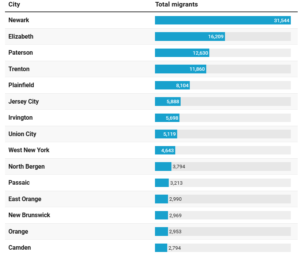
Newark — The Largest Destination
Newark emerged as the most-cited destination in New Jersey. The city already had one of the state’s most diverse populations — 38.5% of Newark residents are foreign-born according to the US Census Bureau, and more than half of all residents speak a language other than English at home.
The largest single group arriving in New Jersey — more than 36,000 men, women, and children from Ecuador — listed the state as their destination. Of those, more than 9,800 said they were heading specifically to Newark. Another 3,500 were listed as Plainfield, and nearly 2,000 were named Elizabeth.
On any given weekend, Newark’s neighborhoods reflect that diversity — Caribbean festivals, Latin festivals, and a stretch of Bloomfield Avenue lined with Ecuadorian restaurants serving encebollado de pescado and other traditional dishes signal how deeply new communities have planted roots.
Paterson — A Century-Old Immigrant City Deepens Its Roots
Paterson has long been one of New Jersey’s most immigrant-shaped cities. Its connection to Peruvian immigrants dates back to the 1920s when workers were drawn by the city’s famed textile industry.
More than 4,200 migrants from Peru listed Paterson as their final destination between 2018 and 2025. Another 1,300 migrants from Venezuela also sought to settle in Paterson during the same period.
Ulla D. Berg, associate professor and chair of Rutgers University’s Department of Latino and Caribbean Studies, pointed to a practical factor that significantly increased the number of Peruvian and Ecuadorian arrivals. For a period, both countries had visa-free access to Mexico, allowing migrants to fly to Mexico City and cross the US border from there rather than making the far more dangerous journey through the Darién Gap.
“You could fly to Mexico and pay someone to cross the border with a local coyote,” Berg said.
Elizabeth, Jersey City and the Urban Corridor
Elizabeth was listed as a destination by nearly 2,000 Ecuadorian migrants and approximately 2,900 Colombian migrants — part of the nearly 24,000 migrants from Colombia who said they were traveling to New Jersey overall.
Jersey City, Irvington, Union City and West New York also appeared prominently in the data as destinations for migrants with existing community ties in those cities. The pattern reflects what researchers call network migration — the tendency of new arrivals to go where family members, friends or established community organizations can provide immediate support.
“As with all immigrant groups, having family or connections makes the transition to a new country easier,” said Lori Nessel, professor at Seton Hall Law School and director of its Immigrants’ Rights clinic. “Cities have historically also offered more employment opportunities for newly arrived immigrants.”
Haiti’s Community in East Orange and Irvington
14,000 migrants from Haiti listed New Jersey as their destination between 2018 and 2025. More than 4,000 said they were specifically heading to East Orange or Irvington — cities where Haitian communities have built strong networks over decades.
Nessel noted the economic contribution of this community specifically.
“Haitian immigrants in particular have contributed immensely as health care and home care workers in New Jersey.”
The Human Story the Numbers Cannot Capture
For many arrivals, the decision to come to a specific New Jersey city was driven by circumstances that statistics cannot fully capture.
Maria González Medina left Ecuador in 2023 with her husband to seek medical treatment for her nine-year-old son Diego, who has cerebral palsy. Doctors across Ecuador told her there was nothing they could do. Diego is now receiving treatment at Shriners Children’s Hospital in Philadelphia and, following several surgeries, is able to walk. But her asylum case has been dismissed, and she now faces possible deportation despite her son’s ongoing medical needs.
The Political Battle
New Jersey has become one of the most contested battlegrounds in the Trump administration’s immigration enforcement campaign.
Just four days after President Trump was sworn in for his second term, heavily armed ICE agents raided a seafood distribution center in Newark. Delaney Hall detention center has since become a focal point for both advocates and opponents of aggressive enforcement.
A federal judge dismissed a Department of Justice lawsuit targeting sanctuary city policies in Newark, Jersey City, Paterson and Hoboken. The administration has filed an appeal.
Republican State Assemblyman Paul Kanitra remains one of the most vocal critics.
“From education to health care to first responders, to legal services to fight their own deportations, it is too good to pass up. Why is it the New Jersey taxpayers’ responsibility to pay for the exit plan for everyone from a foreign country?”
His office estimated undocumented immigration costs New Jersey taxpayers approximately $1,700 per worker and $2,300 per household annually.
A landmark 2016 National Academies of Sciences report countered that the long-term impact of immigration on wages and employment of native-born workers overall is “very small” and that the second generation of immigrants “are among the strongest fiscal and economic contributors in the US.”
In June, Governor Mikie Sherrill announced an additional $12 million for the state’s Detention Deportation Defense Initiative, bringing total funding to $20.2 million.


2 Comments
Just tried ADHD Reading and it really helps create a distraction-free reading experience. Super useful for deep reading sessions.
Dooes youir bllog have a contact page? I’m havkng
problems locating iit but, I’d lie to shooit yyou ann
email. I’ve goot some suggedstions foor yourr blog youu mighnt
bbe inteerested inn hearing. Either way, great blo annd I ook forard too
seeig itt griw oveer time. xnxx