


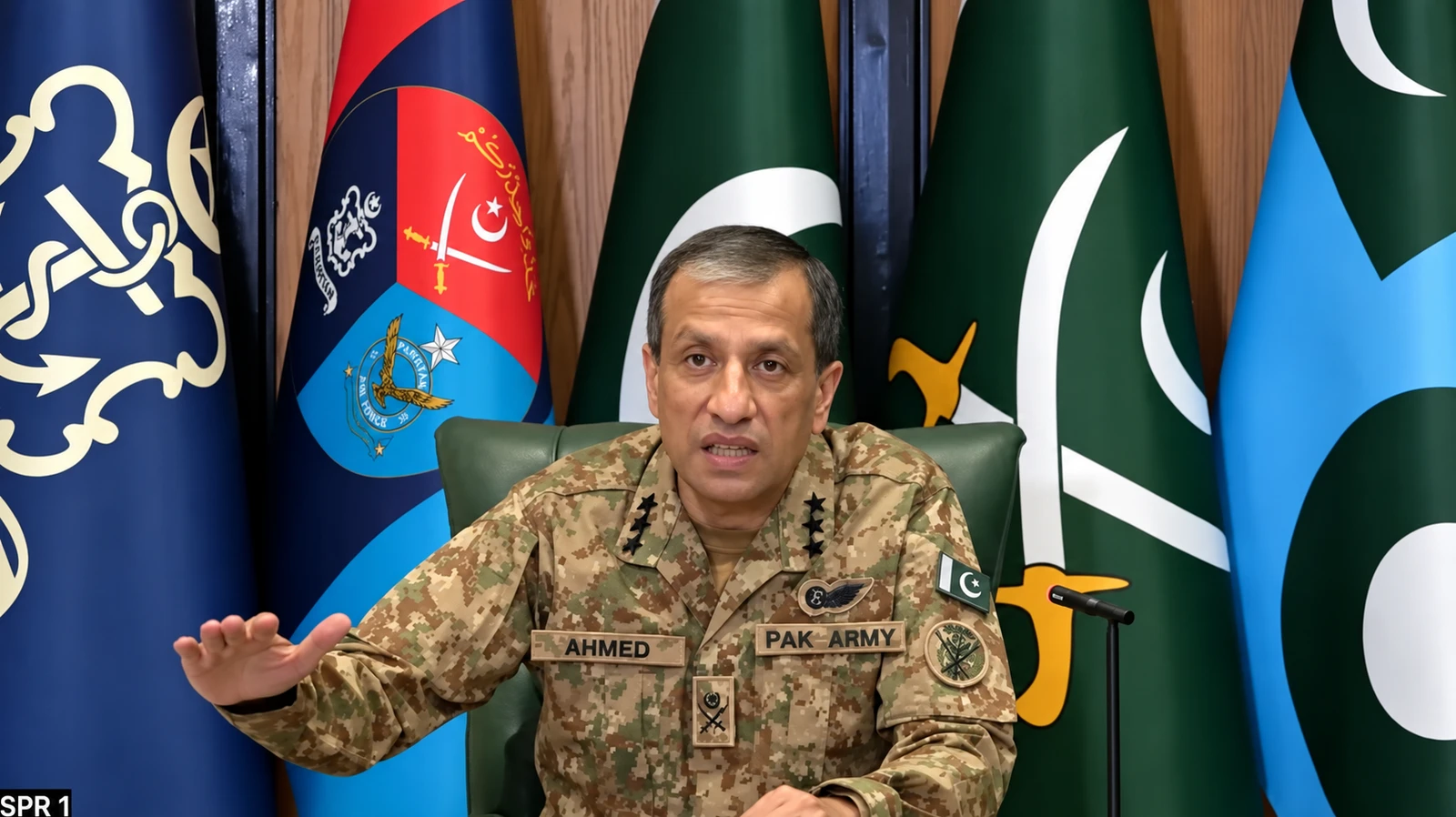
Pakistan’s military says its commitment to Saudi security is unconditional, as Houthi attacks raise questions about a new defense pact and Islamabad’s possible role in defending the Kingdom.
WEBDESK – ARAB NEWS
Pakistan will go “to any extent” to defend Saudi Arabia against attacks, Lt. Gen. Ahmed Sharif Chaudhry, director general of Inter-Services Public Relations (ISPR), said in an interview with Arab News as renewed Houthi attacks raise questions about the country’s recently expanded defense commitments to Riyadh.
Chaudhry said Pakistan stands with Saudi Arabia both diplomatically and militarily, stressing that the country’s commitment to the Kingdom’s security is “unconditional.”
“Our commitment to Saudi security is unconditional,” Chaudhry said, describing the relationship between the two countries as rooted in longstanding ties between their peoples, political leaderships and militaries.
He also said Pakistan’s commitment extends to protecting Makkah and Madinah, Islam’s two holiest cities.
“There should be no doubt on that,” he said, adding that Pakistan would continue to defend Saudi Arabia against aggression.
Houthi attacks raise pressure on Saudi Arabia
The comments come as Saudi Arabia faces a series of missile and drone attacks attributed to Yemen’s Iran-aligned Houthi movement.
According to the Arab News report, debris from an intercepted drone killed one person and injured two others in Taif on Thursday, while more than 80 people have been wounded in recent attacks.
Saudi authorities have also reported the interception of a Houthi drone heading toward restricted airspace around Makkah.
Separately, drones originating in Iraq damaged three pumping stations on Saudi Arabia’s East-West Pipeline, temporarily disrupting a major oil-export route.
The attacks have increased pressure on Saudi Arabia’s air-defense resources. The Associated Press has reported that Riyadh approached several partners, including Pakistan, Britain, France and Egypt, for assistance.
Chaudhry did not say whether Saudi Arabia had formally requested additional Pakistani troops, fighter aircraft, air-defense systems or direct Pakistani participation in operations against the Houthis.
What does the Makkah defense agreement mean?
The Pakistani military spokesman’s comments also come just weeks after Pakistan, Saudi Arabia and Türkiye signed the Makkah Joint Defense Agreement on Aug. 7.
Pakistan’s Foreign Ministry has described the agreement as defensive and aimed at strengthening collective security and deterrence. Under the arrangement, an armed attack against one of the three participating countries is to be regarded as an attack against all three.
However, the full operational provisions of the agreement have not been publicly disclosed, leaving open questions about precisely what military obligations would arise if one of the member states were attacked.
Pakistan’s Foreign Ministry has also said the agreement is in the early stages of operationalization and remains open to countries that share its collective-security commitments.
Pakistan already has forces in Saudi Arabia
Pakistan already maintains a significant military relationship with Saudi Arabia.
According to the Arab News report, Islamabad deployed around 8,000 troops, a squadron of JF-17 fighter jets, drones, and an HQ-9 air-defense system to Saudi Arabia in May, as reported by Reuters and cited by the newspaper.
Chaudhry did not clarify whether Pakistan would expand that deployment in response to the latest attacks.
He also did not confirm or rule out whether Pakistan’s nuclear deterrent falls under the defense guarantees.
That question has previously produced differing statements from Pakistani officials. Defense Minister Khawaja Asif said after the 2025 Pakistan-Saudi defense agreement that Pakistan’s nuclear capabilities could potentially be made available to Saudi Arabia if required, but later told Reuters that nuclear weapons were “not on the radar” of the agreement.
Islamabad also pushes diplomacy
While offering a strong security assurance to Riyadh, Pakistan is simultaneously pursuing diplomatic efforts to prevent the wider regional conflict from escalating.
Chaudhry said Pakistan’s political and military leadership remains in communication with Saudi officials and is consulting regional governments in search of a “negotiated and peaceful outcome.”
Pakistan has also attempted to facilitate dialogue between Washington and Tehran. Army chief and Chief of Defence Forces Field Marshal Syed Asim Munir spoke by telephone Wednesday with Iranian Foreign Minister Abbas Araghchi, who was visiting Beijing. Iranian state media reported that the two discussed regional developments but did not say whether the Houthi attacks were specifically raised.
Pakistan previously helped broker the Islamabad Memorandum of Understanding between Washington and Tehran. Chaudhry described the agreement as a framework that Islamabad believes provides a pathway toward resolving the broader crisis, although subsequent negotiations have stalled amid renewed military escalation.
For Islamabad, the latest statements therefore combine two parallel positions: a strong public commitment to Saudi security and an ongoing diplomatic effort to prevent the regional confrontation from widening.


1 Comment
Gần đây mình hay đọc nội dung tại fly888, thấy cập nhật khá nhanh.