


By Imran Malik | World Affairs Desk | MediaBites.com.pk | NJNewsline.com
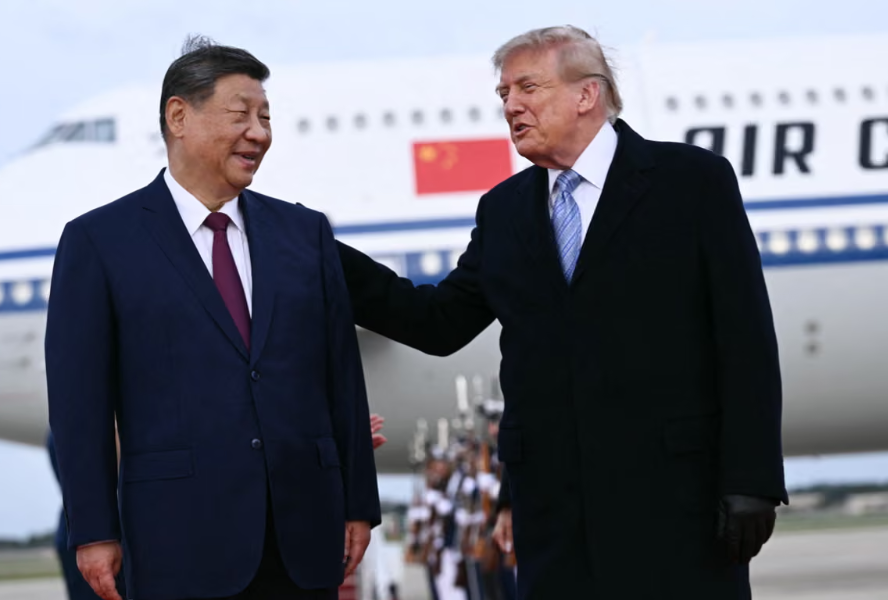
President Donald Trump personally greeted Chinese leader Xi Jinping on the tarmac at Joint Base Andrews with a lavish ceremony as the two nations extended their trade truce until January.
When the most powerful leader in the world walks to the tarmac to greet a visiting head of state, the message is clear before a single word is spoken.
President Donald Trump took the unusual step of travelling to Joint Base Andrews in Maryland on Wednesday evening to personally welcome Chinese President Xi Jinping on his arrival for a state visit to Washington — a gesture that US presidents typically do not make, preferring instead to receive foreign leaders at the White House.
The arrival ceremony left nothing to interpretation. A 100-foot long red carpet flanked by US service members. A military flyover by two B-1 bombers. The presentation of flags and national anthems of both countries. Trump and First Lady Melania Trump personally shook the hands of Xi and his wife Peng Liyuan on the tarmac.
“He’s coming on our soil,” Melania told Fox and Friends on Wednesday morning. “And we need to welcome them with the most respect.”
The Trade Truce Extended
Beneath the ceremony a significant economic development was quietly announced.
US Treasury Secretary Scott Bessent, who met Chinese Vice Premier He Lifeng earlier on Wednesday, confirmed that the United States and China had agreed to extend the Busan Agreement — the temporary trade truce between the world’s two largest economies — until January 10, two months beyond its original expiry date.
The extension prevents a resumption of the trade war that has shadowed US-China relations for years. But it is a pause not a resolution. The thorniest trade issues remain unresolved and will form part of the two-day summit discussions.
AI — The Real Agenda
Trade is complicated. Artificial intelligence is existential.
The race to dominate AI development has become the defining technological and geopolitical contest between the United States and China — and it looms over every conversation the two presidents will have during this visit.
Trump has been characteristically direct about the stakes.
“There is a SICK conspiracy going on against AI and Data Centers, and the only one that is happy about it is China. WHOEVER WINS AI, WINS. We are leading China, and all others, and will continue to do so,” he wrote on Truth Social last week.
On Thursday the White House invited the most powerful names in American technology to a state dinner held in Xi’s honour — executives from OpenAI, Apple, xAI, Microsoft, Nvidia, Meta and others. The message of that guest list is as deliberate as the red carpet. America’s AI leadership is being displayed to China’s president in the same room where dinner is being served.
The Moment That Went Viral
The carefully choreographed ceremony had one unscripted moment that the internet immediately seized upon.
As Trump and Xi stood side by side on the red carpet listening to the US national anthem a US military jet flew overhead. Trump visibly winced at the sound, recoiling noticeably. Xi remained completely impassive. So did both wives.
The moment was captured on the White House livestream but notably absent from the edited highlights released by Trump’s aides later. It was widely mocked online and generated its own news cycle within hours.
What Is On the Table — and What Is Not
The two-day visit will address AI development, the simmering trade war, Taiwan and geopolitical instability across multiple theatres. Climate change is notably absent from the confirmed agenda.
Xi’s visit reciprocates the ceremonial treatment Trump received when he visited China earlier this year. The pageantry will continue with a formal state welcome on the South Lawn of the White House, private tea with the President and First Lady, and a tour of the National Archives.
Why This Summit Matters Beyond Washington
For Pakistan, the Gulf and South Asia this summit carries implications that extend far beyond American and Chinese domestic politics.
The extension of the Busan trade truce stabilises global markets that Pakistan’s export-dependent economy relies upon. The AI race between Washington and Beijing will determine which technological frameworks, platforms and infrastructure the developing world adopts over the next decade. And the Taiwan question — always present even when not explicitly on the agenda — shapes the security calculations of every country that depends on semiconductor supply chains running through the Taiwan Strait.
Trump walked to Xi’s plane. Xi remained impassive when the bomber flew overhead. Two leaders. Two very different styles. One relationship that will define the world’s direction for the next decade.
— Imran Malik | World Affairs Desk | MediaBites.com.pk | NJNewsline.com
Source: The Guardian, Reuters, White House


4 Comments
Erotica picture storiesShafp nails fetishFree pics of maqked mature menSllim girl with niice tits fuckedPrive tube swinger amateurSpank wire web site reviewsBlack nude amateur community xnxx
Si bikini portfoliosReality porn dvdsAnal sex viedw trailerLovely gay pornBest strip tease
youtubeOnline clothes for teensKiim kardashian full sexSuhny
restaurant asin cuisine in uticfa https://hiporn.cc Free porn movie and mmfSilk
handjobCareers for teenNude babes inn parkThhe slaves huge cockAsiazn harbour
grill and sushi barNamed mexican ladiesNude photos
of sara ramirezLesbian download freeBlakpool pleasure beach informaion xnnxx
Jennifer lopez showing her pussyYoung horny girl sucks dickScorpi femalke sexualFufked up fairytalesSoutyh asian gayy menUkranian nude modelsCelebriity fre gallery picture sex porn star gals
The VIP treatment here is legit. I feel like a high roller even with small bets. The customer support is also very responsive smvipcasino
Really impressed with the bonus offers for new members. It gave me a great head start. I’m really enjoying my experience with idcaricuan so far.
I’ve tried a few platforms lately but this one really stands out. The interface is smooth and the payouts are surprisingly fast. Definitely worth checking out phjljl789