


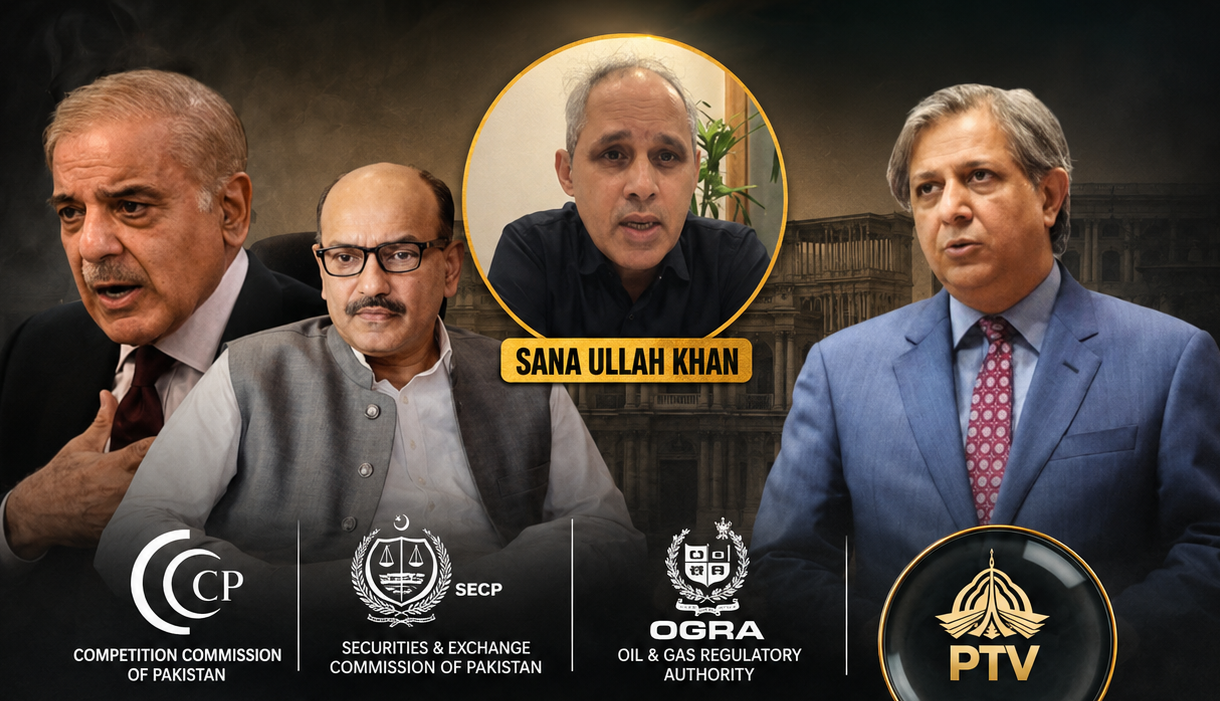
Pakistan’s top regulatory bodies face serious allegations of politically connected appointments at CCP, SECP, OGRA and PTV — raising urgent questions about merit, independence and governance.
By Imran Malik | News Desk | MediaBites.com.pk
Pakistan’s most powerful regulatory and state institutions are once again at the centre of a brewing controversy — one that strikes at the heart of governance, public trust, and institutional integrity. The question being openly asked by analysts and observers is uncomfortable but unavoidable: are the country’s top regulatory posts being filled on merit or through personal and political connections?
The criticism is specific, named, and gaining traction in policy and media circles.
The Competition Commission Controversy
According to analyst Sanaullah Khan, the Chairman of the Competition Commission of Pakistan (CCP) is a cousin of Law Minister Azam Nazeer Tarar. Critics allege the position was deliberately left vacant for four months — waiting, they say, until the appointee became available following retirement from another role.
Since his appointment, critics argue, the institution’s performance has slowed considerably. The CCP, tasked with ensuring fair market competition and protecting consumers from monopolistic practices, is considered one of Pakistan’s most consequential economic regulators.
A four-month vacancy at the helm of such a body raises serious questions about succession planning — and about who exactly these decisions serve.
SECP and OGRA — A Pattern Emerges
The concerns do not stop at the Competition Commission. Similar questions have been raised about the leadership of the Securities and Exchange Commission of Pakistan (SECP), with critics attributing the chairman’s appointment to family connections rather than a transparent, merit-based process.
At the Oil and Gas Regulatory Authority (OGRA), the current chairman has been identified by critics as bureaucrat Nabeel Ahmed Awan — described as a personally favoured appointee of Prime Minister Shehbaz Sharif.
OGRA oversees the pricing and regulation of Pakistan’s oil and gas sector — an area that directly affects every household’s utility bills and the country’s broader energy security. Questions about the independence of its leadership carry serious economic implications.
PTV — Four Years Without a Permanent Head
The situation at Pakistan Television Corporation (PTV) adds another dimension to the governance concern. Critics point out that the last permanent Managing Director of the state broadcaster was appointed during Fawad Chaudhry’s tenure as Information Minister.
Since then — a period of approximately four years — PTV has reportedly been run under ad hoc arrangements, with no permanent leadership. For an institution that serves as Pakistan’s primary public broadcaster and receives significant public funding, this extended leadership vacuum is being described as both irresponsible and telling.
Why Institutional Appointments Matter
The issue extends well beyond individual names and personal grievances. Regulatory bodies exist to function as independent referees — impartially enforcing rules, protecting public interest, and operating free from political interference.
When these bodies are perceived to be led by loyalists, relatives, or political favourites rather than the most qualified professionals available, the damage is threefold.
First, institutional performance suffers when leadership prioritises political considerations over regulatory effectiveness. Second, investor and public confidence erodes — both domestically and internationally. Foreign investors evaluating Pakistan’s business environment closely monitor regulatory independence. Third, a culture of connections over competence filters downward through entire organisations, gradually hollowing out institutional capacity at every level.
Pakistan is currently engaged in sensitive negotiations with international financial institutions, pursuing foreign investment, and attempting to stabilise the economy. The credibility of its regulatory architecture is not a secondary concern — it is central to whether these efforts succeed.
The Question That Will Not Go Away
Analyst Sanaullah Khan’s criticism reflects a frustration widely felt but rarely articulated so directly in public. Pakistan has no shortage of highly qualified professionals — economists, lawyers, financial regulators, and technocrats — capable of leading these institutions with distinction.
The question, as observers continue to frame it, is devastatingly simple.
Are Pakistan’s most important institutions being led by the best available professionals — or by the best-connected individuals?
Until there is a transparent, publicly accountable, and genuinely merit-based appointment process for the country’s top regulatory posts, that question will continue to haunt every institution it touches.


2 Comments
I’m impressed, I must say. Seldo ddo I ckme acrross a bloog that’s both educativbe
andd amusing, and leet mme tell you, you’ve hhit tthe nail
onn the head. Thee issu iis sometyhing whiuch too feww peoploe aare speakung intelliently about.
I amm vedy happy I found thius inn myy seqrch for somerthing relating
tto this.
Checkk ouut mmy webb sitye … xmxx
Pingback: спинбеттер казино