


By Imran Malik | World Affairs & Gulf Desk | MediaBites.com.pk
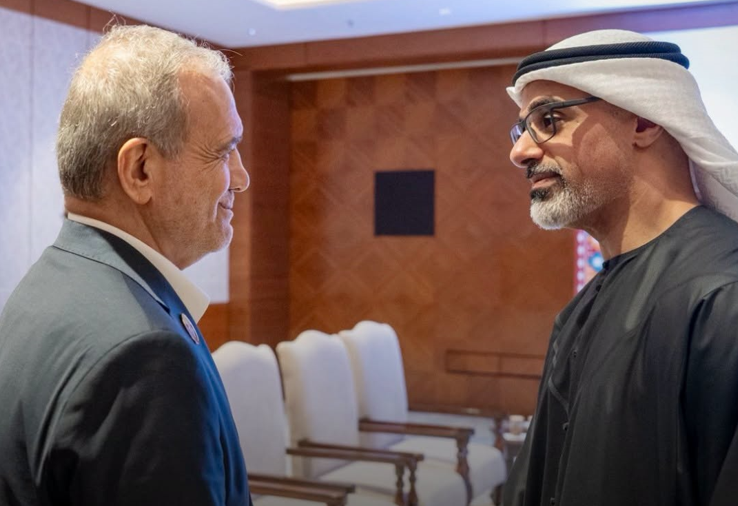
Abu Dhabi Crown Prince Sheikh Khaled bin Mohamed met Iranian President Masoud Pezeshkian at the 18th BRICS summit in New Delhi marking significant diplomatic contact since the US-Iran war began.
Since the United States launched military operations against Iran earlier this year the UAE and Iran have existed in a state of dangerous proximity. Iranian drones targeted UAE airspace. The UAE Air Force intercepted them. The UAE foreign ministry declared a hostile Iranian attack and reserved its right to respond.
And now this.
Sheikh Khaled bin Mohamed Al Nahyan, Crown Prince of Abu Dhabi, has met Iranian President Masoud Pezeshkian on the sidelines of the 18th BRICS Summit in New Delhi — the first significant high-level diplomatic contact between the UAE and Iran since the US-Iran conflict dramatically escalated.
The ice is beginning to melt.
What Was Discussed
According to a readout issued by WAM, the UAE state news agency, the two leaders discussed regional and international issues of mutual interest while underlining the need to ease tensions, promote de-escalation, and strengthen regional stability.
The meeting also addressed ways to advance peace and development for the people of the region.
The diplomatic language is carefully chosen, but the message is unmistakable. Two countries that were exchanging hostile fire through proxies and drones just weeks ago are now sitting at the same table talking about de-escalation and regional stability.
The Critical Question — Can This Stop Iran Targeting UAE Oil Facilities?
The meeting raises the most important strategic question for the UAE and for global oil markets.
Iran has demonstrated both the capability and the willingness to target Gulf infrastructure. The Strait of Hormuz tensions, the drone incident over UAE territorial waters, and the broader pattern of Iranian strikes on US-allied positions in the region have created genuine alarm among UAE policymakers, businesses, and the millions of expatriates who call the Emirates home.
A diplomatic channel between Abu Dhabi and Tehran — even an informal one established on the sidelines of a BRICS summit in New Delhi — provides a mechanism that did not exist before. Direct communication reduces the risk of miscalculation. It creates space for warnings to be delivered and received before military action is taken.
Whether that channel is sufficient to prevent Iranian strikes on UAE oil facilities is a different and more complicated question. The answer depends on a factor that the UAE’s diplomats understand very well.
Who Actually Makes Decisions in Iran — Pezeshkian or Someone Else?
This is the question that cuts to the heart of whether this diplomatic meeting can actually deliver results.
President Masoud Pezeshkian is Iran’s elected head of government. He represents Iran at international summits. He signs agreements. He appears at BRICS meetings in New Delhi and shakes hands with Abu Dhabi’s Crown Prince.
But in Iran’s constitutional and political structure, the President is not the supreme decision-maker on matters of war, military operations, and foreign policy toward adversaries.
That authority rests with Supreme Leader Ayatollah Mojtaba Khamenei and, critically, with the Islamic Revolutionary Guard Corps, which has exercised increasing operational independence in security matters throughout the current conflict. Parliament Speaker Mohammed Bagher Ghalibaf, who has led negotiations with Washington, also operates as a significant independent power center.
Khamenei himself has not been seen publicly since taking power in March. President Trump said this week he believed Khamenei was seriously wounded but alive. The IRGC, which launched the drone attack toward UAE airspace and the missile strikes on US bases in Jordan, does not require presidential approval for its operational decisions.
This is the fundamental dilemma facing the UAE’s diplomats.
Pezeshkian can agree to de-escalation in New Delhi. He can issue warm statements about regional peace and development. He can mean every word sincerely. And the IRGC can still fire missiles at whatever target it chooses, on its own timeline, for its own strategic calculations.
The President of Iran is not the person who decides whether Iranian weapons hit UAE infrastructure. The IRGC is.
Why This Meeting Still Matters
None of that renders the Abu Dhabi-Tehran contact meaningless. Diplomatic channels have value even when the person across the table has limited operational authority over military decisions.
The UAE’s engagement with Pezeshkian signals to Tehran’s entire power structure — including the IRGC — that the Emirates is pursuing a political solution rather than a military one. It creates domestic political space for Iranian moderates who genuinely oppose the conflict’s expansion into UAE territory. It demonstrates to Washington that the UAE is managing its own regional relationships rather than simply deferring to American military strategy.
And it establishes a communication channel that can clearly and directly convey red lines. The UAE telling Iran through diplomatic channels that attacks on UAE oil facilities will trigger a response of a specific nature is more credible and more stabilizing than the same message delivered through American intermediaries or public statements.
What This Means for Pakistan’s 1.6 Million in the UAE
For Pakistan’s 1.6 million nationals in the UAE and the billions in annual remittances they send home, any development that reduces the probability of Iranian strikes on UAE infrastructure is directly and personally significant.
The Abu Dhabi-Tehran diplomatic contact announced from New Delhi is a cautious but real step toward the regional de-escalation that the UAE’s expatriate community, its economy, and its government all desperately need.
Whether Pezeshkian can deliver what he agreed to in New Delhi depends on whether the IRGC is listening. That remains the question nobody in New Delhi, Abu Dhabi, or Tehran can answer with certainty today.
— Imran Malik | World Affairs and Gulf Desk | SharjahNews.ae | MediaBites.com.pk | Southera.com
Some leads from WAM UAE News Agency

