


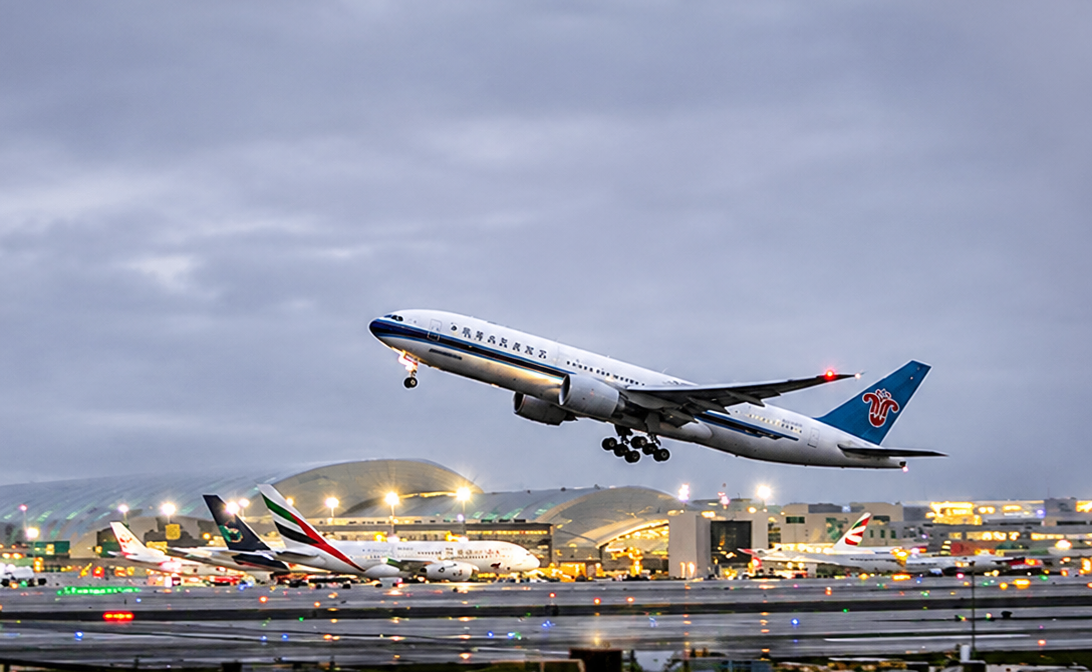
The United States has reopened its airspace after an air traffic communications failure grounded flights nationwide, triggering nearly 10,000 cancellations and stranding thousands of passengers.
WEBDESK – MEDIABITES
WASHINGTON, November 14, 2026: The United States has lifted a nationwide flight ground stop after a major communications failure disrupted air traffic control operations, triggering widespread cancellations, delays, and travel chaos at airports nationwide.
The Federal Aviation Administration (FAA) lifted the restriction on Friday night after a technical failure affected radar and communications systems at air traffic control centers. However, authorities warned that restoring normal flight operations could take several days.
US Transportation Secretary Sean Duffy announced that American airspace reopened at 8:15 p.m. Eastern Time on Friday (0115 GMT Saturday), stressing that departures would resume gradually.
“It’s going to be slow,” Duffy told reporters at the White House.
According to flight-tracking website Flightradar24, nearly 10,000 flights had been canceled by 11:30 p.m. Friday. Delta Air Lines and American Airlines each reported more than 2,200 cancellations, while United Airlines recorded approximately 1,800.
Thousands of passengers were stranded at airports, with some aircraft waiting more than five hours for gate access.
The four-hour nationwide grounding triggered one of the most significant disruptions to US aviation since the September 11, 2001, attacks. Aviation analysts warned that the disruption could continue affecting airline schedules for days.
What caused the nationwide flight disruption?
Duffy said the problem began at approximately 3:36 p.m. Friday, when air traffic control centers experienced instability involving radar and communications systems.
According to the transportation secretary, network switches and routers became overloaded with data, producing inconsistent information that forced authorities to shut down the system as a precaution.
He said air traffic controllers never completely lost radar or communications capabilities and landed thousands of aircraft safely during the disruption.
Duffy confirmed that the immediate technical problem had been fixed and declared flying safe, but acknowledged that the country’s aging air traffic control infrastructure requires a major overhaul.
No evidence of cyberattack or rogue AI
US Homeland Security Secretary Markwayne Mullin said investigators had found no evidence that a cyberattack or an autonomous artificial intelligence system caused the failure.
“It appears this was mechanically driven. However, we’re still looking,” Mullin said.
The National Security Agency was working alongside the Department of Homeland Security to investigate the incident.
Two airline officials said the outage appeared to involve a telecommunications network overseen by L3Harris Technologies, which handles critical radio frequencies air traffic controllers use to communicate with pilots. The company did not immediately respond to a request for comment.
US calls for $50 billion aviation infrastructure overhaul
Duffy blamed insufficient congressional funding for delays in replacing the country’s aging air traffic control technology and called for $50 billion to modernize the system.
Earlier on Friday, the White House and Transportation Department had urged Congress to approve $30.1 billion for improvements to airports and air traffic control infrastructure.
The secretary argued that modernizing the system was necessary to prevent similar disruptions.
Airline passengers face days of disruption
Despite the reopening of US airspace, passengers continued facing cancellations and delays at major airports from Boston and New York to Los Angeles and Seattle.
American Airlines said it was prioritizing international flights and services to smaller cities outside its major hubs to reposition aircraft and crews and accelerate recovery.
Passengers stranded overnight faced uncertainty over rescheduled departures and connecting flights. Airlines will not be required to compensate affected travelers because the disruption resulted from an FAA system failure rather than carrier operations.
The incident also affected airline stocks, with American, United and Delta shares falling 1% to 2% in after-hours trading, while JetBlue declined about 3%.
For international travelers, including passengers flying between the United States and Pakistan, the disruption highlights how technical failures in America’s aviation infrastructure can affect connecting journeys and international travel schedules.
The FAA has lifted the nationwide restriction, but the immediate challenge remains restoring normal airline operations and clearing the backlog of affected flights.

