


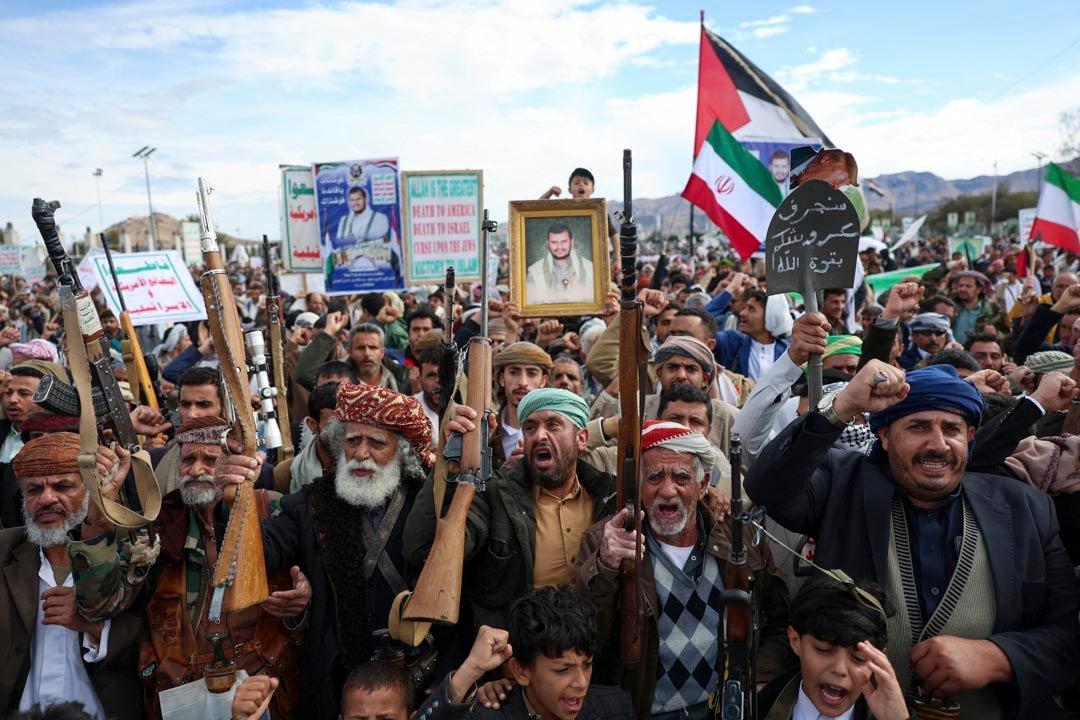
Yemen’s Iran-backed Houthi movement has warned the United States of a “painful response” if Washington joins Saudi Arabia’s military campaign against the group, escalating tensions as missile and drone attacks target Saudi airports, military installations and energy infrastructure.
Mohammed Al Bukhaiti, a member of the Houthi political bureau, told Agence France-Presse (AFP) on Monday that the group would respond immediately if the United States became involved in what it described as aggression against Yemen.
“If the US becomes involved in the aggression against Yemen, we will not deliberate over the decision to respond; rather, there will be a swift and painful response targeting the US and all its interests in the region,” Bukhaiti said.
He also warned employees and workers at Saudi oil facilities and airports to stay away from those sites, which he said had become legitimate targets.
The warning came after US President Donald Trump said Washington was considering joining Saudi strikes against the Houthis. The remarks followed a deadly attack on Riyadh’s King Khalid International Airport on Saturday that killed 13 people and injured hundreds, according to the supplied report.
Trump described the attack as unacceptable and said he planned to speak with Saudi Crown Prince Mohammed bin Salman about the escalating crisis.
Missile attacks intensify across Saudi Arabia
The confrontation continued on Monday, with Saudi Arabia’s military coalition reporting the interception of missile threats near the capital and in the kingdom’s south.
The coalition said it intercepted and destroyed two ballistic missiles launched towards Khamis Mushait, a city near the Yemeni border that hosts a Saudi military installation.
The Houthis also claimed to have targeted the area with a drone and said they had again attacked King Khalid International Airport.
Explosions and aerial threat alerts heightened anxiety in Riyadh, where mobile phones received a government warning about a potential hostile aerial threat. A football match involving Saudi club Al Nassr was delayed following the alert.
Airport operations in Riyadh remained suspended on Monday, disrupting travel for passengers and international airlines.
The attacks have placed additional pressure on Saudi Arabia’s air defenses and raised concerns about the vulnerability of civilian infrastructure in one of the world’s leading oil-exporting countries.
Saudi Energy Minister Prince Abdulaziz bin Salman said the recent attacks had tested the country’s infrastructure, institutions and resilience, adding that the response would need to be equally serious.
Airlines suspend flights as security concerns grow
The escalating security situation has prompted airlines and diplomatic missions to issue warnings and change travel arrangements.
The US Embassy in Saudi Arabia instructed American government employees to obtain authorization before using airports in the kingdom and urged US citizens to exercise extreme caution.
The embassy also warned that American citizens had been detained for photographing recent events in Saudi Arabia.
Etihad Airways announced it would cancel flights to and from Riyadh until the following week, while also suspending services to Dammam and Jeddah. Bahrain’s Gulf Air canceled flights to Riyadh until Saturday.
US carrier Delta delayed the planned launch of its direct Atlanta-to-Riyadh service, scheduled for October 23.
The disruptions highlight the wider economic consequences of the conflict, with airlines, travelers and businesses facing uncertainty as attacks threaten major transport hubs.
A wider regional conflict
The latest escalation comes amid renewed fighting in Yemen’s long-running civil war, in which a Saudi-led military coalition has supported Yemen’s internationally recognized government against the Houthis since 2015.
The conflict intensified again in July 2026, according to AFP, as a broader regional crisis placed additional pressure on energy markets and security across the Middle East.
The Houthis have increasingly targeted Saudi oil facilities, tankers, airports and other transport infrastructure. The group says its campaign is intended to pressure Riyadh over its military role in Yemen.
Security analyst Thomas Juneau of the University of Ottawa said Saudi Arabia’s vast territory makes it difficult to consistently defend every potential target, despite substantial investment in military equipment.
The threat of direct US involvement adds another dimension to the conflict, raising the possibility of further military escalation and retaliatory attacks against American interests in the region.
UN urges both sides to de-escalate
The United Nations has called for restraint amid the growing threat to civilians and critical infrastructure.
UN human rights chief Volker Türk said he was appalled by the repeated attacks on Saudi Arabia but urged all sides to step back from further confrontation.
He warned that continued fighting would bring additional suffering without offering a clear path towards ending the conflict.
Yemen is already facing a prolonged humanitarian crisis after years of war, displacement and economic hardship. A wider confrontation involving the United States and Saudi Arabia could deepen instability and further complicate efforts to deliver humanitarian assistance.
For now, Washington has not confirmed a decision to join Saudi military operations. The Houthis, however, have made clear that any direct American intervention would prompt retaliation, leaving the region facing renewed uncertainty over the conflict’s next phase.

