


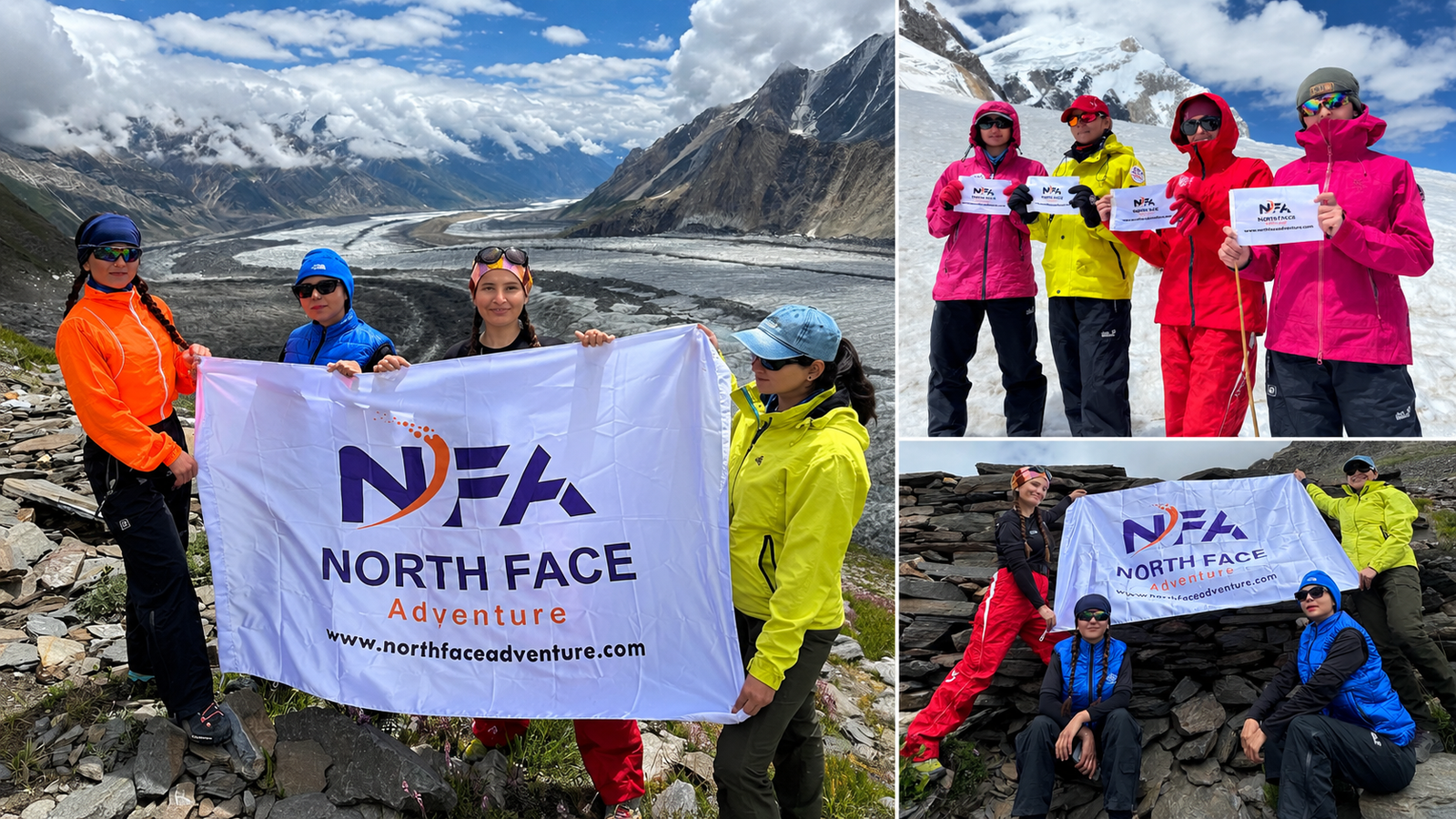
Four women from Gilgit-Baltistan have reached Pakistan’s 7,027-meter Spantik Peak without high-altitude porters, marking a milestone for women’s mountaineering and adventure tourism.
WEBDESK – MEDIABITES
ISLAMABAD, Pakistan — Four women mountaineers from Gilgit-Baltistan have successfully reached the summit of Spantik Peak, completing a demanding high-altitude expedition without the assistance of high-altitude porters and returning safely to Skardu.
Shama Baqir, Samana Rahim, Zooni Aslam and Zaiba Batool Shigri completed the ascent of the 7,027-meter mountain in the Karakoram, according to North Face Adventure. Their achievement was confirmed by the Alpine Club of Pakistan.
Baqir and Rahim are from Shimshal Valley, Aslam is from Gulmit in Gojal, Upper Hunza, and Shigri belongs to Shigar district.
The expedition is being celebrated as a significant achievement for Pakistani women in adventure sports and as an example of the growing potential of Gilgit-Baltistan as an international destination for mountaineering and adventure tourism.
“North Face Adventure is honoured to celebrate these remarkable women and their inspiring achievement,” said Shahzad Faisal Khan, managing director of North Face Adventure. He said the expedition reflected the courage of Pakistani women, the strength of mountain communities and the potential of the country’s adventure-tourism sector.
Spantik, commonly known as the Golden Peak, rises 7,027 meters, or 23,054 feet, in the Spantik-Sosbun range of the Karakoram. The mountain is associated with the Chogolungma Glacier and was first successfully climbed in 1955.
The mountain is among Pakistan’s best-known 7,000-meter peaks. Its standard southeast-ridge route is often used by climbers preparing for more technically demanding high-altitude expeditions, although an ascent still requires extensive preparation, acclimatization, teamwork and the ability to cope with unpredictable weather and extreme altitude.
The achievement also highlights the scale of Gilgit-Baltistan’s mountain landscape. The regional Tourism Department says the area has more than 700 peaks above 6,000 meters and more than 108 exceeding 7,000 meters. Five of the world’s 14 peaks above 8,000 meters — K2, Nanga Parbat, Broad Peak, Gasherbrum I and Gasherbrum II — are also in Pakistan.
Tourism is becoming increasingly important to Pakistan’s economy, with northern areas attracting both domestic and international travelers. Gilgit-Baltistan recorded 989,793 domestic tourist visits in 2024, according to figures cited by North Face Adventure. Skardu led with 302,384 visitors, followed by Hunza with 233,070.
The expedition comes as Pakistan seeks to expand its adventure-tourism industry while improving safety, environmental protection and economic participation by local communities.
North Face Adventure, a Pakistan-based tourism and destination-management company with more than 15 years of experience, said women-led expeditions could help present Pakistan as a more inclusive adventure destination while creating opportunities for guides, hotels, transport operators, artisans and mountain communities.
The company said sustainable growth would require trained guides, stronger safety standards, reliable rescue arrangements, responsible waste management and greater opportunities for women as climbers, guides, entrepreneurs and tourism professionals.
For the four mountaineers, the Spantik summit stands as an example of how preparation, teamwork, courage and determination can overcome one of the Karakoram’s most demanding challenges.


1 Comment
The download process was straightforward and the installation took no time at all. Great start with in777gamedownloadin