


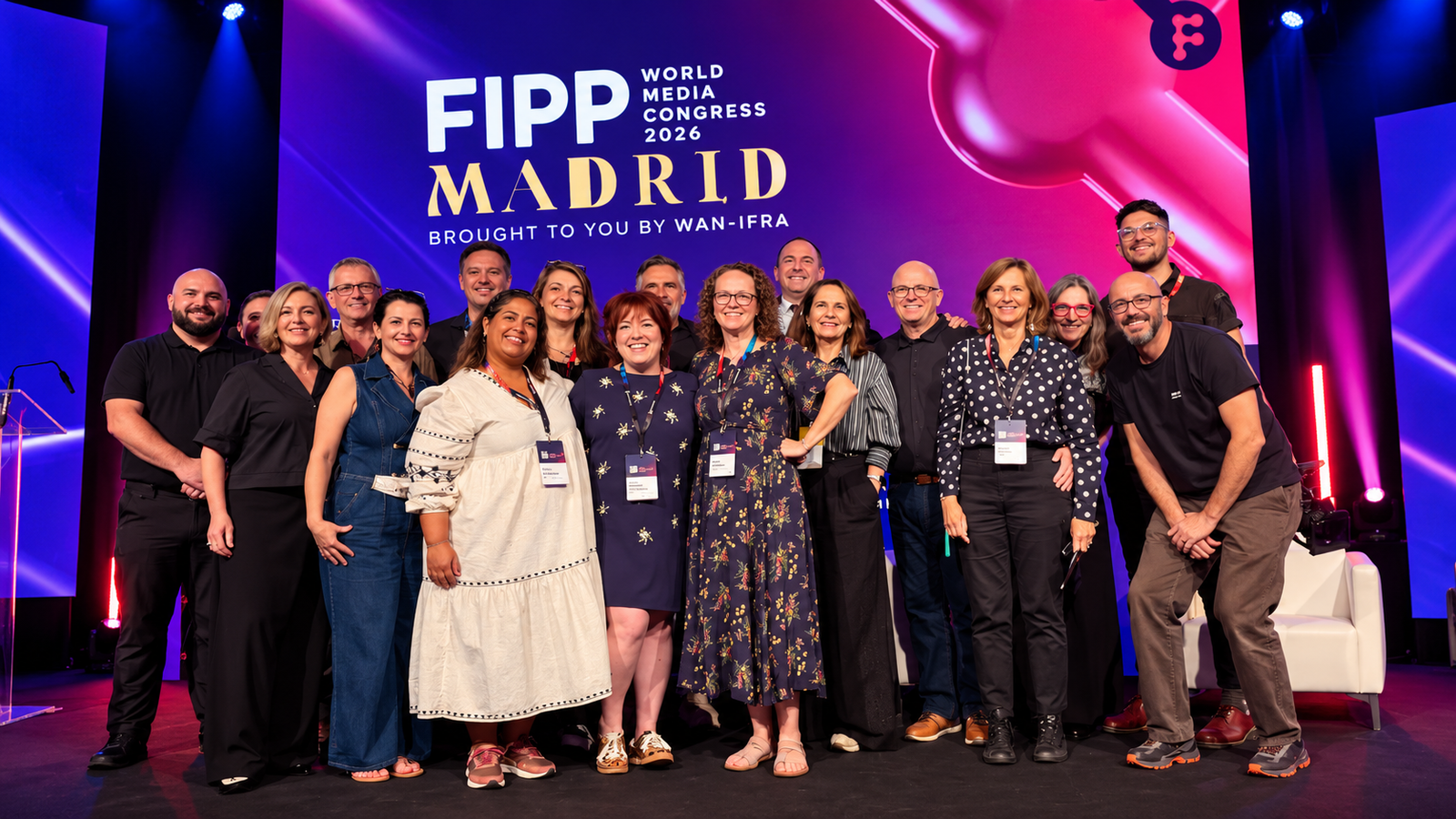
The FIPP World Media Congress 2026 in Madrid delivered one of the most consequential editions of the annual summit, with major announcements on AI monetization, a historic move to Africa, and a global call for governments to follow Australia’s lead on fair compensation for news publishers.
WEBDESK – WAN-IFRA CEO – FIPP MADRID
A Congress That Set New Standards
WAN-IFRA CEO Stig Kirk Ørskov, whose organization co-produces the annual Innovation in Media World Report with FIPP, offered an unambiguous verdict on what unfolded in Madrid.
“In my view, this year’s FIPP Congress set new standards for both program quality and the whole conference experience,” he wrote following the event. “Madrid in glorious October sunshine certainly helped with the latter. But the real credit belongs to the team.”
Ørskov highlighted a program that drew some of the most prominent names in international media, including Jessica Sibley of TIME on building trust in a world shaped by AI agents;
Christian Van Thillo of DPG Media on building a resilient media business through technological and market upheaval;
Erika Heilman of Harvard Business Review on turning audience focus into growth;
Dr. Rainer Esser on the remarkable turnaround of DIE ZEIT;
Laura Williamson of The Athletic on subscription sports journalism at international scale; and
Dmitry Shishkin on the next evolution of the user needs model from the BBC to specialist media.
Among the sessions Ørskov singled out as a personal highlight was his own interview with Jonathan Roberts, Chief Innovation Officer at People Inc., on how publishers can get paid in the age of answer engines. “His approach is clear: control access to your content, get paid for its use, and be a good partner. An encouraging discussion about a new market for publishers, and the work needed to build it on fair terms.”
The congress also paid tribute to outgoing FIPP Advisory Board Chair Yulia Petrossian Boyle for her contribution to the organization and her decisive role in bringing FIPP and WAN-IFRA together. Minette Ferreira was welcomed as the incoming Chair.
Cape Town 2027: Africa Gets Its First FIPP Congress
The headline announcement from Madrid was that the FIPP World Media Congress will move to Cape Town, South Africa, in 2027, marking the first time the African continent has hosted the event. Confirmed dates are 19 to 21 October 2027 at the Cape Town International Convention Center.
Organized in partnership with Media24, one of South Africa’s leading media companies, the move was described by FIPP Managing Director Alastair Lewis as a strategic milestone. “It has been a priority of ours to ensure that FIPP extends its influence beyond Europe and North America and into the Global South.”
Ferreira said the location is particularly significant for the industry. “South Africa has a vibrant, hard-won democratic story, and our media industry has been central to writing it. At a time when trust, relevance and resilience are being tested everywhere, there is real value in gathering in a country where press freedom was fought for, not simply inherited.”
FIPP Chair Petrossian Boyle pointed to Africa’s fast-growing media markets as the strategic rationale. “Nigeria’s media market is growing at nearly twice the pace of America’s, and 98 percent of its internet users are on WhatsApp, a distribution channel most publishers have barely begun to use. Kenya’s internet advertising is growing faster than anywhere on earth.”
Innovation in Media World Report 2026/2027: Truth Is the New Scarcity
The congress launched the Innovation in Media World Report 2026/2027, the industry’s most closely watched annual study, authored by Juan Señor and Jayant Sriram of Innovation Media Consulting in partnership with FIPP and WAN-IFRA.
Drawing on global case studies across six chapters, the report frames the central challenge for publishers in stark terms: in an age of artificial intelligence, content is no longer scarce. Trust is.
“In the print age, our advantage was distribution. In the digital age, it was data. In the social age, it was attention. Now it is really about monetizing truth, because we are in an age of artificial credibility,” said Señor.
The report organizes core revenue models, including licensing, subscriptions, membership, intelligence products, events, commerce, and data, into a practical framework for building durable income when content can be generated at near-zero cost. It calls on publishers to transform editorial archives from passive assets into active revenue streams through licensing deals, data partnerships, AI-powered products, and enterprise services.
On newsroom transformation, the report draws a firm line between augmentation and replacement. “Decide the balance between augmentation and replacement,” said Lucio Mesquita, Senior Consultant at Innovation Media. “And please, if you are toying with the idea of automating everyone, do not.”
The report also argues for the renewed relevance of print, saying physical publishing is finding new value precisely because of digital abundance. Publishers who once considered it obsolete are rediscovering print’s capacity to occupy space, slow attention, and create lasting brand impressions.
Australia’s Bargaining Code: A Blueprint for the World
One of the most discussed sessions examined Australia’s News Media Bargaining Code, legislated in 2021, as a model for governments seeking to rebalance the relationship between news publishers and major technology platforms.
In an on-stage conversation with Ricky Sutton of the Future Media newsletter, the session outlined how Australia’s framework led to Google signing 23 commercial deals and Facebook signing 13 deals with Australian news media businesses, with total payments estimated at approximately AUD 200 million.
The message to assembled publishing industry leaders was direct: what Australia achieved is replicable. The policy case, grounded in economic sustainability, media viability, and the role of a free press in supporting democratic societies, is strong. What it additionally requires is political will.
A Congress That Looked Forward
Taken together, the Madrid congress reflected an industry in active transition, grappling with how to restructure for AI, reduce platform dependency, reclaim direct audience relationships, and make the political and commercial case for its own sustainability.
The move to Cape Town signals that the conversation is also widening geographically, drawing in some of the world’s fastest-growing media markets at a moment when the future of publishing remains open.
FIPP and WAN-IFRA members can access all congress presentations through the FIPP Knowledge Hub. FIPP Congress 2027 takes place 19 to 21 October 2027 in Cape Town.
Image Source: WAN-IFRA CEO
MediaBites.com.pk

