


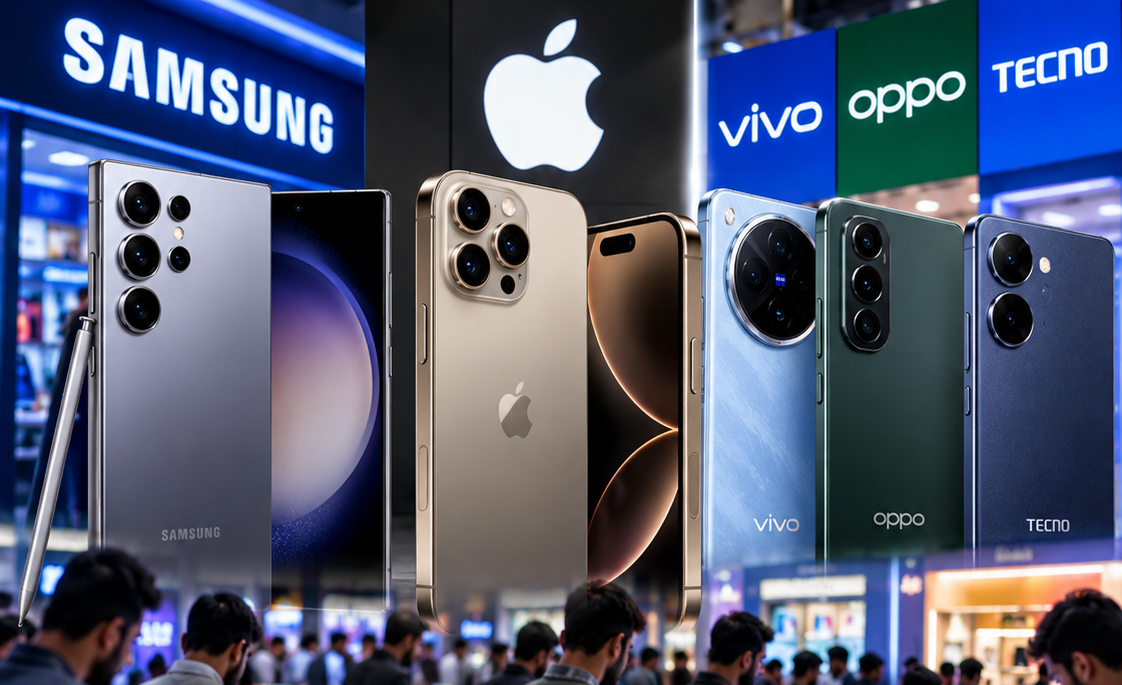
Pakistan’s smartphone market tells an interesting story in 2026. Chinese brands dominate the landscape on paper, yet none has decisively captured Pakistani consumers’ hearts and wallets the way Samsung or Apple has.
BY IMRAN MALIK – MEDIABITES EDITORIAL
Where the Market Actually Stands
According to Nayatel data from May 2026, Samsung leads Pakistan’s smartphone market with a 21.1% share. Behind it, the Chinese brands collectively hold the majority of the market but are split across multiple players: Vivo at 15.2%, Xiaomi at 14.1%, Oppo at 12.2%, Infinix at 9.7%, Tecno at 4.7%, and realme at 4.6%. Apple holds 8.8% despite being the most expensive option. Huawei, once a dominant force, has collapsed to just 2.1%, a direct consequence of U.S. sanctions cutting off its access to Google services and advanced chipsets.
Why Chinese Brands Haven’t Dominated Despite Government Support
The government’s “Make in Pakistan” push brought local assembly lines for Vivo, Oppo, Tecno, and others. Duties were adjusted, tax incentives offered, and localization encouraged. Yet the results have been uneven. Several reasons explain why:
Brand trust deficit. Pakistani consumers, particularly in the mid-to-upper segment, associate Samsung and Apple with reliability and longevity. Chinese brands, despite significant hardware improvements, still carry a perception problem built over years of cheaper, short-lived devices flooding the market.
Fragmented marketing. Chinese brands operate multiple sub-brands targeting overlapping price points, confusing consumers rather than converting them. Oppo, realme, and OnePlus are all under the same parent company. Vivo and iQOO similarly overlap. The marketing teams have struggled to build distinct, memorable brand identities in Pakistan’s chaotic retail environment.
After-sales service gaps. A consistent complaint across Tecno, realme, and Infinix users is weak service center coverage outside major cities. Lahore and Karachi may be adequately served, but secondary cities and rural buyers have been largely ignored, ceding the trust-building opportunity that Samsung has exploited for decades.
The software experience. Post-Huawei, Chinese brands without Google services are a non-starter. Those with Android have the platform, but bloatware-heavy skins, aggressive battery management, and inconsistent update policies continue to push tech-aware buyers toward Samsung or used iPhones.
The Used iPhone, Samsung and Pixel Market
Rather than shrinking, the refurbished premium phone market has grown, and government policy has inadvertently helped it. Customs Valuation Ruling No. 2035, effective January 2026, dramatically slashed assessed values on older iPhones. The iPhone 12 Pro dropped from $280 to $155 in customs valuation; the iPhone X fell to $57. This has made used iPhones significantly cheaper at retail, drawing buyers who previously thought they were out of reach.
The result: a Pakistani consumer can now buy a used iPhone 11 or 12 for a price competitive with a new mid-range Chinese device, and they are choosing the iPhone. For a large segment of aspirational buyers, the perceived value of an older premium device beats a new budget Chinese phone.
Google Pixel’s used market remains niche but is growing among tech enthusiasts who value clean Android and camera quality. Samsung’s used S-series and A-series phones also move well in the secondary market.
What Chinese Brands Need to Do
The opportunity is real, but the window is narrowing. Pakistan has over 240 million people, a young population, and rapidly growing mobile internet use. To turn market presence into market dominance, Chinese brands need sharper single-brand identities, aggressive after-sales investment outside Lahore and Karachi, user-respecting software, and marketing that speaks to Pakistani culture rather than recycled global campaigns.
Send the Editor, Not the Salesman: The Strategic Blind Spot Holding Chinese Smartphones Back in Pakistan
One more blind spot is worth naming. When Chinese mobile companies organize factory visits and press trips to China, they almost exclusively invite sales and marketing teams, not editors, reporters, or media publishers. This is a strategic mistake. A journalist or editor who walks through a Vivo or Tecno production facility, sees the R&D process firsthand and understands the engineering behind the product comes back with a story, not a sales pitch.
That story builds credibility with readers in a way no paid campaign ever can. The big bosses at these companies need to rethink who gets on that plane. Bringing publishers and newsrooms into the factory experience is not a cost; it is an investment in earned media and long-term brand trust. Until that mindset shifts, Chinese brands will keep spending heavily on marketing while leaving their most powerful channel, independent editorial coverage, largely untapped.
Huawei’s collapse is a cautionary tale. Market share built on price alone evaporates the moment a better-value option appears. Brand loyalty has to be earned.

