


By Imran Malik
Veteran journalist Ahmed Waleed’s return to Samaa TV comes at a sensitive time, with industry circles closely watching whether experience and professionalism can stabilize internal turbulence.
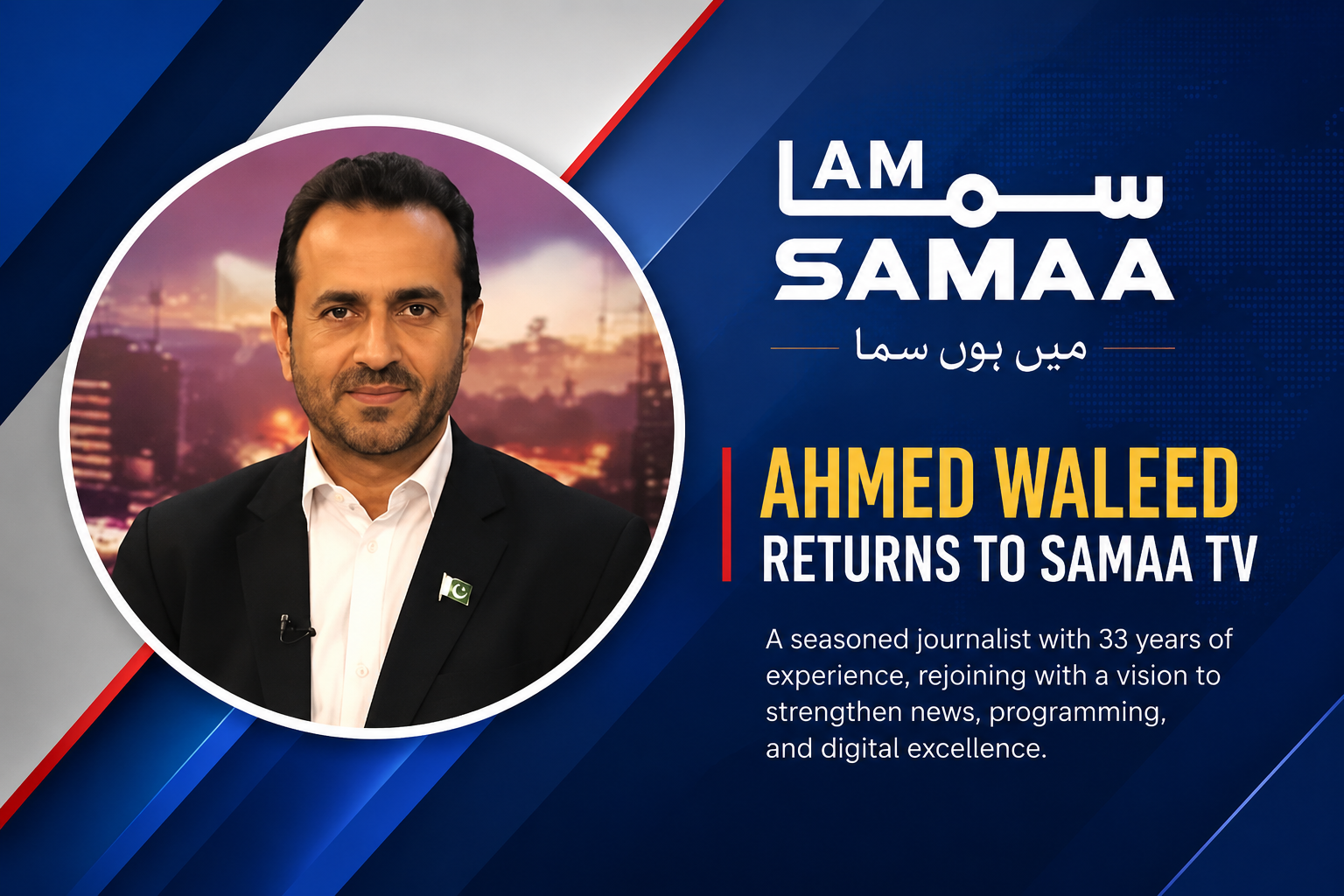
Pakistan’s television industry is once again buzzing with newsroom speculation after senior journalist Ahmed Waleed rejoined Samaa TV for a second stint, a move many insiders see as both strategic and symbolic.
With nearly 33 years of experience across print, television and digital journalism, Ahmed Waleed’s return signals Samaa management’s apparent attempt to bring institutional maturity and editorial stability at a time when the channel has increasingly found itself part of media industry gossip and internal controversy.
Waleed has previously worked with some of Pakistan’s leading media organizations, including The News, Dawn News, Dunya News, Aaj TV, Geo News and The Nation. Over the years, he has built a reputation as a professional newsroom figure with expertise in editorial operations, monitoring, programming and current affairs management.
Unlike many television executives who rise rapidly through aggressive visibility, political networking or dominance over a specific beat, Ahmed Waleed has largely maintained a quieter and more understated profile within the industry.
That reserved personality may have cost him visibility in an industry increasingly driven by loud branding and internal power projection, especially among Lahore-based media managers competing for influence and executive relevance.
Some colleagues even jokingly referred to him as “Homeopathic” — a nickname reflecting his calm, measured and low-key working style rather than confrontational newsroom politics.
Yet insiders argue that precisely this temperament may now be what Samaa TV needs.
His return comes during a period when the channel is facing internal pressure and social media chatter linked to controversies surrounding programming decisions and reports associated with anchorperson Ali Imran Junior.
In recent days, industry observers have noted what many describe as a visible “panic mode” inside the organization, with multiple responses, clarifications and video statements allegedly being circulated at various levels to control the narrative.
Media analysts believe such reactive strategies often damage a channel’s image more than the controversy itself.
Encouraging former employees or unofficial voices to publicly defend a network or attack critics on social media rarely helps rebuild editorial credibility, according to senior journalists familiar with Pakistan’s television culture.
This is where Ahmed Waleed’s role may become significant.
As Head of Monitoring — a position considered equivalent to director-level responsibility in many television structures — expectations from him extend far beyond traditional newsroom oversight.
Industry sources suggest he could play an important role in improving programming coordination, strengthening editorial discipline, enhancing package quality and modernizing Samaa’s digital media approach.
His international exposure through workshops conducted by the International Center for Journalists (ICFJ), including training in breaking news, ethics, business journalism and conflict-zone reporting, is also being seen as an added advantage.
Those familiar with his working style say he understands crisis management and knows how to prevent minor newsroom controversies from escalating into reputation-damaging public battles.
His earlier association with Samaa through opinion writing and editorial contributions also means he is not entering an unfamiliar environment.
Still, the larger question remains whether professionalism alone is enough to stabilize modern Pakistani television newsrooms, where ratings pressure, digital outrage, political polarization and internal insecurity often shape editorial decisions more than traditional journalism values.
Ahmed Waleed’s comeback may not generate the same social media excitement as celebrity anchors or politically charged hires, but within media circles, it is being viewed as a serious management decision.
For Samaa TV, the challenge is not merely bringing back an experienced journalist — it is deciding whether the channel truly wants calm institutional rebuilding or continued survival through reactive media firefighting.


3 Comments
Pingback: เว็บพนันเกาหลี
Pingback: https://danaliyos.businessemailsender.com/no-account-casino-lijst-snel-spelen-zonder-lange-registratiestap/
Pingback: SEO