


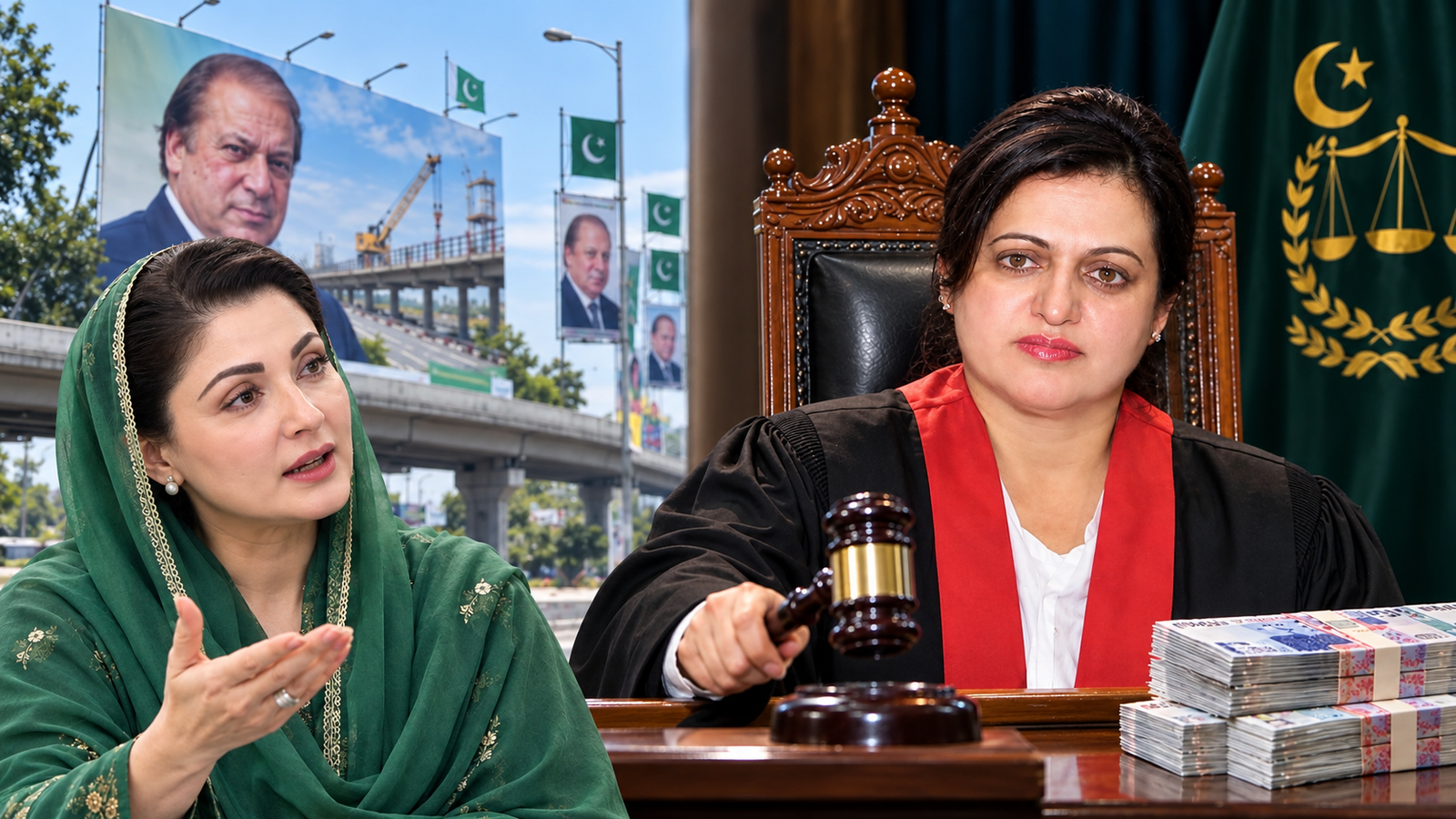
A Lahore High Court bench imposed Rs 100,000 costs on activist Ashba Kamran who filed a petition questioning why Nawaz Sharif’s photographs are displayed on Punjab government funded public projects.
A citizen, an activist, asked a simple and entirely legitimate question. Why are giant photographs of a private political figure being displayed on public hospitals and government projects funded by taxpayers’ money?
The Lahore High Court’s answer was to fine her Rs 100,000.
Ashba Kamran, a citizen activist, filed a petition in the Lahore High Court questioning the display of Nawaz Sharif’s photographs on Punjab government projects — public infrastructure built with government funds, not with the personal money of the Chief Minister or her father.
Her argument was straightforward, legally grounded and impossible to dismiss on its merits.
“All Punjab Government projects are sourced by government funds. Not by the CM or her father’s pockets. Then why are giant-sized pictures being displayed outside government hospitals and public buildings?”
It is the kind of question that a functioning accountability system should welcome, examine and answer transparently. It is the kind of question that Article 19-A of Pakistan’s Constitution — the right to information — exists to facilitate.
Instead, the Lahore High Court imposed a cost of Rs 100,000 on the petitioner, citing errors in her contempt petition and unnecessary use of judicial time.
The Question That Was Never Heard
The petition raised a constitutional and legal issue that goes to the heart of how public resources are used in Pakistan.
Government projects — hospitals, roads, schools, public buildings — are funded through taxation. Every Pakistani who pays taxes, buys goods subject to GST or contributes to the economy in any way is a co-funder of every government project in Punjab. Those projects belong to the public. They are not the personal achievements of any political leader, regardless of how prominently that leader’s photographs appear on their inauguration banners and perimeter walls.
The use of public money to display photographs of a private individual — even one who is the father of the sitting Chief Minister — on publicly funded infrastructure raises legitimate questions about the boundary between government communication and political advertising at the public’s expense.
These are not fringe questions. They are questions that courts in functioning democracies take seriously, examine carefully and answer clearly.
The Lahore High Court chose not to examine them at all. It chose instead to penalise the person who asked them.
Rs 100,000 Fine — What It Signals
The imposition of Rs 100,000 in costs on a citizen activist who filed a petition on a matter of clear public interest sends a message that extends far beyond this single case.
It signals that asking accountability questions about how public money is used can be personally expensive. It signals that procedural imperfection in a petition — something any lawyer can identify and exploit — is sufficient grounds to silence a public interest argument without ever examining its substance. And it signals that the judiciary in this instance chose to protect the powerful from scrutiny rather than protect a citizen’s right to ask questions of her government.
The court cited errors in the contempt petition and unnecessary use of judicial time. Errors in a petition are correctable. Judicial time is valuable. But the cure for a procedurally imperfect petition that raises genuine public interest questions is not a six-figure fine on the petitioner. It is guidance, correction and an invitation to refile properly.
The Photographs and the Principle
The specific issue Ashba Kamran raised is not trivial.
Across Punjab, government hospitals, infrastructure projects and public buildings carry enormous banners, hoardings and photographs of Nawaz Sharif — a private citizen who holds no current government position — alongside those of Chief Minister Maryam Nawaz.
There is a meaningful difference between a government communicating the achievements of its publicly funded projects to the public and a government using publicly funded projects as backdrops for the political promotion of a party and its leadership. The first is legitimate. The second is the use of public money for partisan political advertising.
The line between these two categories is precisely what Ashba Kamran asked the court to examine. She deserved a hearing. She received a fine.
A Judicial System That Needs to Answer Questions Too
Pakistan’s judiciary is not beyond accountability. Courts are public institutions. Judges are public servants. Judicial decisions — particularly those that penalise citizens for asking accountability questions — are themselves subject to public scrutiny and public comment.
The decision to fine Ashba Kamran Rs 100,000 for a procedurally imperfect petition rather than hear her public interest argument on its merits is a judicial decision that deserves to be examined, discussed and questioned.
A judiciary that protects citizens’ right to question power is an asset to any democracy. A judiciary that penalises citizens for exercising that right — however imperfectly — is something else entirely.
Ashba Kamran asked who is paying for those photographs. Pakistan deserves to know the answer. And it deserves a court system that helps it find out rather than charging it Rs 100,000 for asking.

