


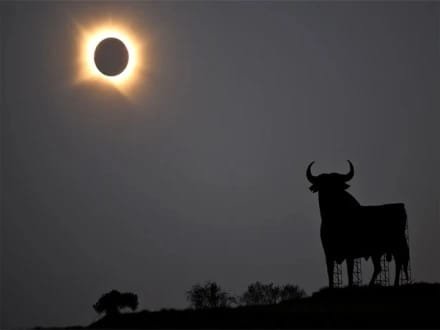
Europe witnesses its first total solar eclipse in over two decades as the Moon completely covers the Sun across Iceland, Spain and Greenland, stunning millions with sudden darkness and glowing corona.
Webdesk-Mediabites
What Happened on 12 August 2026
A total solar eclipse swept across parts of Europe on 12 August 2026, the first such event visible from mainland Europe in more than two decades. The Moon perfectly aligned between Earth and the Sun, casting a narrow path of total darkness over Greenland, Iceland, northern Spain and a small corner of Portugal. Outside this path, most of Europe experienced a deep partial eclipse.
Where Totality Was Visible
The path of totality began in remote northern Russia, crossed the Arctic, passed over Greenland and the western tip of Iceland, then reached northern Spain just before sunset. In Spain the shadow stretched from Galicia and Asturias through to the Balearic Islands. Maximum duration of totality reached about two minutes and 18 seconds over the North Atlantic near Iceland. In northern Spain the total phase lasted between one minute and one minute 50 seconds, depending on the exact location.
What Viewers Actually Saw
During totality the Sun’s bright disk vanished completely. Daylight collapsed into an eerie twilight within seconds. The Sun’s outer atmosphere — the corona — became clearly visible as a soft white and pinkish glow surrounding the black disk of the Moon. Temperatures dropped noticeably. Birds fell silent. In Spain the eclipse occurred near sunset, creating a dramatic combination of totality followed by a crescent Sun setting over the horizon.
Partial Eclipse Across the Rest of Europe
Most of the continent saw a deep partial eclipse. In the United Kingdom the Moon covered 90 to 96 percent of the Sun, the deepest partial eclipse visible from Britain since 1999. London recorded around 90–91 percent coverage, Cornwall closer to 95 percent. France, Ireland, Belgium, the Netherlands, Germany and Scandinavia also experienced strong partial phases. In many places the partially eclipsed Sun set while still partially covered, producing striking sunset views.
Why This Eclipse Mattered
Total solar eclipses are rare at any single location. The previous total eclipse visible from mainland western Europe occurred in 1999. The 2015 totality was limited to the Faroe Islands and Svalbard. This 2026 event therefore ranked as a once-in-a-generation spectacle for tens of millions of Europeans. An estimated 15 million people lived inside the path of totality, while hundreds of millions more could see a significant partial eclipse.
Crowds and Observation Sites
Northern Spain became the primary destination. Cities and towns along the path of totality, including areas near León, Burgos, Zaragoza and the northern coast, attracted large numbers of astronomers, photographers and tourists. Iceland’s western coast and cruise ships off Greenland also hosted dedicated viewing groups. Many observers used certified solar eclipse glasses. Experts repeatedly warned that ordinary sunglasses, phone cameras or homemade filters are not safe and can cause permanent eye damage.
Scientific and Observational Interest
The European Space Agency and NASA tracked the event closely. Instruments on the Solar Orbiter spacecraft collected data on the solar corona during the eclipse window. Ground-based observers documented the corona’s structure, solar prominences and the rapid changes in ambient light and temperature. The short duration of totality and the low altitude of the Sun in Spain created unique photographic challenges and opportunities.
Bonus Celestial Event
The same night the annual Perseid meteor shower reached its peak. Clear, dark skies after the eclipse allowed many people to watch both the solar spectacle and a strong display of shooting stars within a 24-hour period. Astronomers described the combination as an unusually rich window for skywatchers.
Safety and Viewing Guidance
Proper ISO-certified solar eclipse glasses remained essential whenever any part of the Sun’s bright surface was visible. During the brief total phase only, when the Moon completely covered the Sun, it was safe to look with the naked eye. Partial phases required continuous protection. Authorities and astronomy groups distributed warnings in multiple languages across Europe in the days leading up to the event.
Historical Context
Total solar eclipses occur somewhere on Earth roughly every 18 months on average, yet any given location waits decades or centuries between totalities. The 12 August 2026 eclipse belonged to Saros cycle 126. Its path favoured high latitudes and therefore produced relatively short totality. Future eclipses will offer longer durations in different regions, including a highly anticipated event in Spain in 2027.
Public Reaction and Coverage
Millions paused daily activities to watch. Beaches, mountain viewpoints, city rooftops and observatories filled with people wearing eclipse glasses. Social media and news outlets filled with images of the corona, diamond-ring effects and crowds reacting as darkness fell. The event generated extensive live coverage from national broadcasters and international agencies.
Key Takeaways for Future Eclipses
Clear skies, proper eye protection and a location inside or near the path of totality remain the three decisive factors. Weather proved mixed in some areas, with clouds affecting Iceland and parts of northern Spain, while other sites enjoyed excellent views. Planning travel, checking local forecasts and using reliable eclipse maps proved essential for those who travelled specifically for the event.
This rare alignment of Sun, Moon and Earth delivered one of the most widely observed astronomical events of 2026 across Europe, combining scientific value with a shared moment of collective wonder.


1 Comment
[9641]rongho99 | Link vào cổng game slots nổ hũ và baccarat,Truy cập rongho99 để trải nghiệm sảnh baccarat online hấp dẫn, tải app rongho99 tiện lợi và nạp tiền casino qua momo nhanh chóng. Tham gia ngay hôm nay! visit: rongho99