


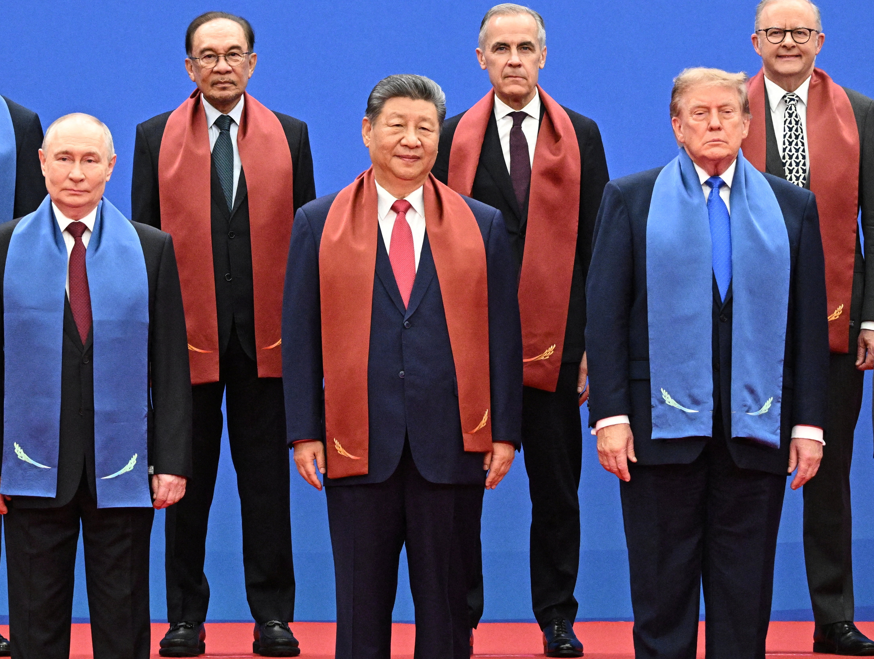
Trump told the APEC summit in Shenzhen that the US will not allow robust AI regulation, calling the technology almost completely good, ahead of talks with Xi and Putin.
WEBDESK – MEDIABITES
US President Donald Trump told the Asia-Pacific Economic Cooperation (APEC) summit in Shenzhen on Thursday that Washington opposes robust AI regulation and “won’t allow that to happen,” Reuters reported. He spoke ahead of an unprecedented trilateral meeting with Chinese President Xi Jinping and Russian President Vladimir Putin.
Trump backs AI, rejects tight rules
Trump told the gathering that the United States has been a Pacific power for hundreds of years. He said Washington will keep promoting growth, stability and peace across the region, and that he is looking forward to meeting Xi and Putin.
Trump called AI “super intelligence,” the term his administration prefers, and described the technology as “almost completely good.” He said its bad elements need careful management, but added that the US opposes any robust regulation that would stifle it.
Xi pushes open trade
Xi used his speech to criticize trade protectionism. He called for free and open trade and a fair, non-discriminatory environment for cooperation.
He said China would give $20 million to support practical cooperation within APEC and would set up an Asia-Pacific Community Research Center in Shenzhen. Xi also urged closer regional cooperation on green development, digital technology, cross-border data flows, clean energy and small businesses.
Putin returns to center stage
Putin criticized Western sanctions and invited regional partners to use Russia’s logistics infrastructure, saying some already do. He said Russia contributes to regional security and that partners “can always count on” Moscow.
His appearance next to Trump and Xi puts the Russian leader back at the center of a major diplomatic gathering, despite the war in Ukraine and Russia’s strained ties with Western governments.
About APEC
APEC was founded in Canberra in 1989 as an informal 12-member dialogue. It now has 21 member economies, which together account for about 62% of global GDP and roughly half of world trade. Its commitments are non-binding and reached by consensus.
Based on Reuters live reporting by Kay Johnson, Lioman Lima, Neha Mustafi, and Christine Chen.

