


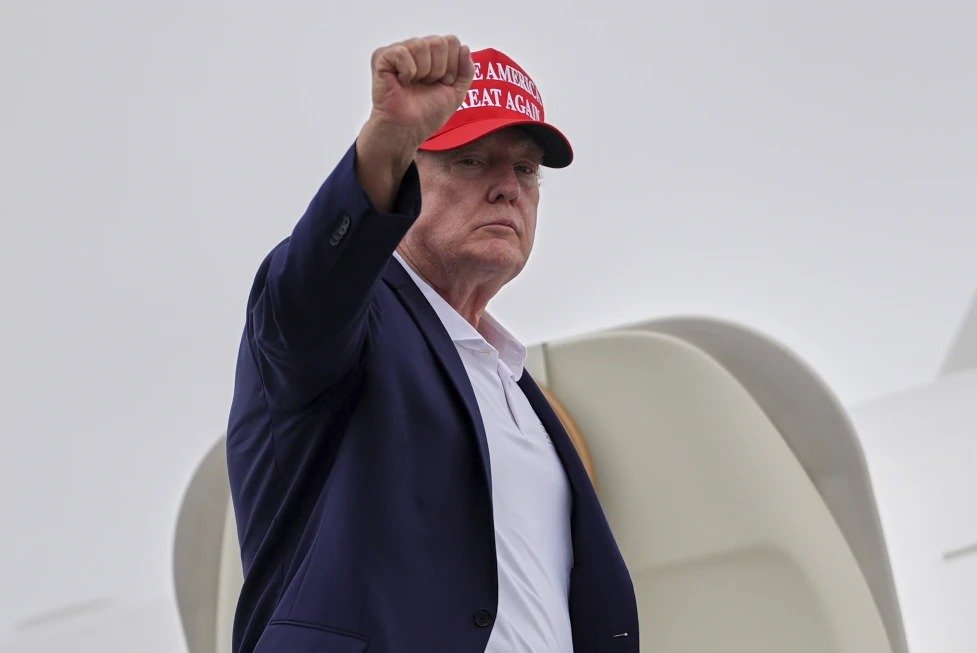
President Trump orders Pentagon to substantially reduce joint military exercises with South Korea, citing costs, his strong ties with Kim Jong Un, and Seoul’s refusal to join Iran denuclearization efforts.
webdesk. Madiha Bhatti
Trump’s Sudden Directive
US President Donald Trump has instructed the Pentagon to “substantially reduce” the scale of annual joint military exercises with South Korea. The order came on Sunday via a Truth Social post, just hours before the Ulchi Freedom Shield drills were set to begin on Monday. Trump said it was too late to cancel the exercises entirely but made clear he was “not happy” that the United States had previously agreed to take part.
The 11-day exercises, involving roughly 18,000 South Korean troops alongside US forces, are designed to strengthen combined readiness against North Korean threats. They typically include live field training, computer-simulated command post exercises, and scenarios covering drones, GPS jamming, cyberattacks, precision targeting, and wet-gap crossings.
Cost, Signals, and a Personal Relationship
Trump framed the decision around two main points. First, he called the drills costly, noting that the United States pays a large share of the expenses “as usual.” Second, he argued that the exercises send “a signal that is totally inappropriate and hostile” to North Korea. He emphasized his “very good relationship” with North Korean leader Kim Jong Un and described Pyongyang as having been “unthreatening and respectful” throughout his current presidency.
“Based on my very good relationship with Kim Jong Un, of North Korea, I am not happy with the fact that the United States has, long ago, agreed to participate in Joint Military Exercises with South Korea,” Trump wrote. He directed Defense Secretary Pete Hegseth to implement the reduction.
The Iran Connection
In the same post, Trump linked the decision with a parenthetical “somewhat unrelated (?)” to South Korea’s response on Iran. He said he had recently asked the South Korean president whether Seoul would join US efforts toward the “Denuclearization of the Islamic Republic of Iran,” and received a “No thanks!” reply. The remark placed alliance burden-sharing and broader geopolitical alignment alongside the traditional focus on the Korean Peninsula.
Exercises Proceed Amid Uncertainty
South Korean military authorities confirmed that Ulchi Freedom Shield began as scheduled. Officials indicated no formal request from Washington to alter the scale had been received at the time of initial reports. The drills had been planned at a level similar to recent years and were intended to incorporate lessons from recent conflicts, including North Korea’s deployment of troops to support Russia in Ukraine and the evolving use of unmanned systems and electronic warfare.
North Korea has long condemned the joint exercises as rehearsals for invasion. In the days leading up to the drills, Pyongyang conducted ballistic missile tests banned under United Nations resolutions and issued warnings of “stern steps” against what it called aggressive war preparations.
Historical Echoes and Alliance Questions
The order revives a pattern from Trump’s first term, when the United States and South Korea suspended or significantly scaled back major joint exercises amid diplomatic outreach to North Korea. Those earlier reductions were also justified on cost and *provocative* grounds. Critics at the time and now argue that reduced training can weaken interoperability, slow South Korea’s progress toward greater defense self-reliance, and erode deterrence on the peninsula.
Supporters of the move view it as consistent with Trump’s preference for personal diplomacy with Kim and his long-standing skepticism of expensive overseas commitments. The timing — coming after North Korea’s recent missile activity and amid heightened regional tensions involving Iran — has intensified debate over whether the reduction strengthens or complicates the US-South Korea alliance.
Broader Strategic Context
Approximately 28,500 US troops remain stationed in South Korea as a core element of the mutual defense treaty. Joint exercises have for decades served as both practical training and a visible demonstration of alliance resolve. Scaling them back while keeping the formal structure intact leaves open questions about the precise adjustments: fewer troops, shorter duration, reduced live-fire components, or scaled computer simulations.
South Korea’s defense and foreign ministries did not immediately issue detailed public responses beyond confirming the drills would proceed. Opposition voices in Seoul have raised concerns about alliance management and the potential long-term impact on readiness. In Washington, some lawmakers described the reduction as shortsighted given North Korea’s advancing capabilities and its military cooperation with Russia.
What Comes Next Implementation details
from the Pentagon remain limited. The exercises will continue in some form through August 27, but the *substantial* reduction ordered by Trump is expected to reshape their scope. Analysts will watch closely for any corresponding signals from Pyongyang, further statements from Seoul, and whether the adjustment becomes a template for future years.
The decision underscores the tension between alliance traditionalists who prioritize robust combined training and a presidential approach that prioritizes cost, personal diplomacy with North Korea, and expectations of broader strategic alignment from partners. As the reduced Ulchi Freedom Shield unfolds, both the practical military effects and the diplomatic reverberations across Northeast Asia will become clearer.


1 Comment
Howdy would you mind stating which blog platform you’re working with? I’m looking to start my own blog in the near future but I’m having a hard time choosing between BlogEngine/Wordpress/B2evolution and Drupal. The reason I ask is because your design and style seems different then most blogs and I’m looking for something completely unique. P.S Sorry for being off-topic but I had to ask!