


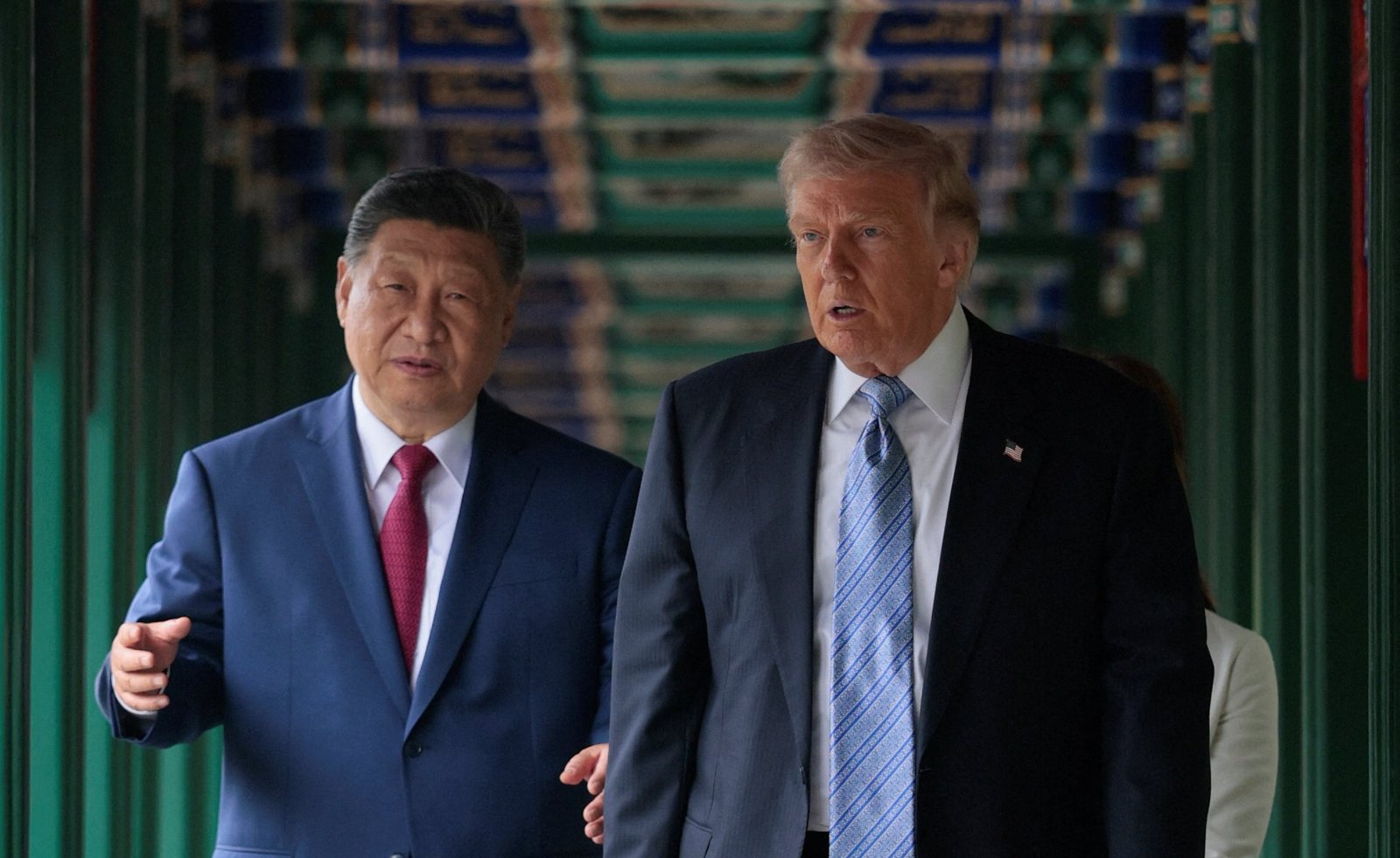
Donald Trump says Chinese President Xi Jinping offered to help broker peace with Iran during high-stakes Beijing talks that also exposed growing tensions over Taiwan and global security.
WebDesk – MediaBites News
US President Donald Trump revealed that Chinese President Xi Jinping offered to help broker a peace deal with Iran during a closely watched summit in Beijing that focused on stabilizing increasingly fragile US-China relations.
The announcement came as Trump wrapped up a major visit to China, where both leaders attempted to project optimism despite serious disagreements over Taiwan, trade, military tensions, and the Middle East.
Speaking after the talks, Trump described his meetings with Xi as “extremely positive and productive,” insisting relations between Washington and Beijing were “good and getting better.”
In an interview with Fox News, Trump disclosed that Xi had shown willingness to support efforts aimed at ending the escalating Iran conflict, which has rattled global energy markets and heightened fears of wider regional instability.
“We feel very similar about how we want it to end,” Trump said alongside Xi. “We don’t want them to have a nuclear weapon.”
According to White House officials, both leaders also agreed on the importance of keeping the Strait of Hormuz open, the critical oil shipping route heavily affected by the Iran crisis earlier this year.
China, which remains Iran’s largest trading partner and heavily depends on Gulf energy supplies, holds considerable economic influence over Tehran despite publicly criticizing US and Israeli military actions in the region.
The Beijing summit blended carefully staged diplomacy with visible geopolitical friction.
Xi personally hosted Trump at the Zhongnanhai leadership compound, where the two leaders reportedly walked through historic gardens and held lengthy private discussions over tea before formal meetings and lunch sessions.
Trump praised Xi as “warm” and “all business,” while Chinese state media described the summit as bringing “stability” to a turbulent international environment.
However, Taiwan emerged as one of the summit’s most sensitive flashpoints.
Chinese officials said Xi warned Trump that mishandling Taiwan could push both countries toward “clashes and even conflicts,” reflecting Beijing’s growing alarm over the expansion of US military support for the self-governed island.
China considers Taiwan part of its territory and has repeatedly vowed to reunify the island with the mainland, refusing to rule out the use of force.
The United States, while officially recognizing the “One China” policy, continues to maintain close unofficial ties with Taiwan and has significantly increased defense cooperation with Taipei in recent years.
An $11 billion US weapons package for Taiwan announced during the Trump administration remains a major source of tension between the two powers.
US Secretary of State Marco Rubio reiterated during the trip that Washington’s Taiwan policy had not changed, while warning China it would be “a terrible mistake” to attempt to take Taiwan by force.
The summit also addressed economic cooperation, artificial intelligence, fentanyl trafficking, and broader security coordination.
Analysts say the visit highlighted the increasingly complicated nature of US-China relations, where economic interdependence coexists with deep strategic rivalry.
Trump’s Beijing trip marked the first state visit by a sitting US president to China in nearly a decade and came at a time when both powers are trying to avoid deeper confrontation amid global economic uncertainty and escalating geopolitical crises.


1 Comment
Pingback: xüm tablets | plur beyond molly | buy xum plur | plur tablets | plur gummies | beyond molly | xum beyond shrooms | plur xum | xum community pack | xum wholesale | xum plur for sale |