


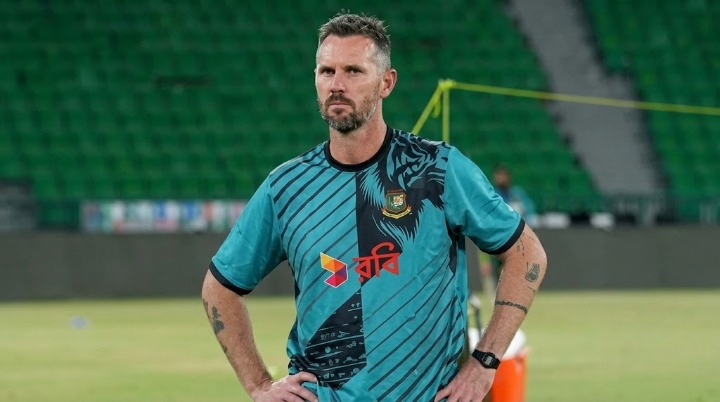
Shaun Tait has resigned as Bangladesh fast bowling coach, ending his tenure unexpectedly. The move raises concerns over coaching stability and future pace development plans.
WEBDESK – UzGul – MEDIABITES NEWS
Former Australia fast bowler Shaun Tait has stepped down as Bangladesh’s fast bowling coach, ending his role earlier than expected. The sudden resignation has sparked widespread discussion in cricket circles about Bangladesh’s coaching stability and long-term pace development plans.
The decision comes at a sensitive time for Bangladesh cricket, which has been working to strengthen its fast-bowling unit ahead of major international assignments.
Officials are now expected to reassess their coaching structure as the team continues its rebuilding phase.
Sudden Exit Shocks Bangladesh Cricket Setup
Tait’s departure was not anticipated, making it a surprise development within the Bangladesh cricket system. He had been actively involved with the national team’s pace bowlers, focusing on skill development and consistency.
His role included mentoring young fast bowlers, improving control in death overs, and helping the team adapt to different playing conditions.
Although the exact reason for his resignation has not been fully detailed, the timing has raised questions about internal planning and coaching dynamics.
Focus on Fast Bowling Development
Bangladesh has historically relied more on spin bowling, but in recent years, there has been a clear push to develop a stronger pace attack.
Tait’s appointment was part of that long-term strategy. Known for his raw pace during his playing career, he was expected to instill aggression and technical refinement in emerging fast bowlers.
The coaching plan also included preparing bowlers for overseas conditions, where pace and bounce play a more significant role.
However, results in this department have remained inconsistent, which may have contributed to broader discussions about coaching direction.
Pakistan Angle: Regional Coaching Trends in Focus
Tait’s coaching experience is not limited to Bangladesh. He has also worked with Pakistan’s fast bowlers in the past, giving him exposure to similar subcontinental cricket challenges.
Pakistan, like Bangladesh, has repeatedly rotated fast-bowling coaches in search of long-term consistency and improved performance.
This regional pattern highlights a broader issue: while talent exists, maintaining stability in coaching roles remains a challenge across South Asian cricket boards.
Analysts often point out that frequent changes in specialist coaching positions can disrupt player development and long-term planning.
Internal Challenges and Strategic Questions
Bangladesh cricket has undergone several coaching changes in recent years, particularly in specialized roles such as batting and fast bowling coaches.
While the team has shown improvement in limited-overs cricket, consistency in Test and overseas performances continues to be a concern.
Tait’s exit now adds another layer of uncertainty to the team’s support structure.
Cricket experts believe that continuity is essential for building a competitive fast-bowling unit capable of performing in varied conditions.
What Shaun Tait Brought to the Role
As a player, Shaun Tait was known for his extreme pace, often exceeding 150 km/h, making him one of Australia’s most intimidating fast bowlers.
In his coaching role, he attempted to bring that aggressive mindset into Bangladesh’s system, focusing on pace generation, fitness, and tactical awareness.
He also worked closely with younger bowlers to help them improve control under pressure situations.
Despite these efforts, Bangladesh’s fast-bowling performances remained uneven, with occasional bright spells but a lack of sustained dominance.
Coaching Stability Becomes Key Issue
The resignation once again highlights Bangladesh’s ongoing struggle with maintaining stability in its coaching staff.
Frequent changes often force players to adapt to new systems, techniques, and philosophies within short periods.
This can slow down long-term development, especially for fast bowlers who require consistent technical guidance.
Cricket analysts suggest that building a stable coaching environment could be as important as selecting the right players.
What Happens Next for Bangladesh?
The Bangladesh Cricket Board is now expected to search for a replacement fast bowling coach.
The next appointment will likely focus on someone with strong international experience and familiarity with subcontinental playing conditions.
The team is also preparing for upcoming series where fast bowling performance will be under close scrutiny.
Until then, interim arrangements may be put in place to ensure continuity in training and preparation.
Bigger Picture for International Cricket
Tait’s resignation reflects a wider trend in modern cricket, where coaching roles are becoming increasingly short-term and performance-driven.
Teams around the world continue to experiment with different coaching setups in pursuit of immediate results.
However, experts warn that constant changes can hinder long-term player development and team identity.
For Bangladesh, the challenge now is to restore stability while continuing their efforts to strengthen the pace bowling department for future competitions.


4 Comments
Theo mình thấy thì nhà cái fly88 có nhiều nội dung giải trí khá đa dạng.
Pingback: Filmmaker dies of ‘sadness’ at 56 - Media Bites
Pingback: eating disorder therapist san diego
Pingback: สมหวัง168 เว็บหวยออนไลน์มาแรง