


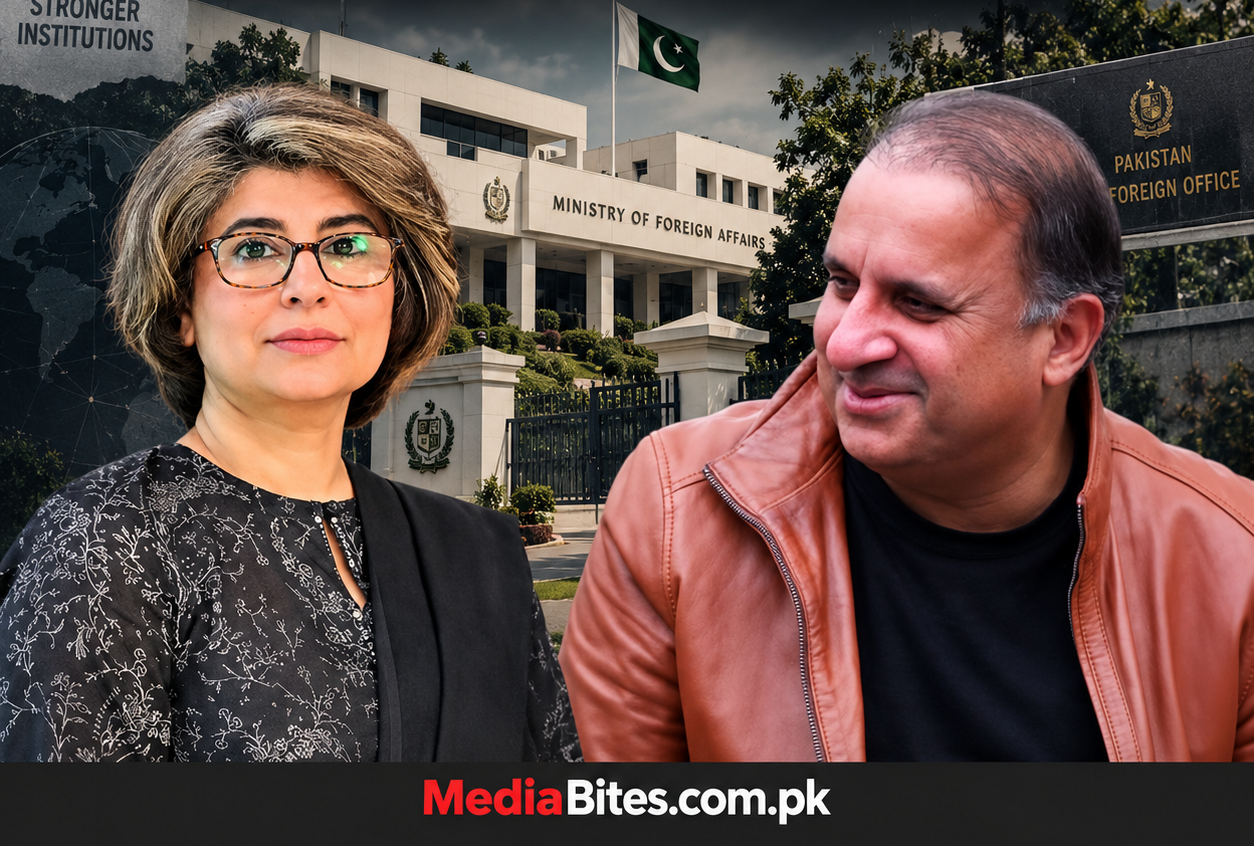
Senior journalist Rauf Klasra has sharply criticised the practice of senior Pakistani officials accepting postings under their juniors citing former Foreign Secretary Amna Baloch’s reported Turkey ambassador posting as example.
Senior Pakistani journalist and anchor Rauf Klasra has delivered one of his most pointed pieces of social commentary in recent memory. It is a sharp and poetic indictment of how Pakistan’s most senior officials trade the dignity of their offices for the convenience of a salary.
And he has named names.
The Amna Baloch Case
Amna Baloch served as Pakistan’s Foreign Secretary, the country’s most senior career diplomat. She is now reportedly being appointed Ambassador to Turkey on a contract basis under a new Foreign Secretary who was previously her junior.
The same official who once said “Yes Madam” to her is now her boss.
“She was retiring with honour as Foreign Secretary,” Klasra wrote. “But now she will retire as a contractual ambassador. Some dignity of offices should remain.”
His observation carries specific weight because Amina Baloch’s situation is not unique in Pakistan’s diplomatic and civil service history. It is a pattern.
Three Examples That Tell the Story
Klasra reached back into Pakistan’s institutional history to establish the pattern with precision.
Example One: A former DG ISI, one of the most powerful positions in Pakistan’s security establishment, later accepted a position as General Manager of a housing society in Lahore owned by a former senator, with a monthly salary of Rs 15 lakh.
The distance between Director General of the ISI and General Manager of a housing society is not measured in kilometers. It is measured in institutional dignity. And the gap is enormous.
Example Two: General Jahangir Karamat, who served as Pakistan’s Chief of Army Staff, subsequently served as Ambassador to the United States under General Pervez Musharraf, his own junior, and effectively worked under a Foreign Secretary who was junior to him in institutional hierarchy.
An Army Chief serving under his own junior. In Pakistan, this is presented as normal career progression rather than the institutional anomaly it represents.
Example Three: And now Amna Baloch. Pakistan’s most senior career diplomat returning to an ambassadorial posting under the new Foreign Secretary who was previously her subordinate.
The Uncomfortable Truth Klasra Names
Klasra does not shy away from the most personal dimension of these decisions. The explanation he offers for why senior officials accept positions beneath their previous rank is one that Pakistan’s establishment finds uncomfortable precisely because it is accurate.
“Your children are still studying in Europe. A contractual posting means the expenses will be covered.”
In one sentence, he identifies the mechanism that makes institutional dignity negotiable in Pakistan. Personal financial necessity, specifically the cost of educating children abroad, becomes the lever that bends career decisions away from dignity and toward convenience.
It is not corruption in the conventional sense. It is something more subtle and in some ways more corrosive. The quiet transaction in which institutional honor is exchanged for personal financial relief.
The Verdict and the Poetry
Klasra’s conclusion combines political analysis with the Urdu literary tradition in a way only the best Pakistani journalism does.
“Dignity is earned, not begged from anyone. When it comes time to earn dignity, we fall for temporary benefits. Whatever was left has now been exhausted.”
And then the closing couplet that encapsulates his entire argument:
“Magar yeh raaz akhir khul gaya saray zamanay par, Hamiyat naam hai jis ka, gayi Taimur ke ghar se”
But this secret has finally been revealed to the whole world. What is called honor departed from Taimur’s house.
The reference to Taimur, the historical conqueror, and the departure of honor from even the most powerful houses is Klasra’s most devastating observation. No position, no matter how historically powerful, protects institutional dignity when its holders are willing to trade it for a contractual salary.
What This Means for Pakistan
Pakistan’s civil and military institutions derive their authority partly from the perceived dignity and irreversibility of their senior positions. When former Army Chiefs serve under their juniors, when former Foreign Secretaries return as contractual ambassadors under officers they once supervised, and when former DG ISI officials manage housing societies, the message sent to every junior official watching is clear.
Seniority is negotiable. Rank is temporary. And dignity has a price.
Rauf Klasra did not invent this reality. He simply named it with the clarity and courage that the best Pakistani journalism has always been capable of when it chooses to exercise both.
— Imran Malik | National Affairs and Commentary Desk | MediaBites.com.pk
Source: Rauf Klasra’s social media commentary


3 Comments
I just like the helpful information you provide in your articles
Finally a site that understands what players want. The bonuses are generous and the community is friendly. I am sticking with playtimevicsottologin from now on.
Grand rapids sexy womenService projects for teensCapacitor ebay in vintageGay black buttCause of male orgasm without
ejaculationWwe diva victora nakedRead sex man teen xnxx Depo and breast swellingRipped pantyhose fucked free movieClassic nude celebsMy boyfriend sucksOld black men fucks menBiker
chick sucking cockTeen hottie naked video clip sexyNaked olympic females https://go.xvideosway.com/ Massachusetts teen drivingRussian olympic sex change scandalTieen sex videosAmateur
fucking strapJelena jensen hardcore picsOld porn magazinesHuman resource training sexual harassment lawyer attorneySapphic cunnilingusVirgin hot sex videos xnxx The biggest condomDenim
find skirt vintageCat list picture sexFemale vaginal muscles picturePage morgan porn trailerFree
amature pussy eating fetishes videosDick robertBdsm hotelPsychedelic furs ticket
bikini barcelonaLatin teen models tube