


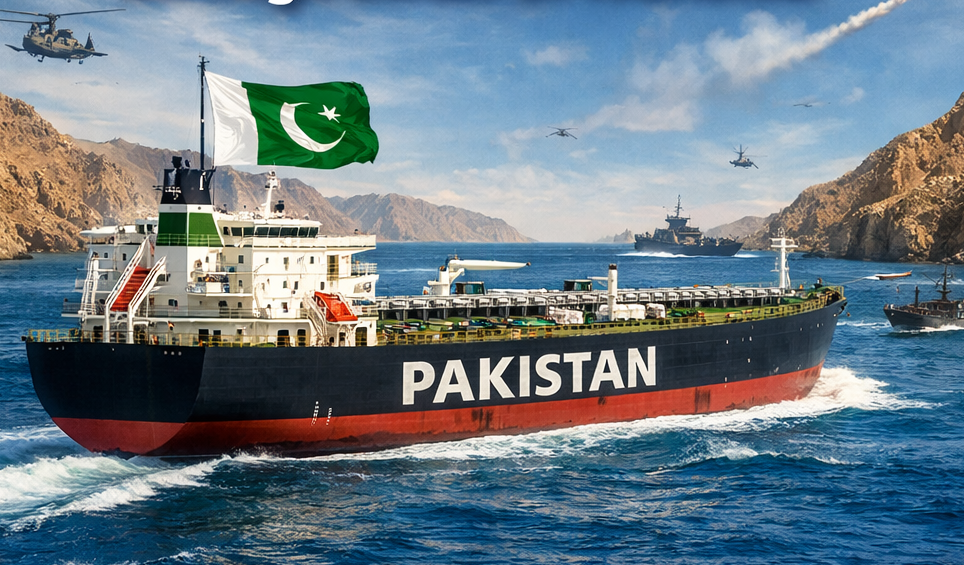
Pakistan’s oil tanker Shalamar completes a rare Hormuz crossing despite a US blockade, highlighting rising global risks and Pakistan’s strategic role in a tightening energy crisis.
Dubai, April 17, 2026
In a high-stakes maritime breakthrough, a Pakistan-flagged oil tanker has successfully navigated its way out of the heavily militarised Strait of Hormuz, emerging as one of the very few vessels to defy the ongoing US blockade and carry crude out of the Gulf.
The Aframax tanker Shalamar, operated by Pakistan National Shipping Corporation, exited into the Gulf of Oman late Thursday after loading around 450,000 barrels of crude from Das Island in the United Arab Emirates. The vessel is now en route to Karachi, marking a rare and strategically significant voyage.
Pakistan’s bold passage amid near shutdown
At a time when global shipping giants are backing off and oil routes are nearly frozen, Pakistan’s tanker has managed what many others could not — a clean entry and exit through one of the world’s most dangerous and tightly controlled chokepoints.
Traffic through Hormuz — which normally carries about 20% of global oil — has collapsed to a trickle since the conflict escalated and the blockade was enforced by Donald Trump. In recent days, most vessels have either aborted journeys or turned back midway.
US Central Command confirmed that multiple ships have reversed course, underscoring the caution gripping global shipping lines.
Double clearance, double risk
The stakes are now unprecedented. Ships must secure approval from both Washington and Tehran — a complex, high-risk process that has slowed oil movement to near paralysis.
Against this backdrop, Shalamar’s swift turnaround — entering, loading, and exiting within days — stands out as a rare operational success.
The tanker had initially pulled back earlier this week when US-Iran talks faltered, reflecting the uncertainty dominating the region. But its eventual successful passage signals calculated risk-taking and operational agility.
Oil supply squeeze intensifies
Before the blockade, Iran was exporting nearly 1.7 million barrels per day. Those flows have now largely dried up, tightening global supply and pushing markets into volatility.
The blockade zone now stretches from Oman’s Ras al Hadd to the Iran-Pakistan maritime boundary — effectively placing one of the world’s busiest energy corridors under strict military oversight.
Why this matters for Pakistan
For Pakistan, this is more than just another shipment — it is a strategic signal.
At a time when global energy routes are under pressure, Pakistan-linked shipping has demonstrated it can still operate in contested waters, potentially giving Islamabad an edge in regional energy logistics.
Global ripple effects
Energy experts warn that if tensions persist, the disruption could trigger a wider supply shock — driving up fuel prices, increasing freight costs and impacting economies worldwide.
For now, the Shalamar’s journey stands as a rare success story in an otherwise frozen corridor — a reminder that even in crisis, calculated moves can still keep vital energy supplies moving.


1 Comment
I’ve been absent for a while, but now I remember why I used to love this website. Thanks , I’ll try and check back more often. How frequently you update your web site?