


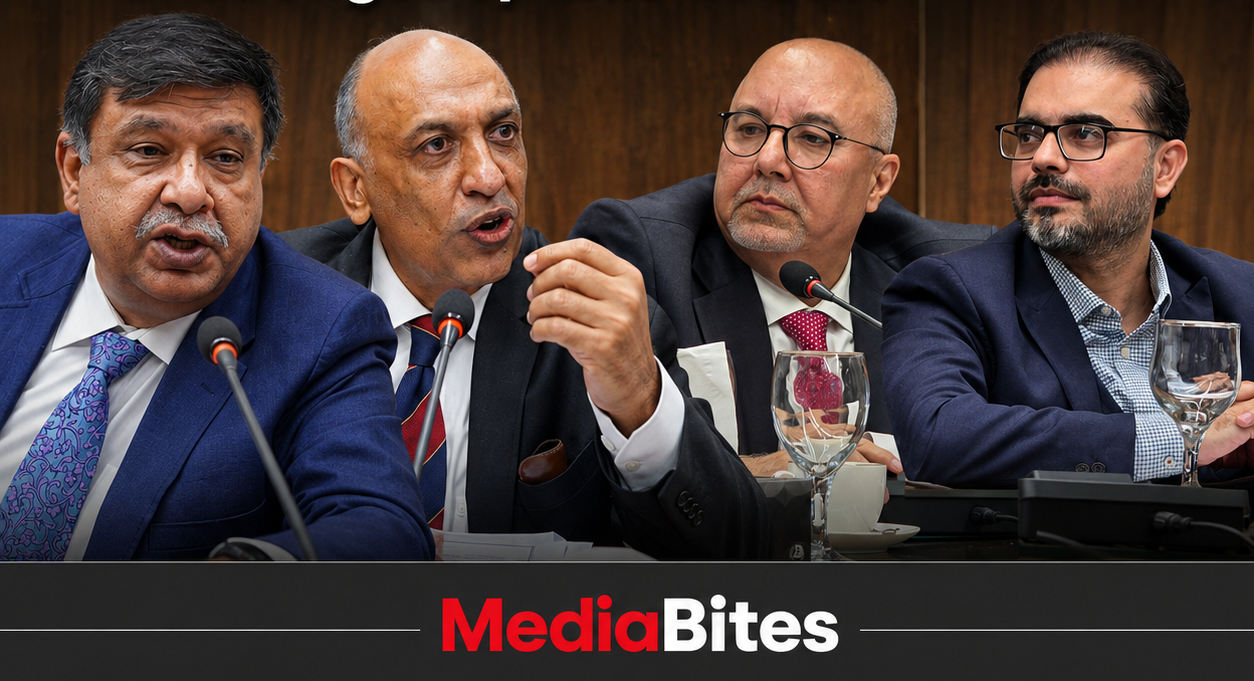
An LCCI discussion on “Investment Challenges in Pakistan” turned into a lively and sometimes heated debate on SMEs, exports, government policies and economic realities, with businessmen openly criticizing institutions and demanding practical solutions instead of lengthy speeches.
BY IMRAN MALIK – MediaBites Special Report
An invitation from Lahore’s energetic media personality, Amer Salam Malik, pulled this writer out of “event laziness” mode despite the daily torture of traveling through the under-construction Main Barki Road — a road that, thanks to the “excellent planning” of the Lahore Development Authority (LDA), currently looks more like a post-war excavation site than a functioning city road.
Still, after Amer’s reminder, attending the session at Zubeida Hall on “Investment Challenges in Pakistan” proved worthwhile.
Arriving on time, guests were warmly welcomed by the always humble and active Amer Salam Malik. And honestly, attending his event without taking a picture with him feels incomplete.
Within 45 minutes, the hall was packed with Lahore’s business community, entrepreneurs, and professionals. The panel featured Shehzad Raza Makki, COO of Mezan International Foods, Shahid Malik, Regional Head SME at Bank Alfalah, and Barrister Hassan Nawaz, Head of Chambers at Hassan Law Chambers. Senior journalist Zahid S. Malik moderated the discussion, while Tanveer Ahmed Sheikh, Senior Vice President of the Lahore Chamber of Commerce and Industry (LCCI), attended as Chief Guest.
Following the recitation of the Holy Quran and the national anthem, Tanveer Ahmed Sheikh began what was expected to be a keynote address. However, the speech quickly evolved into a full-scale analytical presentation covering foreign direct investment, speculation markets, the undocumented economy, import duties, unemployment, energy policy, and government priorities.
The speech was detailed, data-heavy, and thought-provoking — but it also unintentionally shifted the entire direction of the session. Instead of focusing on “Investment Challenges in Pakistan and the Way Forward,” the discussion gradually shifted toward SMEs and small-business survival strategies.
Except for Mezan International Foods’ Shehzad Makki, the remaining panelists largely focused on SME-related challenges and opportunities.
At one point, several businessmen interrupted even before the formal Q&A session started. Some openly questioned LCCI’s influence over government institutions, while one participant bluntly remarked that there was little benefit in inviting representatives from multinational companies, banks or large corporations when officials from the State Bank or Ministry of Commerce would have been more relevant for practical policy discussions.
The discussion frequently drifted away from the original topic, leaving many attendees without clear answers on Pakistan’s broader investment roadmap.
Having recently attended the Online News Association’s Digital Media Congress in Chicago, where nearly 18 panel discussions were conducted over three days, the contrast in structure was impossible to ignore.
In international conferences, moderators usually spend only a few minutes introducing speakers before quickly moving into focused discussion points. Each question is answered equally by all panelists, followed by concise concluding remarks.
At the LCCI session, however, lengthy speeches dominated the discussion, leaving little room for balanced interaction or structured debate.
A simple suggestion for future sessions: shorter moderator introductions, timed responses from speakers, focused themes, and stronger audience engagement.
Despite the organizational issues, several comments during the session stood out.
Businessman Rana Sohail Ahmed stressed the importance of exploring global business opportunities and revealed ongoing efforts to connect Pakistan’s business community with Senegal’s Chamber of Commerce for mutual cooperation.
Ms. Ashba Kamran shared an interesting personal example, explaining how her children chose technical training and entrepreneurship after O-Levels and A-Levels, rather than pursuing traditional four-year degrees.
Moderator Zahid S. Malik presented eye-opening export figures, highlighting that Pakistan’s exports had declined by 7% in the past nine months. He also pointed out that Pakistan and Turkey had similar export figures of around $3 billion in the 1980s, while Turkey’s exports have now surged to nearly $273 billion in 2026 compared to Pakistan’s stagnant $50–60 billion range.
Another participant suggested that all SME-related departments should operate under a single umbrella institution to improve coordination and efficiency.
Tanveer Ahmed Sheikh defended LCCI by saying the chamber acts like “Hyde Park,” where businessmen are encouraged to openly criticize institutions and government policies.
Meanwhile, Shehzad Makki perhaps delivered the session’s strongest line: “SMEs are our survival.”
He emphasized that real change must come from within the business community itself instead of constantly waiting for government policy shifts.
Shahid Malik of Bank Alfalah spoke from the heart, saying that society has become increasingly selfish, with people focusing only on their own interests rather than thinking about the industry as a whole. He remarked that “big fish eat the small fish,” highlighting the challenges faced by smaller businesses.
He also categorically clarified that there is a common myth that banks do not grant loans against the pledge or guarantee of plots, land or other assets. According to him, banks are now providing loans without much of the traditional red tape associated with such financing.
Interestingly, despite wanting to ask detailed questions about Mezan’s business strategies, the flow of discussion never created the right opening. A question for Bank Alfalah’s Shahid Malik, however, was successfully shared on a small chit during the session, and to his credit, he responded warmly and even shared his contact number for future discussions.
The snacks were good, the networking lively, and the final group photographs brought smiles back after an intense debate-filled evening.
The session may not have delivered a concrete roadmap for solving Pakistan’s investment crisis, but it certainly exposed the frustration, confusion, and urgency felt by the country’s business community.
And perhaps that, in itself, was the real story of the evening.


2 Comments
Pingback: Another LCCI evening, another packed session despite Lahore’s scorching heat - Media Bites
Can I just say what a relief to find someone who actually knows what theyre talking about on the internet. You definitely know how to bring an issue to light and make it important. More people need to read this and understand this side of the story. I cant believe youre not more popular because you definitely have the gift.