


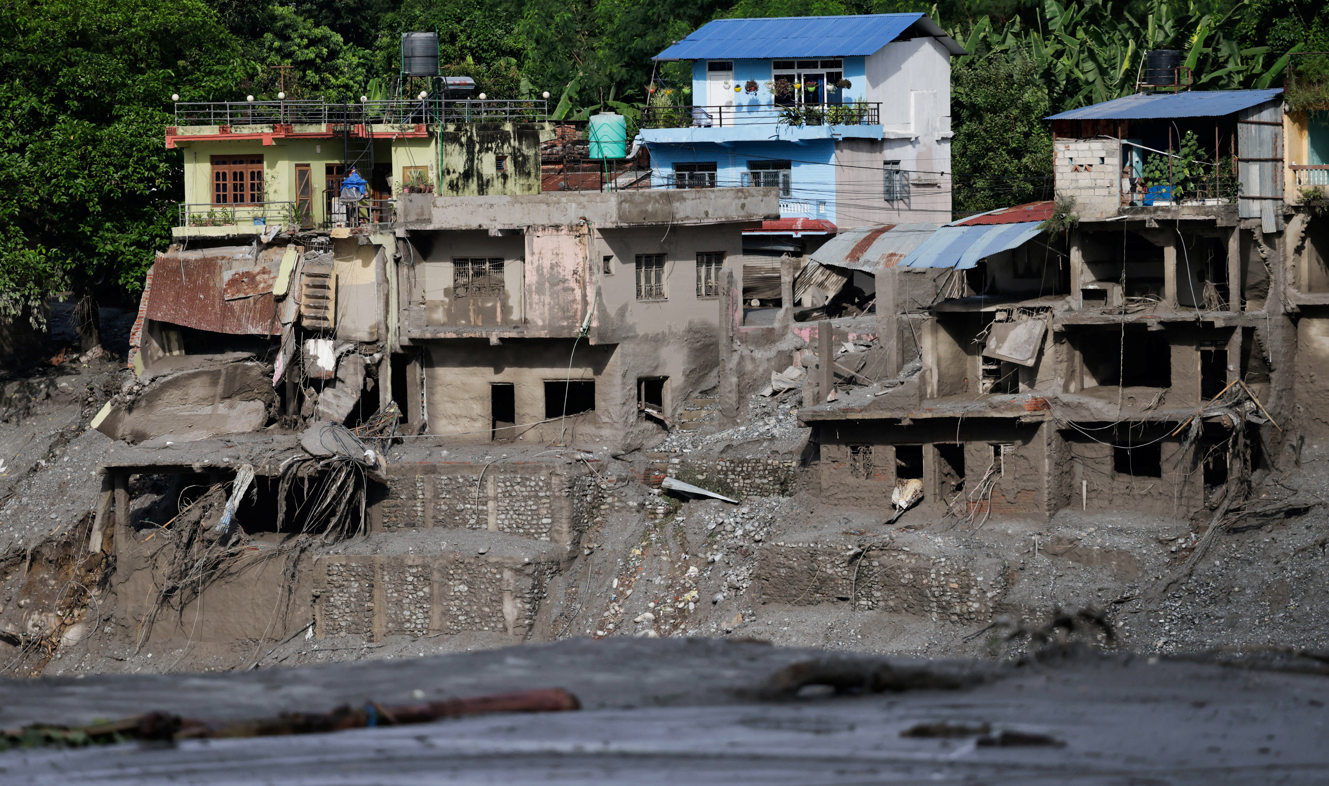
Nearly 1,500 people including hundreds of foreign nationals are missing after a massive Himalayan flood of mud rocks and water tore through Nepal and China’s Tibet killing at least 165 and stranding pilgrims and tourists.
By Imran Malik | World Affairs Desk | MediaBites.com.pk | SharjahNews.ae
One of the most devastating natural disasters to strike the Himalayan region in recent memory has left nearly 1,500 people missing, scores dead, entire communities buried under thick layers of mud and debris, and hundreds of foreign tourists and pilgrims stranded across a vast and difficult mountain corridor connecting Nepal and China’s Tibet.
The catastrophe struck on Wednesday when an apparent collapse of glacial ice and rock sent a massive surge of mud, water, and debris crashing into the Lhende River near the Nepal-China border, tearing through settlements, destroying roads and bridges, and inundating the Rasuwagadhi border area with terrifying speed.
The Scale of the Disaster
The human toll is staggering and still rising.
In Nepal, at least 165 people are feared dead, with police warning the figure will climb as rescue teams recover more bodies from beneath meters of mud and debris. 826 people are reported missing in Nepal alone.
In Tibet’s Gyirong County, Chinese authorities reported 558 people missing, according to state broadcaster CCTV.
Combined across both sides of the border, the missing total stands at approximately 1,384 people and rising — with the full scale of the catastrophe still emerging as rescuers reach isolated and devastated communities.
Hundreds of Foreign Nationals Among the Missing
The disaster struck one of Asia’s most significant pilgrimage and tourism corridors at a moment of peak activity, trapping hundreds of foreign nationals alongside local communities.
Nepali authorities confirmed that nearly 600 of the 826 missing in Nepal are foreign nationals, including:
- 177 Indians
- 63 Americans
- 34 Australians
- 33 Britons
- 25 Canadians
In Tibet’s Gyirong County, an additional 260 foreign nationals are among the 558 missing reported by Chinese authorities.
Governments worldwide have begun mobilizing diplomatic and humanitarian responses. The United States said it was sending a disaster response adviser and providing $500,000 in emergency assistance. Canada and Australia confirmed they were closely monitoring the situation and seeking information about their missing citizens. The United Nations said teams and partners were mobilizing supplies and personnel for affected communities.
What Caused the Floods — Glacial Collapse, Not Earthquake
Early scientific assessments point to a glacial collapse as the disaster’s trigger, a finding with alarming implications for climate science and Himalayan safety.
The US Geological Survey initially detected seismic signals suggesting a magnitude 4.4 earthquake in the region. Further analysis revealed those signals were not generated by tectonic movement at all. They were produced by the collapse of a glacier or surrounding rock and ice mass, followed by a catastrophic debris flow.
The collapsed glacier unleashed a wall of mud, rock, and water that traveled down the Lhende River valley with extraordinary force, overwhelming everything in its path. Drone footage from Trishuli showed homes and properties buried under thick layers of mud. Videos from the Chinese side captured people running from a wall of water and debris that swept away vehicles and entire buildings in seconds.
Chinese authorities issued an additional warning Thursday about a still-dammed lake upstream in Gyirong, formed behind debris from the initial collapse. If that natural dam fails, it could trigger a second devastating surge downstream, significantly complicating ongoing rescue operations and putting already affected areas at renewed risk.
The Sacred Corridor That Was Struck
The affected region is not simply a mountain route. It is one of Asia’s most spiritually significant corridors.
The mountainous area connecting Kathmandu with Lhasa through the Rasuwagadhi border crossing serves pilgrims traveling toward Mount Kailash and Lake Mansarovar, sites considered among the most sacred in both Hindu and Buddhist traditions. Thousands of pilgrims from India, Nepal, and beyond travel this route annually, making any disruption a matter of profound religious and humanitarian concern for communities across South Asia.
The timing of the disaster, during an active pilgrimage season, helps explain why so many foreign nationals were present in an area that would otherwise see limited international tourist traffic.
Survivors Speak — A Wall of Mud, a Wife Lost Beneath It
The human cost of this disaster is most painfully captured in the words of those who survived it.
Keshav Prasad Baral, a 68-year-old survivor, told Reuters that a wall of mud entered his home and swept away his wife as he desperately tried to carry her to safety.
“My wife is still somewhere beneath the mud,” he said.
Another survivor escaped death by clinging to a mango tree as the house where he had been working disappeared entirely beneath the floodwaters and debris around him.
These individual stories multiply across hundreds of affected households in settlements that no longer exist.
The Rescue Operation — 5,000 Personnel, Helicopters, Impossible Terrain
The rescue effort is operating under some of the most difficult conditions imaginable.
More than 5,000 Nepali army and police personnel have been deployed across the affected areas. Helicopters are dropping tents, food, and emergency supplies into isolated communities that roads can no longer reach. Rescue teams face damaged infrastructure, continuing instability on surrounding slopes, ongoing flood risk, and terrain that makes every meter of progress a significant logistical achievement.
With entire settlements along riverbanks swept away and rescue crews still searching beneath tonnes of debris, authorities have warned repeatedly that the confirmed death toll and missing persons count will rise significantly as emergency operations reach areas not yet accessible.
Glacial Floods and Climate Change — The Warning Behind This Disaster
The apparent glacial collapse that triggered this disaster is not an isolated event. It is consistent with an accelerating pattern of glacial instability across the Himalayan region that climate scientists have been warning about for years.
The Himalayas contain the world’s largest reservoir of ice outside the polar regions. As global temperatures rise, glacial melt accelerates, creating unstable ice masses and glacial lakes prone to sudden, catastrophic failure. The phenomenon, known as Glacial Lake Outburst Floods (GLOFs), poses an existential threat to communities across Nepal, Tibet, India, Pakistan, and Bangladesh that depend on Himalayan watersheds.
For Pakistan, which shares the Himalayan and Karakoram glacial system, the disaster in Nepal and Tibet is a stark reminder of the flood risk that climate-driven glacial instability poses to communities across the country’s northern regions.
For Pakistanis With Family or Friends in the Region
Pakistani pilgrims and tourists travel the Kailash Mansarovar route annually. Any Pakistani nationals with family members or friends who may have been traveling in the Nepal-Tibet border region at the time of the disaster are advised to contact the Pakistani Embassy in Kathmandu and the Ministry of Foreign Affairs emergency helpline for assistance.
— Imran Malik | World Affairs Desk | MediaBites.com.pk | SharjahNews.ae | Southera.com Source: Reuters, CCTV, US Geological Survey, Nepali Police

