


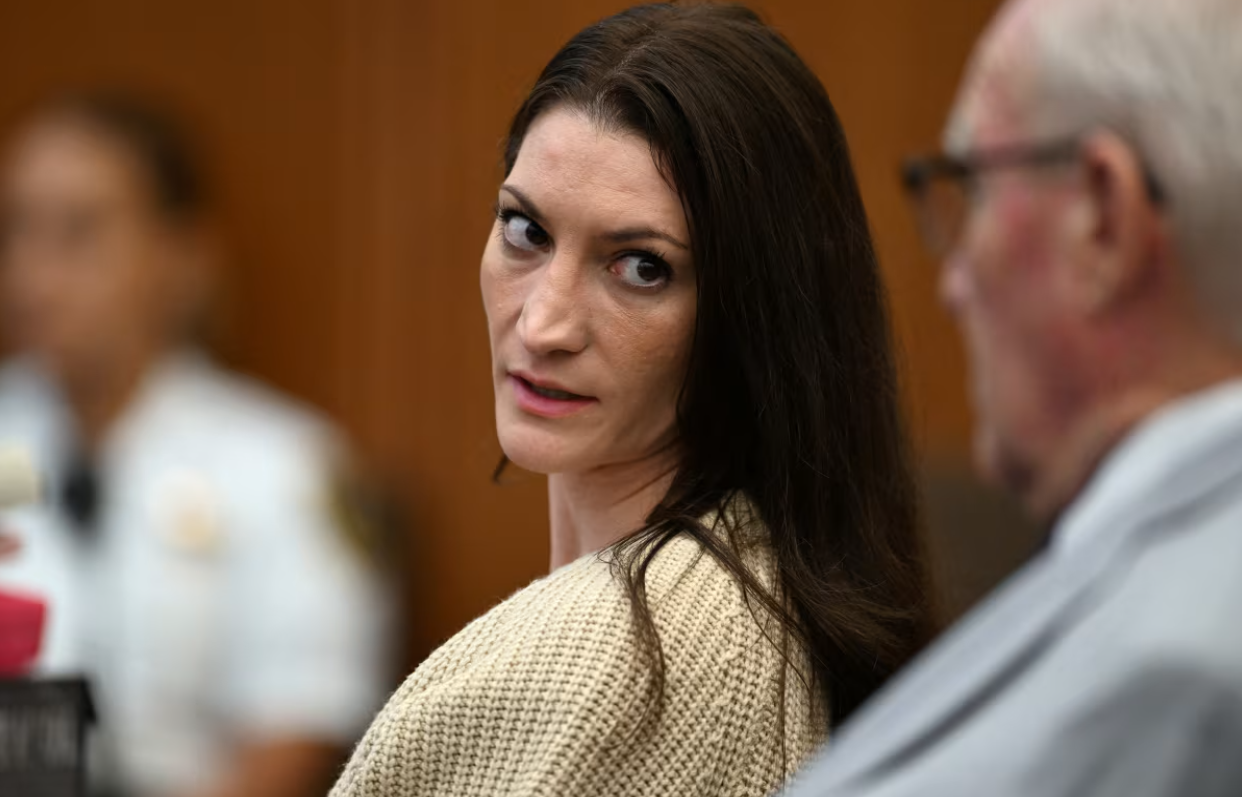
Lindsay Clancy murder trial jury deliberates five possible verdicts including not guilty by reason of insanity after the former nurse killed her three children citing postpartum psychosis in 2023.
By Imran Malik | US News Desk | NJNewsline.com | MediaBites.com.pk
For five weeks, the trial of Lindsay Clancy has gripped the American public in a way that few criminal cases do — not because of what happened, which is not disputed, but because of why it happened, which may never be fully resolved.
Clancy, a 36-year-old former nurse from Massachusetts, killed her three small children in the basement of their family home in 2023. She does not dispute killing her two sons and daughter. What she disputes, through her legal team, is whether she was mentally capable of understanding that what she was doing was wrong.
On Monday morning, a jury of nine women and three men resumed deliberations with five possible verdicts before them, each carrying dramatically different consequences for a woman whose case has divided legal experts, mental health professionals, and the American public simultaneously.
The Five Verdicts the Jury Can Return
Not Guilty Considered highly unlikely by legal observers. Would mean Clancy walks free.
Not Guilty by Reason of Insanity The most likely outcome if the defence succeeds. Under Massachusetts law, a not guilty by reason of insanity verdict would result in Clancy being detained in a psychiatric hospital rather than a prison. This is the outcome her legal team is pursuing.
First-Degree Murder The most serious outcome. First-degree murder in Massachusetts requires proof of intentional, premeditated killing with extreme atrocity or cruelty. Mandatory sentence: life in prison without the possibility of parole. Legal experts say jurors would effectively need to view Clancy as showing no mitigating factors whatsoever.
Second-Degree Murder A catch-all under Massachusetts law for any murder that does not meet the first-degree threshold. Carries a life sentence with the possibility of parole after 15 years.
Manslaughter The least serious homicide verdict available. Would require the jury to find that Clancy acted without premeditation or extreme cruelty.
The Core Legal Question — Insanity or Intention?
The entire trial has revolved around a single question that Massachusetts law frames with unusual precision.
Clancy’s defence argues she was suffering from postpartum psychosis following the birth of her youngest child, hallucinating a voice that ordered her to kill her children. Expert witnesses testified about the severity of the condition and family members described her deteriorating mental state in the weeks before the killings.
Under Massachusetts law, the burden is entirely on the prosecution to prove beyond reasonable doubt that Clancy was criminally responsible when she killed her children. They can do this by proving either that she did not suffer from mental illness at the time or that, even with mental illness, she still controlled her actions and knew they were wrong.
The prosecution’s position is unambiguous. While acknowledging Clancy was mentally ill, prosecutor Jennifer Sprague argued during closing arguments that her illness was not severe enough to prevent her from knowing right from wrong. Prosecution expert witnesses also challenged whether Clancy actually heard the voice she described.
What Legal Experts Are Saying
Criminal defence lawyer Elyse Hershon summarised the fundamental stakes with clarity.
“The case really comes down to where she is going to serve the rest of her life. The defence thinks it should be a psychiatric facility. The prosecution thinks it should be in a state prison.”
Heather Cucolo, a New York Law School professor and mental health law expert, described the threshold for a first-degree murder conviction as requiring jurors to effectively see Clancy as a monster with no mitigating factors — an extremely high bar given the undisputed evidence of mental illness in the record.
Why America Is Watching
The Clancy case has become a national conversation about postpartum mental illness, the limits of criminal responsibility, and the question of how the justice system should treat defendants whose actions, however horrific, may have been driven by a medical condition rather than criminal intent.
For the families of the three children who died, no verdict will feel adequate. For the millions of Americans who followed this trial, the jury’s decision will be a statement about where the line between illness and criminality sits in American law.
Deliberations continue. The verdict could come at any time.


5 Comments
Gần đây mình hay đọc nội dung tại fly888, thấy cập nhật khá nhanh.
Người mới nên bắt đầu từ fly888 để làm quen hệ thống.
I love how I can bet anytime and anywhere. The 24/7 availability is perfect for my schedule and the odds are quite competitive. kr247bet
I was skeptical at first but after a few wins I am totally convinced. The graphics are top notch. Visit impor88slot for the real deal.
Finally found a reliable link to get the app. The download was smooth and the installation didn’t take long. Definitely the best way to get megaparidownload working on my phone.