


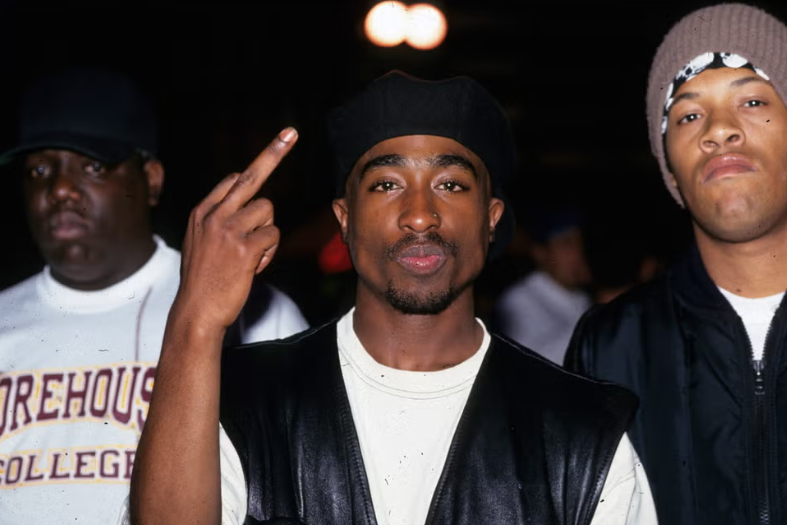
Former South Side Compton Crips gang boss Duane Davis has been found guilty of orchestrating the 1996 murder of rap legend Tupac Shakur ending America’s most famous cold case after 28 years.
By Imran Malik | US News Desk | NJNewsline.com | MediaBites.com.pk
One of the longest-running cold cases in American music history is over.
Duane “Keffe D” Davis, 63, former boss of the South Side Compton Crips street gang, was found guilty Monday of one count of murder with a deadly weapon for orchestrating the drive-by shooting that killed Tupac Shakur in Las Vegas on September 7, 1996.
The verdict arrived just hours after the jury received the case, ending nearly three decades of conspiracy theories, unanswered questions, and one of the most intriguing cold cases in the history of American music and culture.
Shakur was 25 years old when he was killed at the height of his career. He has sold more than 75 million records worldwide and remains one of the most influential voices in the history of hip-hop.
What the Jury Decided
Standing impassively in a Las Vegas courtroom wearing a black suit, Davis heard the verdict read without visible reaction. He then announced he would appeal.
In the gallery, Shakur’s relatives held hands. Some hugged. Others cried. Outside the courthouse, devoted fans of the rapper were simultaneously weeping and cheering.
Prosecutors had argued throughout the trial that Davis, while not the man who pulled the trigger, had ordered the shooting and supplied the weapon his nephew Orlando Anderson used to fire the fatal shots at Shakur’s vehicle.
The shooting was planned as retaliation after Anderson was involved in a physical confrontation with Shakur and his crew at a Las Vegas casino earlier that same evening. Davis was seated in the white Cadillac from which the shots were fired.
His Own Words Convicted Him
The most extraordinary dimension of this case is that the key evidence that convicted Davis came almost entirely from his own mouth.
In a secret 2008 police interview related to the death of fellow rapper Notorious B.I.G., Davis had acknowledged his role in Shakur’s death. He then elaborated further in his 2019 memoir “Compton Street Legend” and in multiple documentaries, podcasts, and media interviews over subsequent years.
Those public admissions voided a protective agreement he had established with authorities that had previously blocked criminal charges from being filed. The court ruled his 2008 police interview could be used as evidence against him.
Prosecutor Binu Palal made the case with devastating simplicity in closing arguments.
“For years, he had been telling people that he is responsible for Tupac Shakur’s murder,” Palal told the jury. “He’s the shot caller. When you have the shot caller sitting shotgun when shots are fired, there’s no doubt he’s responsible.”
Davis’s defence team argued his statements were fiction — bravado and exaggeration designed to sell books and generate media attention. His lawyer Michael Sanft urged jurors to dismiss his client as a liar who told tales for commercial gain.
The jury deliberated for hours. Then returned a guilty verdict.
The Context — East Coast, West Coast and a Generation’s Defining Tragedy
Shakur’s murder in September 1996 occurred at the peak of the most intense and most consequential rivalry in music history — the East Coast vs West Coast hip-hop war of the mid-1990s, intertwined with deep gang feuds between the Bloods and Crips that had embedded themselves within hip-hop culture.
Six months after Shakur’s death, Notorious B.I.G. was also killed in a drive-by shooting in Los Angeles. Neither case had produced a conviction in the nearly three decades since.
With Davis’s guilty verdict, one of those two defining tragedies of hip-hop’s golden era has finally found its resolution in a courtroom.
Sentencing is scheduled for October 13.


1 Comment
Simple and effective. I love that there is no unnecessary clutter on the site. It just works exactly how you want it to. Love braa44