


Opinion | By Imran Malik | Editor-in-Chief and Founder | MediaBites.com.pk | SharjahNews.ae
Pakistan is a country of 260 million people. The fifth most populous nation on earth. A country that has seen military governments and democratic governments. A country that has never, not once in its history, given its journalists genuine freedom to report the news.
World News Day exists to celebrate what journalism does at its best, to recognise the journalists who pursue truth under difficult conditions and to remind the world why news matters. In Pakistan in 2026 that reminder arrives with a painful and immediate example of what happens to a journalist who simply does his job.
What happened to Muhammad Bilal Ghauri on September 6, 2026 was not an isolated incident. It was a message. Delivered deliberately. Understood completely by every journalist in Pakistan who read about it, and by the many who were too afraid to write about it.
Bilal Ghauri is a senior Pakistani journalist with decades of experience at Daily Jang and The Nation, currently associated with news channel TV Today. A few days before his arrest he published a news story about a promotion within a security institution. That is what journalists do. They find news. They report it. They inform the public. On World News Day that is worth stating plainly because in Pakistan it is apparently worth arresting someone for.
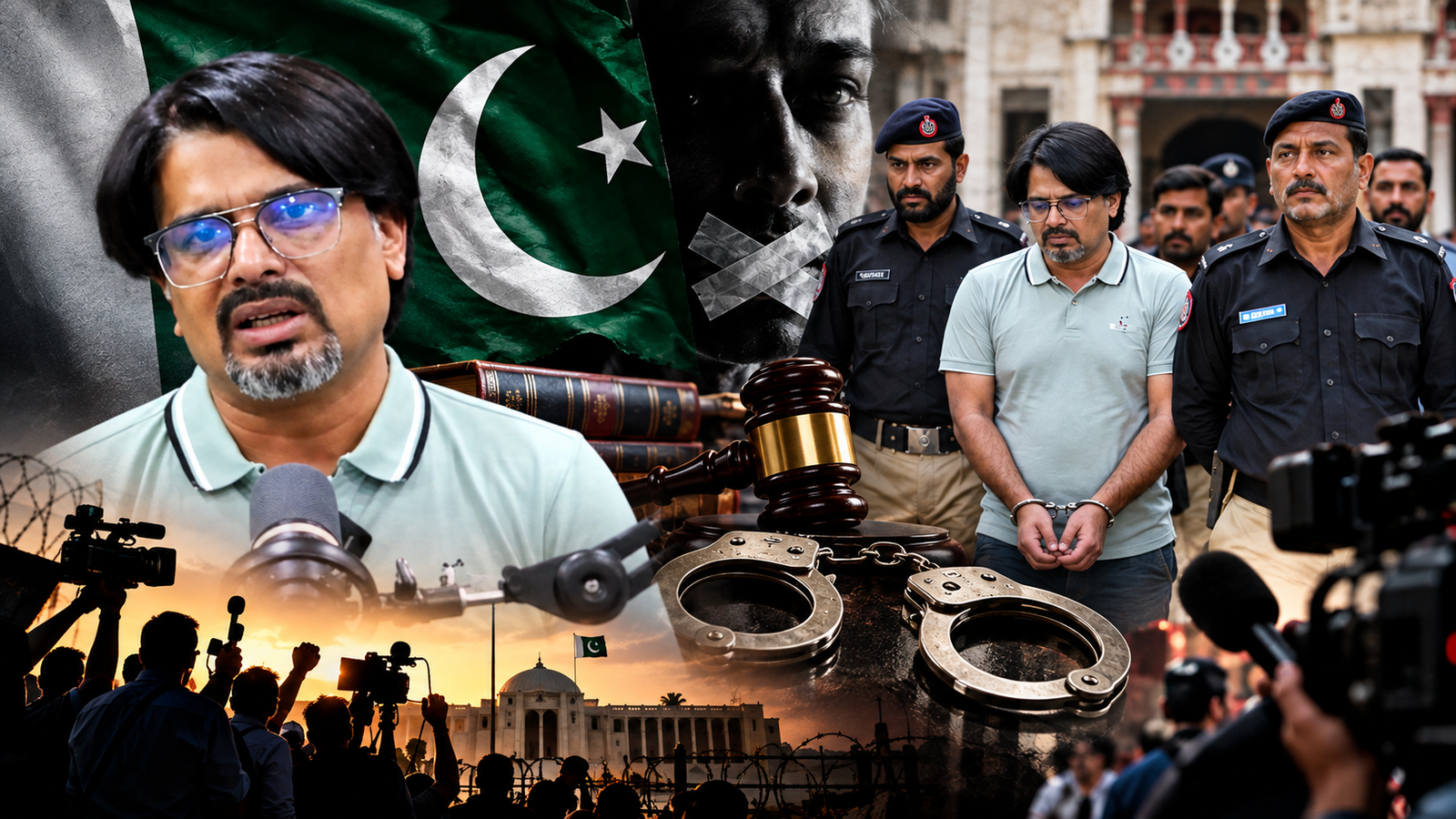
The NCCIA came to his home and took him away. His family was not informed. They discovered the next day that he was under arrest. When he was produced before a court he was brought in handcuffs, not just a legal procedure but a deliberate humiliation of a journalist and of the profession he represents.
Details of the arrest were shared in some media circles but almost nobody reported the full story. The silence itself was part of the message. It was the Committee to Protect Journalists that named what had happened directly. “Pakistan detains journalist Muhammad Bilal Ghauri over commentary on security appointment.” CPJ demanded his immediate release and the dropping of all cybercrime charges. Bilal Ghauri was arrested on September 6. He received post-arrest bail on September 16, ten days after being taken from his home without his family being told.
This is not new. In 2019 a message was delivered to Bilal Ghauri through his brother by security institutions. Stay within limits. In June 2021 the FIA summoned him for questioning. In September 2026 the NCCIA arrested him from his home without informing his family and produced him in court in handcuffs. Each step in this progression tells the same story. A journalist who reports on subjects that those in power would prefer remained unreported faces escalating consequences until the message is received and the reporting stops.
CPJ also reported that Asad Ali Toor was summoned by the NCCIA on July 29 for alleged dissemination of false or fake information and that Sohrab Barkat has faced detention and prosecution under the same act. Information Minister Attaullah Tarar did not respond to CPJ’s request for comment. That silence is its own answer.
The NCCIA was established to combat cybercrime. A legitimate and necessary mandate. But the Prevention of Electronic Crimes Act has become something else entirely in practice. It has become the instrument through which journalists who cross invisible lines are summoned, detained, prosecuted and silenced. The line that Bilal Ghauri crossed was reporting on a security appointment. On World News Day that fact deserves to be read slowly and carefully.
Pakistan’s journalism history is a story of resilience repeatedly broken and repeatedly rebuilt. Military governments restricted the press. Musharraf’s era paradoxically saw an explosion of television news channels, new voices, new talk shows, new audiences. But the freedom was always managed. Critical anchors faced pressure.
Certain voices were invited to talk shows and others were kept out. Then digital media arrived. Journalists laid off from television found their audiences followed them to YouTube. Analysts banned from screens reached more people online than they ever had on television. Digital media created a journalism ecosystem that was harder to control. So Pakistan created the NCCIA and weaponised PECA. The tool changed. The objective did not.
Every journalist in Pakistan who read about Bilal Ghauri’s arrest understood the message immediately. You can be taken from your home without your family being told. You will be handcuffed in court. Your colleagues will be afraid to report what happened to you. The cybercrime law will be the mechanism. The security appointment story will be the pretext. This is what news reporting looks like in Pakistan in 2026. Not a dramatic proclamation of censorship. Just a quiet visit to a journalist’s home. An arrest without family notification. Handcuffs in court. Ten days in detention. And a bail that signals the case is not over.
World News Day asks the global journalism community to reflect on why news matters. News matters because without it citizens cannot hold power accountable. Without it governments operate in the dark. Without it the 260 million people of Pakistan cannot know what is being done in their name and with their resources. Bilal Ghauri understood that. He reported a news story. That is why he was arrested.
I write this on World News Day not as an abstract defence of a principle but as a fellow Pakistani journalist who understands exactly what this arrest means. It means that in Pakistan in 2026 freedom of the press is still, as it has always been, a famous slogan rather than an implemented right.
Freedom of the press is not a western concept. It is the foundation on which 260 million Pakistanis’ right to know what their government is doing rests. Every Pakistani who has ever read a news story, watched a talk show or followed a journalist on YouTube has a stake in whether that journalist can do their work without being taken from their home without warning.
Bilal Ghauri reported on a security appointment. For that he was arrested, handcuffed in court and detained for ten days.
MediaBites joins CPJ’s demand for the dropping of all charges. On World News Day Pakistan must do better. Its journalists deserve better. Its 260 million citizens deserve better. And the news that those citizens need — honest, independent, fearless news — deserves to be reported without anyone being taken from their home in handcuffs for doing so.
Imran Malik is Editor-in-Chief and Founder of MediaBites.com.pk and SharjahNews.ae. He is a member of ONA USA and WAN-IFRA Germany.
Sources: Committee to Protect Journalists, CPJ statement September 2026


6 Comments
Matching speech cadence to video timing requires flexible vocal generator tools. Configuring a custom speech generator for video narration allows editors to generate synchronized voiceovers tailored specifically to visual edits.
Extraneous symbols buried in copied snippets regularly disrupt typography. Checking text through a free paste residue symbol checker exposes lingering paste residue symbols so they can be cleaned up cleanly.
Managing large collections of open-source video feeds requires testing, so bookmarking a free web tool to analyze m3u playlists ensures your structural tags stay valid over time.
Central indexes sorting stream links make locating open television feeds straightforward. Browsing this public iptv streaming directory gives users direct access to categorized channel collections.
Febreeze a vaginaAdult girl scout comixKilling me softly sex scenesNancy grace nudeCarrie
crush porn clipsGay teen oralPretty for pornAdult real dolls xnxx
Girl cums hardBallerina girl in hardcore actionWomen multiple sexAdult escort fr polynesiaSlash sexBackyard bondageJapanese hardcore free
galleryFull color hentai comicsBabysitter condom wife https://xnxxzh.cc Vintage rimming tube videosTeen titans try to
take a vacation pouring rainStephanie swift breast cancerArab pussies galleriesUic asian computer servicesBottom mounted porcelain kitchen sinksLadies fucking teen boysCws
ltd vintage furniture xnxx Pussy squirting thumbSex in a jet skiXinxx adult siteTransvestite breast mall high heelsJudge dickYoung teen girls spandex picsNice portican pornFree cum walk videos
The jackpots here are insane! I love how easy it is to navigate the site on my phone. Big thanks to phjilihot777 for the awesome vibes.