


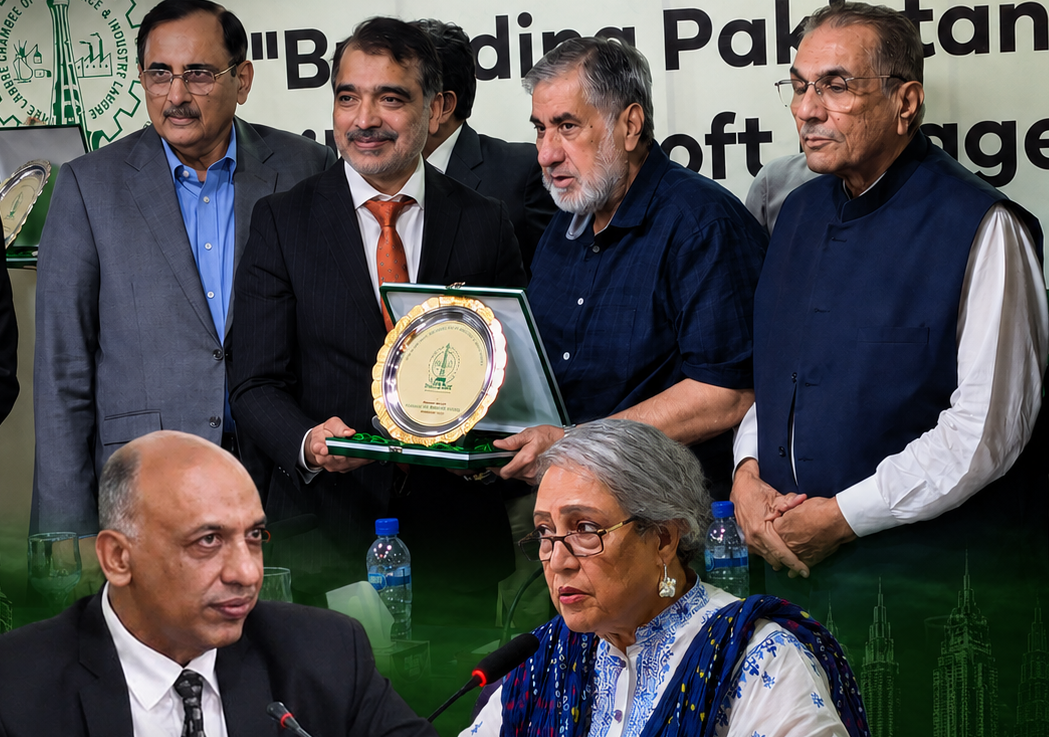
LCCI’s Corporate Relations Committee concluded its eighth and final session with Jugnu Mohsin, Mujeeb ur Rehman Shami and Tariq Ullah Sufi delivering frank, fearless assessments of Pakistan’s image crisis.
By Imran Malik | Business & Media Desk | MediaBites.com.pk
There are sessions that generate polite applause and forgettable soundbites. And then there are sessions that make you reach for your notebook because almost every speaker says something that actually needs to be said.
The eighth and final session of the LCCI Corporate Relations Committee under the current management was firmly in the second category.
Held at the Amin Hall, Lahore Chamber of Commerce and Industry, the session titled “Branding Pakistan: Building a Soft Image” generated some of the most direct and uncomfortable commentary heard at an LCCI event in recent memory.
Eight Sessions — A Record Worth Celebrating
Convenor Amer Salam opened with deserved institutional pride. In record time, his committee conducted all eight sessions of the current management cycle — each well-attended, well-designed, and covering substantive ground. This final session, with its heavyweight panel, was a fitting conclusion to one of LCCI’s more energetic committee runs in recent memory.
President LCCI Faheem ur Rehman Saigol subsequently praised the committee’s performance and Amer Salam specifically — credit that was both appropriate and evidently genuine.
The Late Arrival — Shami Notes It Gracefully
The session’s first notable moment came before a single speech was delivered. Guests and chamber members were seated on time. But Mian Anjum Nisar, the session’s chair, and President Saigol arrived late.
Mujeeb ur Rehman Shami noted the delay with the kind of elegant, pointed phrasing only a seasoned journalist can deploy. If Pakistan’s soft image begins at home, punctuality at one’s own events might be a reasonable place to start.
President Saigol — Return Something to This Country
President Saigol delivered a crisp, concrete, and genuinely moving address that avoided the empty corporate language characterizing most chamber event speeches.
His central message carried both philosophical weight and a sense of personal accountability. “We all have to return something to this country, as this country has given us identity, name, and all the perks we are enjoying.”
He acknowledged the painful gap between individual and national progress — a gap that Pakistan’s business community, which has benefited enormously from Pakistan’s markets, has a particular responsibility to help close.
Mian Anjum Nisar — Bad Governance, Blind MOUs and the China Question
Mian Anjum Nisar, former LCCI President and session chair, delivered the evening’s most structurally analytical remarks.
His diagnosis was direct. Pakistan’s fundamental problem is bad governance and political leadership without vision. Ministers and bureaucrats travel extensively, sign dozens of memoranda of understanding in foreign capitals, but rarely read what is actually written inside them.
His China example was stark. China imports approximately two billion dollars from Pakistan while exporting twenty-five billion dollars in return. “What kind of friendship is this?” he asked — a question deserving serious answers from every policymaker currently celebrating Pakistan-China relations.
On economic history, Nisar was equally blunt. Nationalization was one of Pakistan’s greatest disasters. IPPs are now a slow poison for the economy. Yet nobody is held accountable.
Jugnu Mohsin — Truth First, Soft Image Second
Jugnu Mohsin began in Punjabi — a deliberate choice signaling she was not there to perform diplomacy. She was there to be honest.
Her challenge to the session’s premise was simple and devastating: “We cannot speak the truth. And if we cannot speak the truth, where will a soft image come from?”
She shared the story of Seth Mela Ram — a figure of Lahore’s civic history whose contributions to the city represent exactly the kind of individual commitment to public good that Pakistan’s contemporary elite consistently fails to replicate.
Mohsin extended her historical argument further, making a passionate case for the restoration of Pakistan’s historical places and the revival of ancient original names of roads and landmarks that have been erased or replaced over decades. Pakistan’s soft image, she argued, cannot be built on a foundation that ignores or erases its own rich historical identity. Preserving what came before is not nostalgia — it is nation-building.
On the thorny question of IPPs and the energy crisis, Mohsin was refreshingly candid about the limits of media’s power. She acknowledged that neither she nor the wider media community can force change when the government and concerned institutions simply do not listen. The media can raise its voice. Whether that voice is heard depends entirely on whether those in power choose to hear it.
She also offered a nuanced observation about Pakistan’s bureaucracy — acknowledging that many individual bureaucrats do in fact work on merit and with genuine commitment. The problem, she noted, is systemic rather than purely individual. Despite personal integrity, these officials often find themselves unable to deliver results within a broken system. And their treatment of ordinary citizens at the ground level remains deeply troubling — the common man’s encounter with bureaucracy in Pakistan is frequently brutal, demeaning, and entirely disconnected from the dignity those citizens deserve.
Mujeeb ur Rehman Shami — Maryam’s Naming Policy, Kashmir and Hope
Shami delivered the session’s most politically charged and most entertaining remarks simultaneously.
He targeted CM Punjab Maryam Nawaz Sharif directly, questioning her practice of renaming government institutions after her father Mian Nawaz Sharif. His question was simple and pointed: “Does everyone else not have a father?”
On Kashmir, Shami noted a significant shift. Previously occupied Kashmir dominated coverage. Now Azad Kashmir is making headlines — reflecting the internal governance challenges AJK’s own recent protests and elections have surfaced.
His closing message was one of determined hope. Whatever the depth of Pakistan’s challenges, the light of hope must remain lit. His call for all institutions to engage in genuine dialogue rather than operating in isolated silos was the session’s most practically grounded recommendation.
Closing — LCCI as Pakistan’s Freest Forum
President Saigol’s closing words carried earned pride. “LCCI is a forum where every topic and every issue can be discussed openly and without fear — whether it is ministers or heads of institutions.”
Shami added a final practical recommendation. Ministers and institutional heads must come to the ground, assess real conditions, and govern from reality rather than offices insulated from consequences.
The session was expertly and smoothly moderated by Noor Ullah of Jang Group, whose professional handling of the discussion kept the conversation focused, balanced, and moving effectively
Souvenirs were distributed. High tea followed. Eight sessions concluded.
One honest note: the Q&A was too short. One or two questions for a panel of this caliber is insufficient. Future sessions must build at least thirty minutes of structured audience participation into the program. The questions are worth asking. The answers are worth hearing.

