


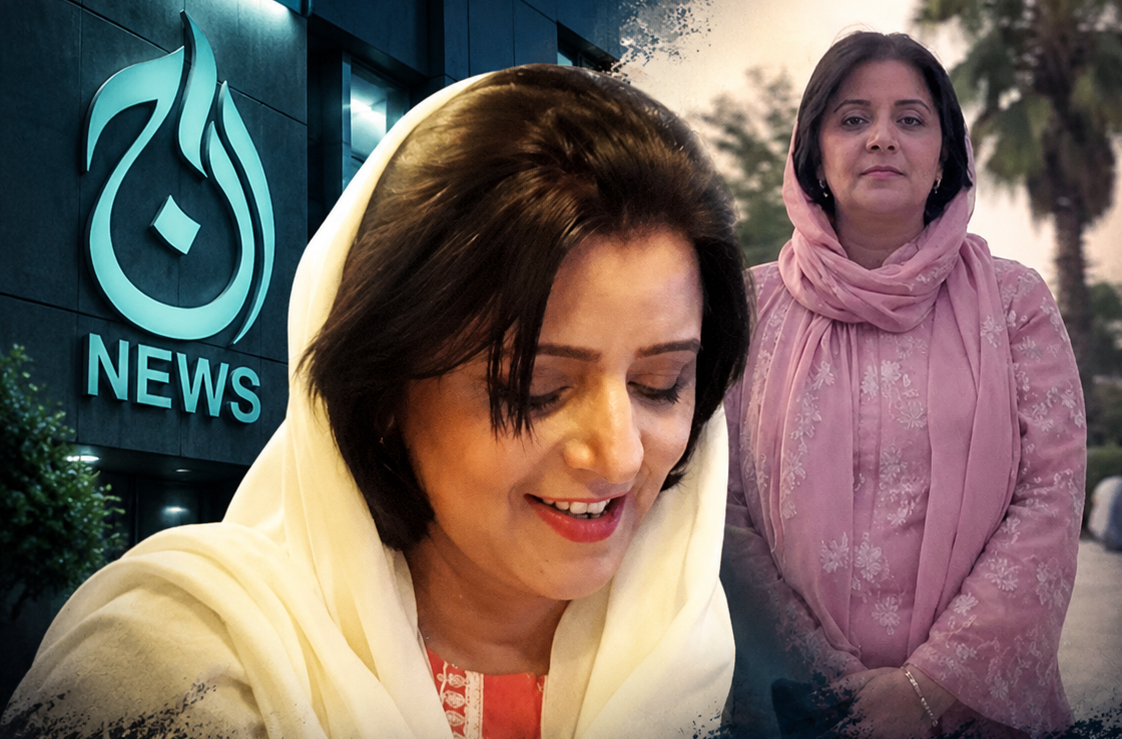
Farzana Ali, the journalist who reported from Swat, the tribal belt and Kabul — and broke every glass ceiling in Khyber Pakhtunkhwa — says her two-decade association ended in a way she would not have chosen
Farzana Ali spent 27 years telling Pakistan’s most dangerous stories, from Swat to Kabul, from the tribal belt to the front lines of the war on terror. She became KP’s first female television bureau chief. She hosted live programs from a conflict zone when other women journalists were nowhere near one.
After 20 years and one month at Aaj News, she was shown the door, and she said so publicly: “I would have preferred it to end normally, not under pressure.”
Her departure reopens a wound Pakistan’s media industry refuses to treat. APNS exists for print publishers. PBA exists for broadcasters. Ad agencies and media houses have bodies that represent their interests at every table that matters.
But the journalist, the person who actually goes into the field, files the story, builds the audience and carries the channel’s credibility on their byline, has no institutional home. No grievance body. No arbitration forum. No protection mechanism when a 20-year career ends with a quiet push out the door.
Farzana Ali’s story is not just about one journalist and one channel. It is about an industry that has built elaborate structures to protect revenue, and none to protect the people who generate it.
She added a line that will resonate with anyone who has spent time in Pakistan’s media industry: “Perhaps in one way it is good, because what was unknown is no longer unknown.”
Who is Farzana Ali
To understand why this departure matters, you have to understand what Farzana Ali built — and what she survived to build it.
She entered journalism in October 1997 through print media, at a time when a woman reporting hard news from Khyber Pakhtunkhwa was not just unusual — it was, by the standards of the region, unthinkable.
She made it thinkable anyway.
Ali went on to become the first female bureau chief of a television channel in Khyber Pakhtunkhwa — a milestone documented by the Committee to Protect Journalists and celebrated by international press freedom organizations.
She reported from Swat during the military operations. She covered the former tribal districts during the bloodiest years of Pakistan’s war on terror. She crossed into Afghanistan and reported from Kabul during periods of intense upheaval. She hosted Hot Frontier — a live television program from Peshawar focused on the conflict zone — at a time when most women journalists in Pakistan were safely behind studio desks in Islamabad and Karachi.
The International Federation of Journalists documented the extraordinary breadth of her career: human rights, militarisation, terrorism, displacement, women’s issues — all from one of the most dangerous reporting environments in the world.
Twenty-seven years in journalism. Twenty of them at Aaj News.
The Departure
The timing carries its own irony. As recently as September 2026, Aaj News’ own website listed Farzana Ali as its Peshawar bureau chief, with her byline appearing on reports covering KP’s political developments and security incidents.
Then came the exit — and the carefully worded but unmistakable X post.
Ali has not elaborated publicly on the specific circumstances. The channel has made no statement. But the phrase “under pressure” — from a journalist of her stature, with her history, after two decades of service — is not a phrase that goes unnoticed in Pakistan’s journalism community.
Colleagues and fellow journalists have flooded her mentions with messages of support and solidarity.
What It Says
Pakistan’s media industry has a well-documented record of pushing out experienced, independent-minded journalists — particularly those who cover security, conflict and the northwest — when their presence becomes inconvenient for any number of reasons, none of which are ever officially stated.
Farzana Ali has spent 27 years making herself inconvenient in the best possible way: by going where the stories were, reporting what she found, and doing it from a region where both the stories and the reporters faced mortal risk.
That she leaves under a cloud, after two decades, without a dignified farewell, says less about her than about the institution she is leaving.
She has mentioned in past interviews that she intends to write a book someday about the stories she could not tell.
That book, when it comes, will be worth reading.
Aaj News had not issued a statement on Ali’s departure at the time of publication. MediaBites will update this report if the channel responds.
— Compiled by Imran Malik, MediaBites desk, with reporting from X, IFJ, CPJ, Voicepk.net and WRN

