


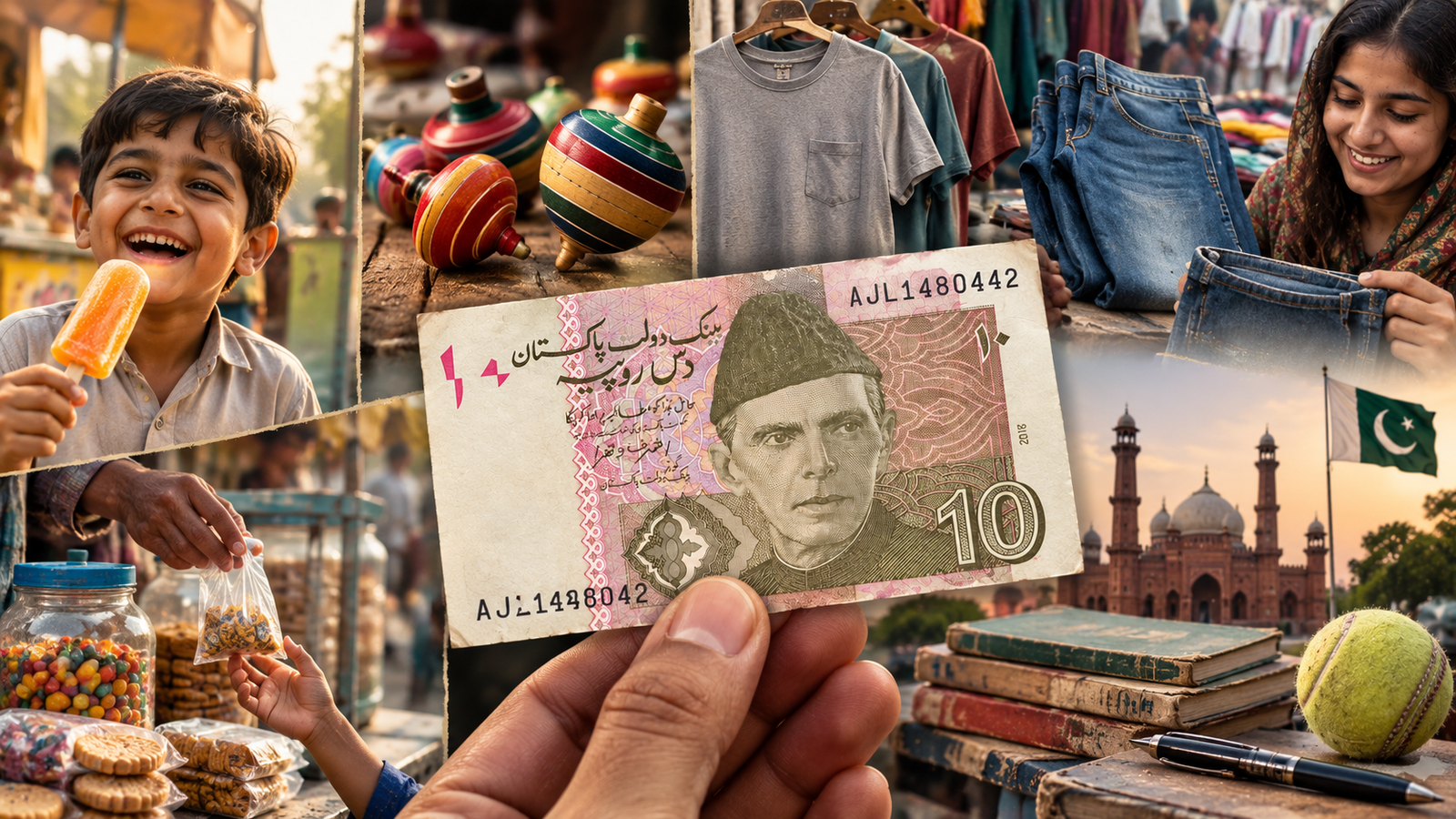
Pakistan’s central bank is considering replacing the Rs10 banknote with a coin, but no final decision or withdrawal date has been announced, officials say.
ISLAMABAD — Social media has been awash with claims that Pakistan’s Rs10 currency note is about to disappear, but the State Bank of Pakistan has not announced any deadline for withdrawing the denomination.
The speculation follows remarks by SBP Deputy Governor Dr Inayat Hussain before the Senate Standing Committee on Finance last month. He told lawmakers that the central bank was considering removing the Rs10 banknote from a future currency series and replacing it with a Rs10 coin.
The comments quickly triggered posts on social media suggesting that the banknote would soon cease to be legal tender and that people had only until the end of this month to exchange it.
However, the State Bank has not issued any such deadline or confirmed a date for withdrawing the Rs10 note.
In response to questions about the issue, an SBP spokesperson said the central bank had made no announcement confirming that the Rs10 banknote would be discontinued and replaced by a coin.
That distinction is important because considering a change to the currency system does not mean that the existing Rs10 note is immediately being withdrawn.
Where did the proposal come from?
The discussion about replacing the Rs10 banknote began with Deputy Governor Hussain’s comments to the Senate finance committee.
The proposal is part of a broader consideration of Pakistan’s future currency series. If implemented, the Rs10 denomination would eventually be represented by a coin rather than a banknote.
Pakistan has previously moved in the same direction with lower-value denominations. One-, two- and five-rupee banknotes were eventually replaced by coins.
Such changes are generally linked to the declining purchasing power and durability of lower-value banknotes.
Why replace a note with a coin?
Former SBP governor Salim Raza told BBC Urdu that the decision to replace lower-denomination notes with coins is linked primarily to the changing value of money.
As inflation reduces purchasing power, very low-value notes become less useful for everyday transactions. Banknotes can also become damaged or worn relatively quickly, while coins can remain in circulation for considerably longer.
Financial affairs expert Rashid Masood also pointed to purchasing power as a key consideration.
He said the value of a denomination matters when determining whether it remains useful in circulation. As the purchasing power of a small denomination falls, demand for it can gradually decline.
The transition from a banknote to a coin, however, is not necessarily straightforward from a cost perspective.
Coins require metal and a manufacturing process, while banknotes require specialised paper, ink and printing. The economics therefore depend on how long each form of currency remains usable and how frequently it needs to be replaced.
Currency printing costs are rising
The issue has also emerged as the cost of producing Pakistan’s currency continues to increase.
According to figures cited from the State Bank’s annual financial report for fiscal year 2025-26, the cost of printing currency notes during the year was Rs29.6 billion, compared with Rs27.8 billion the previous year.
The figures cover the printing of currency notes across denominations and do not provide a separate cost for producing Rs10 banknotes.
Rashid said the cost of printing banknotes should therefore not be viewed as the only reason behind a possible change.
He noted that banknotes require specialised paper and ink, while coins involve metal and minting costs. The more fundamental consideration, he said, is whether a denomination still has sufficient purchasing power and practical use.
What happens to the existing Rs10 note?
For now, there is no announced deadline for exchanging or withdrawing Rs10 banknotes.
The State Bank’s comments indicate that replacing the denomination with a coin remains under consideration rather than being an immediately implemented policy.
If the central bank eventually approves the change, it would be expected to announce the details, including the introduction of the new coin and arrangements concerning existing banknotes.
Until such an announcement is made, social media claims suggesting that the Rs10 note must be exchanged by a particular date should not be treated as an official instruction.
The discussion does, however, highlight a wider issue facing Pakistan’s currency system: as prices rise and the purchasing power of smaller denominations declines, the role of low-value notes and coins in everyday transactions continues to change.
What readers need to know
The Rs10 note has not been officially withdrawn. The State Bank is considering replacing it with a Rs10 coin in a future currency series, but no final withdrawal decision or exchange deadline has been announced.


1 Comment
Visual storytellers often animate pictures using minimax h3 to bridge the gap between static graphic design assets and engaging video content needed for modern digital media.