


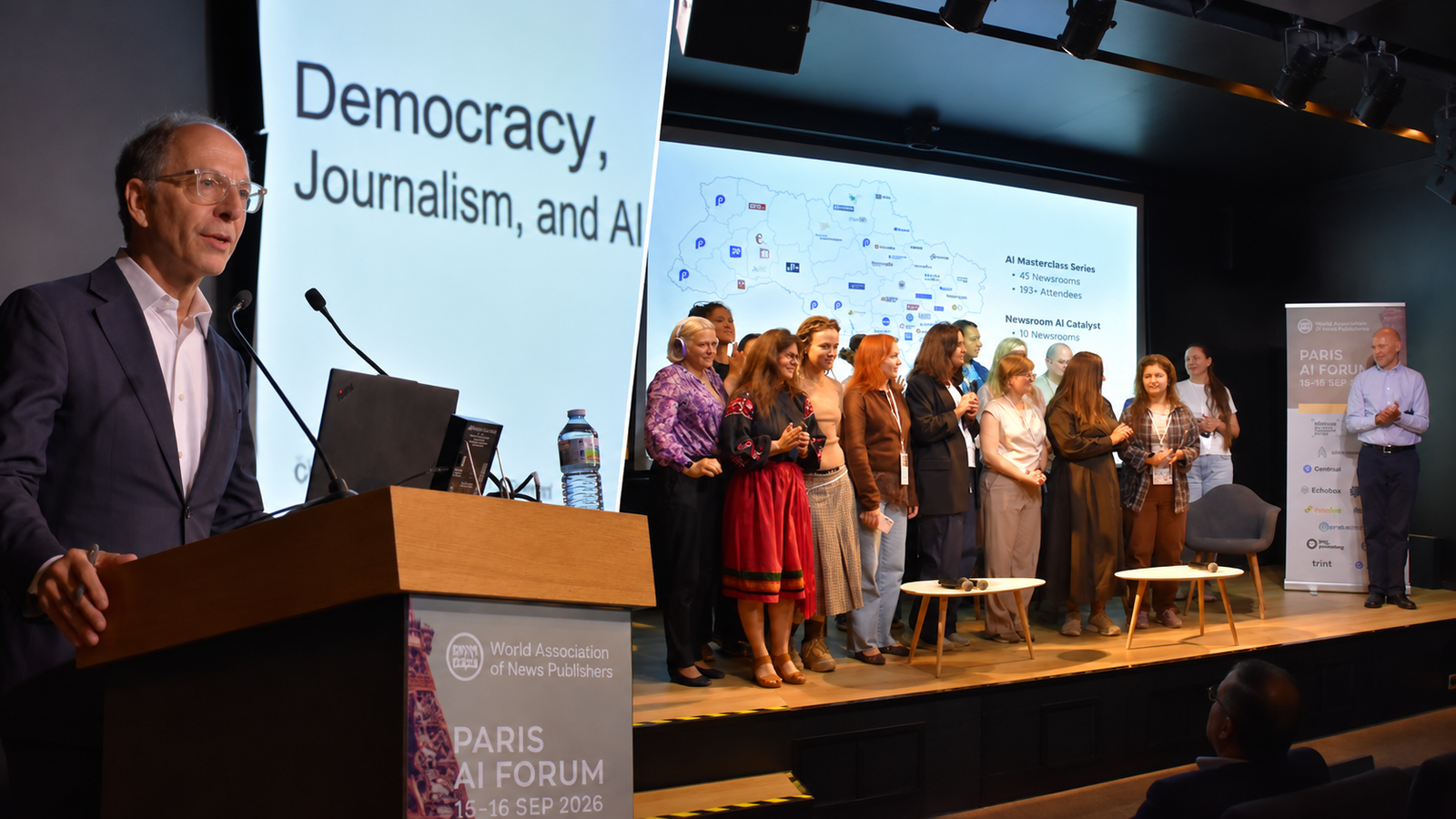
OpenAI Chief of Intellectual Property Tom Rubin delivered a keynote at WAN-IFRA’s Paris AI Forum announcing 12 weeks of intensive AI support for ten Ukrainian newsrooms beginning September 17.
By Imran Malik | Media Industry & World Affairs Desk | MediaBites.com.pk
The most powerful speech at WAN-IFRA’s Paris AI Forum was not about technology. It was about a journalist charging her phone in a darkened Ukrainian town while preparing a newspaper for people the internet can no longer reach.
Tom Rubin, Chief of Intellectual Property and Content at OpenAI, took the stage in Paris to deliver a keynote titled “Democracy, Journalism, and AI” — and he used it to announce the next phase of the most consequential journalism support programme of 2026.
The Programme That Began With a Dinner Conversation
The story behind the OpenAI-WAN-IFRA-AIRPPU partnership for Ukrainian newsrooms began not in a boardroom but at a dinner table.
At WAN-IFRA’s annual Congress board dinner in Marseille in June 2026, Rubin found himself seated across from Oksana Brovko, CEO of the Association of Independent Regional Press Publishers of Ukraine and one of the most determined defenders of independent journalism in the world.
He asked her two questions.
“What do you need and how can we help?”
That conversation produced a programme that launched in August with a masterclass series open to 40 Ukrainian newsrooms. The next phase begins on September 17 — 12 weeks of intensive support for 10 Ukrainian newsrooms to develop AI projects tailored to their specific needs, covering both reporting and the business of keeping a newsroom financially sustainable.
MediaBites reported on this programme and Oksana Brovko’s remarkable work in a previous story. The Paris keynote confirms that programme is now moving from concept to implementation.
When Darkness Falls Over a Ukrainian Town
Rubin brought the human reality of Ukrainian journalism into the Paris forum with words that stopped the room.
“When darkness falls over a Ukrainian town, it can mean an air raid, a missile strike, or another attack on the power grid. And somewhere, a journalist is finding a way to keep working: charging her phone, checking an evacuation route, preparing a newspaper for people the internet can no longer reach.”
He quoted Oksana Brovko’s own words about journalists in small towns who “did not switch off the lights, even when everything around them was falling into darkness.”
“We are here because those lights must not go out.”
Rubin spoke from a position of genuine understanding. He worked as a journalist at The New York Times, Associated Press, and CBS News, covering terrorism, murder, and the everyday affairs of communities. He also sits on the executive committee of the Reporters Committee for Freedom of the Press in the United States.
But he acknowledged the distance between his own experience and what Ukrainian journalists face.
“Nothing in my own journalism experience remotely compares with the reality facing our Ukrainian colleagues: keeping independent journalism alive while your country is fighting for its survival.”
AI as Tool Not Substitute
Rubin’s keynote drew a clear and deliberate line about what AI is and is not for journalism.
“We see AI as a tool to support journalists, not a substitute for them.”
He cited WAN-IFRA research showing that in a survey of more than 100 media leaders, three quarters reported efficiency improvements from AI. He referenced data journalist Jacopo Ottaviani’s experience building a working prototype in hours with AI assistance — a searchable atlas helping Italian communities understand flood and landslide risks.
For Ukraine specifically, the applications are immediate and urgent. An overstretched team could use AI to translate urgent information, organise witness testimony, find leads in public contracts, and uncover propaganda or disinformation claims for reporters to investigate.
But Rubin was equally direct about the risks.
“AI can miss context and produce answers that are wrong. It can also be misused to falsify images and voices. Newsrooms need to check outputs against evidence. Reporters and editors remain responsible for what they publish.”
The Underground Newspaper in the Sorbonne Cellars
Rubin drew a historical parallel that resonated powerfully in the Paris setting.
During World War II and the German occupation of Paris, the underground newspaper Défense de la France began printing in the cellars of the Sorbonne to reach readers. Journalists have always found ways to use whatever tools available to keep telling the truth under the most difficult conditions.
He quoted two war correspondents who understood that mission at its most fundamental.
Marie Colvin, who covered conflicts around the world before being killed in Syria: “War reporting is still essentially the same — someone has to go there and see what is happening.”
Mstyslav Chernov, Pulitzer Prize winner for his reporting from Mariupol: “I can only make sure that as many people as possible will see what I saw.”
“Being there, gathering evidence, and helping people understand it: that is the work. Every useful tool should help journalists do more of it.”
What the Ukrainian Newsrooms Will Do
The newsrooms entering the 12-week programme have already identified where AI can help them most.
Trudova Slava wants AI to monitor online sources and find stories across communities scattered by war. Kremenchuk Telegraph plans to use it to search public records for investigative leads — the same kind of work that requires large teams at well-resourced publications but could become accessible to a local team of three or four journalists with the right AI tools.
Rubin closed with a vision of what this programme ultimately works toward.
“During reconstruction, local reporters will follow rebuilding funds, ask when schools will reopen, and tell the stories of families returning home. They will help their communities remember what happened and have a say in what comes next. That is a future worth working for.”
MediaBites and the International Journalism Community
MediaBites has covered this story from its beginning — from Oksana Brovko’s original announcement about the programme to today’s Paris keynote. As a member of WAN-IFRA and ONA USA, MediaBites believes the Ukrainian newsroom AI programme is the most important practical demonstration of what responsible AI-journalism partnership looks like in 2026.
The lights in Ukraine’s newsrooms must not go out. And if a conversation over dinner at a WAN-IFRA board meeting in Marseille is what keeps them on, that is a reminder of why these international journalism community gatherings matter beyond the panels and the keynotes.
Tom Rubin asked two questions. The programme is the answer.
— Imran Malik | Media Industry and World Affairs Desk | MediaBites.com.pk | SharjahNews.ae
Source: WAN-IFRA Paris AI Forum, Tom Rubin keynote


16 Comments
Медицинские услуги на дому выбирают при стабильном самочувствии, когда нет признаков тяжелого острого состояния и врач допускает лечение вне клиники. На дому можно провести курс назначенных внутривенных капельниц, выполнить отдельный укол, организовать наблюдение медсестры и получить консультацию врача. Услуга полезна, если обратившемуся сложно самостоятельно приехать на прием или требуется провести лечение в удобное время.
Изучить вопрос подробнее – nadomu2.kapelnica-ot-zapoya-v-moskve14-1.ru/
Запой представляет собой продолжительное употребление спиртного, при котором зависимый постоянно возвращается к алкоголю, чтобы временно снизить проявления похмельного синдрома. Такое поведение поддерживает интоксикацию и увеличивает токсическое воздействие продуктов распада этанола на печень, сердце, сосуды, мозг и другие внутренние органы. Чем дольше продолжается запой, тем выше вероятность осложнений и тем сложнее самостоятельно выйти из этого состояния без медицинской помощи.
Ознакомиться с деталями – вывод из запоя москва и область
пояснения
a blsp at
Hello!
Diagnostics and overhaul internal combustion engine cars are carried out with full diagnostics everyone unitsFull recovery motor in Moscow is done after full disassembly and troubleshooting all units
ford explorer engine repair
ford mondeo engines overhaul
ford engine repair
https://remont-ford123.ru
Share, where did you go?
Мы работаем с вниманием к деталям повседневности: как человек засыпает на фоне вечернего света, сколько воды переносит малыми глотками, как реагирует на цифровые уведомления, есть ли привычные «включатели» тяги и как на организм влияет шумное окружение. Врач и куратор переводят этот жизненный контекст в ясные, измеримые ориентиры: время до сна, число пробуждений, вариабельность пульса к сумеркам, объём воды, аппетит, переносимость тёплой мягкой пищи. Решения принимаются адресно и последовательно, чтобы сохранять ясность днём и избегать ненужной фармаконагрузки.
Выяснить больше – анонимная наркологическая клиника калининград
Рекомендации строятся вокруг состояния человека, а не по универсальному шаблону для всех случаев.
Изучить вопрос подробнее – прокапать капельницу от запоя
Came away with a small but real shift in perspective on the topic, and a stop at glassaisle pushed that shift a bit further, the kind of subtle reframing that good writing does to a reader without making a big deal of it is something I always appreciate when it happens which is sadly not that often.
Thanks for the honest framing without exaggerated claims that the topic will change my life, and a stop at moonlitmerch kept the same modest tone, restraint in marketing language signals trustworthiness and the writers here are clearly playing the long game by building credibility rather than chasing immediate clicks through hyperbole.
Quality writing that respects the reader’s intelligence without overloading them, and a quick look at workspaceward reflected that approach, a balanced thoughtful site that earns trust by being consistent rather than by shouting about how trustworthy it is which is the usual approach online sadly across most content categories.
Appreciate the thoughtful approach, the writer clearly took time to make this readable for someone who is not already an expert, and a look at olivebazaar kept that going nicely, easy on the eyes and easy on the brain which is always a winning combination when reading on a busy day.
Even from a single post the editorial care is clear, and a stop at parcelbay extended that care across more pages, the kind of attention to quality that shows up in every paragraph is what separates serious sites from the rest and this one has clearly invested in that paragraph level attention across what I have read.
Вызов врача особенно актуален, если близкий находится в запое несколько суток, плохо спит, практически не принимает питание, испытывает сильную слабость или не может самостоятельно справиться с похмельным синдромом. Нарколог приезжает на указанный адрес, проводит диагностику и определяет безопасный способ лечения. Срочный выезд позволяет начать помощь прямо сейчас, не заставляя зависимого самостоятельно приезжать в центр. В большинстве стандартных случаев врач может провести вывод на дому, однако решение всегда зависит от клинической картины.
Ознакомиться с деталями – https://4.vyvod-iz-zapoya-moskva1-13.ru
Продолжительное употребление алкоголя нарушает обмен жидкости, солей и витаминов, усиливает токсическую нагрузку на внутренние органы и провоцирует абстинентный синдром. В основном обращение требуется, когда зависимый не способен самостоятельно остановить очередной эпизод, плохо спит, испытывает тошноту, тремор, головную боль, тревогу и выраженную слабость. В таком случае лечение на дому позволяет начать вывод из запоя в привычной обстановке, а при более сложной картине лечение проводится в стационаре.
Дополнительная информация – postavit-kapelnicu-ot-zapoya
Работа клиники строится на комплексном подходе. Лечение зависимости может включать диагностику, детоксикацию, медикаментозное лечение, снятие ломки, вывод из запоя, кодирование от алкоголизма, психотерапию, психологическую поддержку и последующую реабилитацию. Врач оценивает медицинские данные, определяет противопоказания и предлагает подходящий способ помощи. Такой путь позволяет не ограничиваться временным улучшением физического состояния, а работать с причинами болезни, поведением зависимого, мотивацией и условиями, необходимыми для устойчивой трезвости.
Дополнительная информация – https://narkologicheskaya-klinika-moskva15.ru/
Good afternoon
Repair block motor is done after deep diagnostics all unitsFull recovery power unit in Moscow is performed after full disassembly and troubleshooting all assemblies
ford engines overhaul
ford engine overhaul cost
ford focus 3 engine repair
https://remont-ford123.ru
What experience have you had?
Can I simply say what a relief to discover someone that genuinely understands what they are talking about online.
You certainly realize how to bring a problem to light and make it important.
More and more people should look at this and understand this side
of the story. I was surprised that you’re not more popular given that you surely
have the gift. xnxx