


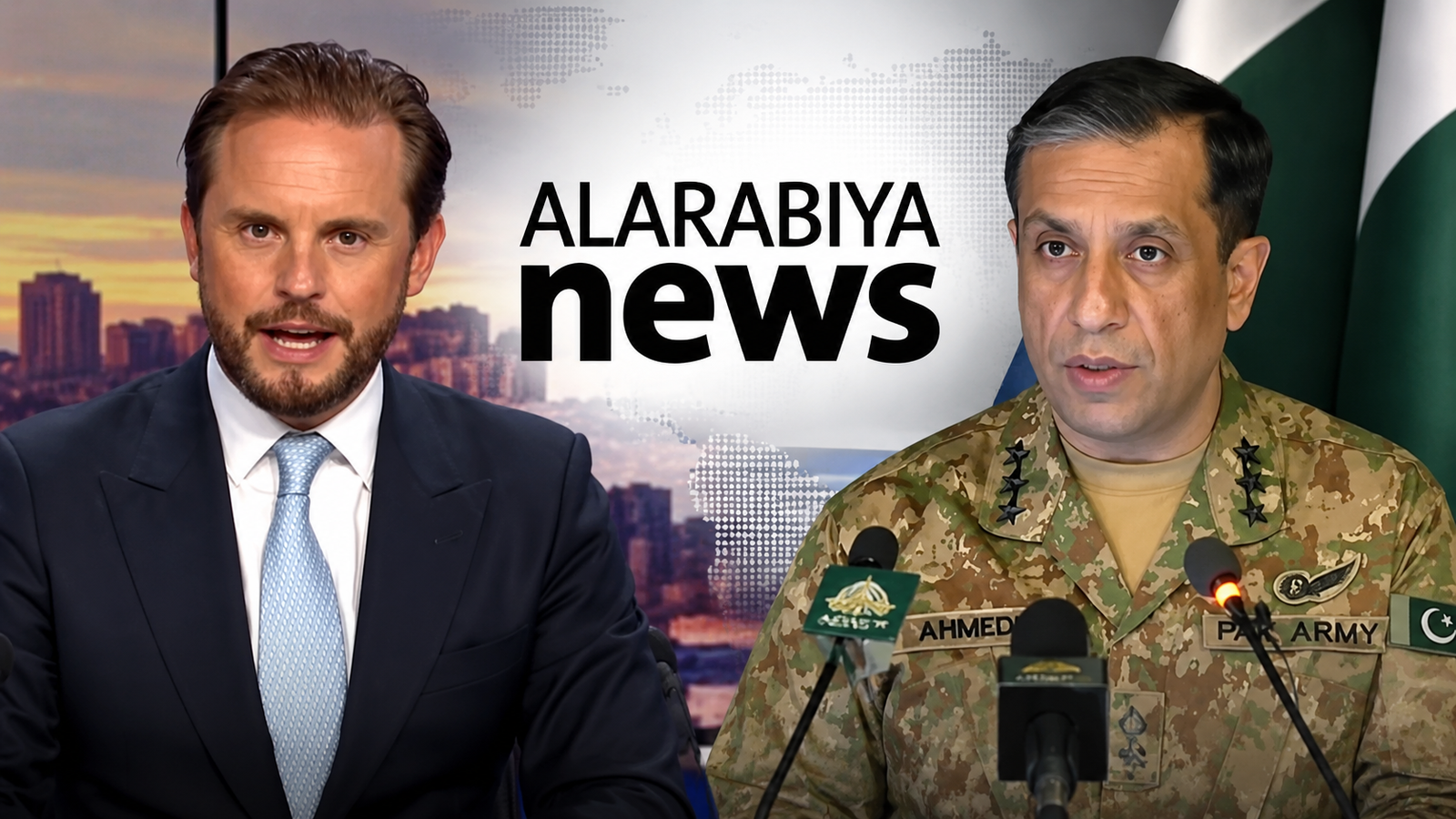
Pakistan’s military spokesperson, DGISPR, says the defence pact with Saudi Arabia and Turkiye is defensive, complements existing partnerships and seeks to strengthen regional peace, security and stability.
WEBDESK – MEDIABITES – Courtesy: DAWN
Inter-Services Public Relations Director General Lt Gen Ahmed Sharif Chaudhry has described the Makkah Defence Alliance between Pakistan, Saudi Arabia and Turkiye as a defensive framework designed around collective deterrence rather than broader regional ambitions.
Speaking in an interview with Al Arabiya English’s Global News Today, Lt Gen Chaudhry said the agreement formalised longstanding defence relationships among the three countries and should not be viewed as an arrangement directed against other states or existing partnerships.
“It is defensive. There’s nothing aggressive. There are no regional aspirations. It is collective deterrence,” he said, while describing the agreement as complementary to the members’ other international relationships.
Pact built around mutual defence
The Makkah Defence Alliance was established following an agreement signed by Pakistan, Saudi Arabia and Turkiye on Aug. 7. Under the publicly announced framework, an attack on one member is to be treated as an attack on all three.
Its first Strategic Political and Defence Committee meeting was held in Istanbul on Aug. 31. The three countries agreed to further institutionalise cooperation, strengthen collective deterrence and establish a secretariat in Saudi Arabia, initially headed by a Pakistani secretary general for three years.
Asked how the mutual defence commitment would work in practice if a member state came under attack, Lt Gen Chaudhry said operational details of defence arrangements were not normally made public.
He said implementation would be a matter for the three participating countries, while the publicly released text sets out the nature of their commitments.
Relationship with China
Lt Gen Chaudhry also rejected suggestions that the new framework could compete with Pakistan’s strategic relationship with China.
He said Pakistan’s ties with Saudi Arabia and Turkiye were longstanding and well understood internationally, while all three alliance members maintained strong relationships with Beijing. He characterised the pact as complementary to those relationships.
The alliance’s stated framework also stresses sovereignty, territorial integrity and non-interference. Turkish Foreign Minister Hakan Fidan said after the inaugural meeting that the arrangement was not directed against any particular country.
Could other countries eventually join?
On the possibility of expansion, Lt Gen Chaudhry said the agreement was not framed exclusively as an alliance of Muslim countries.
He said countries sharing principles including regional peace, stability, non-aggression, non-interference and collective deterrence could potentially become partners, but any decision on expansion would rest with the leadership of Pakistan, Saudi Arabia and Turkiye.
Fidan previously said a roadmap was being considered for a process through which other countries could join the arrangement.
Pakistan stresses diplomacy amid Middle East tensions
The interview also covered Pakistan’s efforts to encourage dialogue between the United States and Iran amid continuing Middle East tensions.
Lt Gen Chaudhry said the Makkah agreement did not complicate Pakistan’s position toward Iran and reiterated Islamabad’s preference for a negotiated settlement to regional conflicts. He described Pakistan’s diplomatic engagement as being driven by its interest in regional peace.
He said Pakistan’s political and military leadership had remained engaged with relevant parties in an effort to encourage dialogue rather than a military solution.
India dialogue remains possible
Discussing Pakistan-India relations, Lt Gen Chaudhry said military-to-military communication remained possible and noted that contact between the directors general of military operations had proved useful during and after the two countries’ May 2025 military confrontation.
He said Pakistan supported communication and engagement provided that such exchanges took place on equal terms and with respect for sovereignty and territorial integrity. On the broader question of resuming political dialogue, he said that decision rested with the political leadership.
The interview also covered Afghanistan, cross-border terrorism and security operations in Balochistan, with Lt Gen Chaudhry reiterating Pakistan’s position that Afghan territory should not be used for attacks against Pakistan.
For the Makkah Defence Alliance, however, his central message was that the three-country framework should be understood as a mechanism for deterrence and defence, rather than as the foundation of an offensive regional bloc.

