


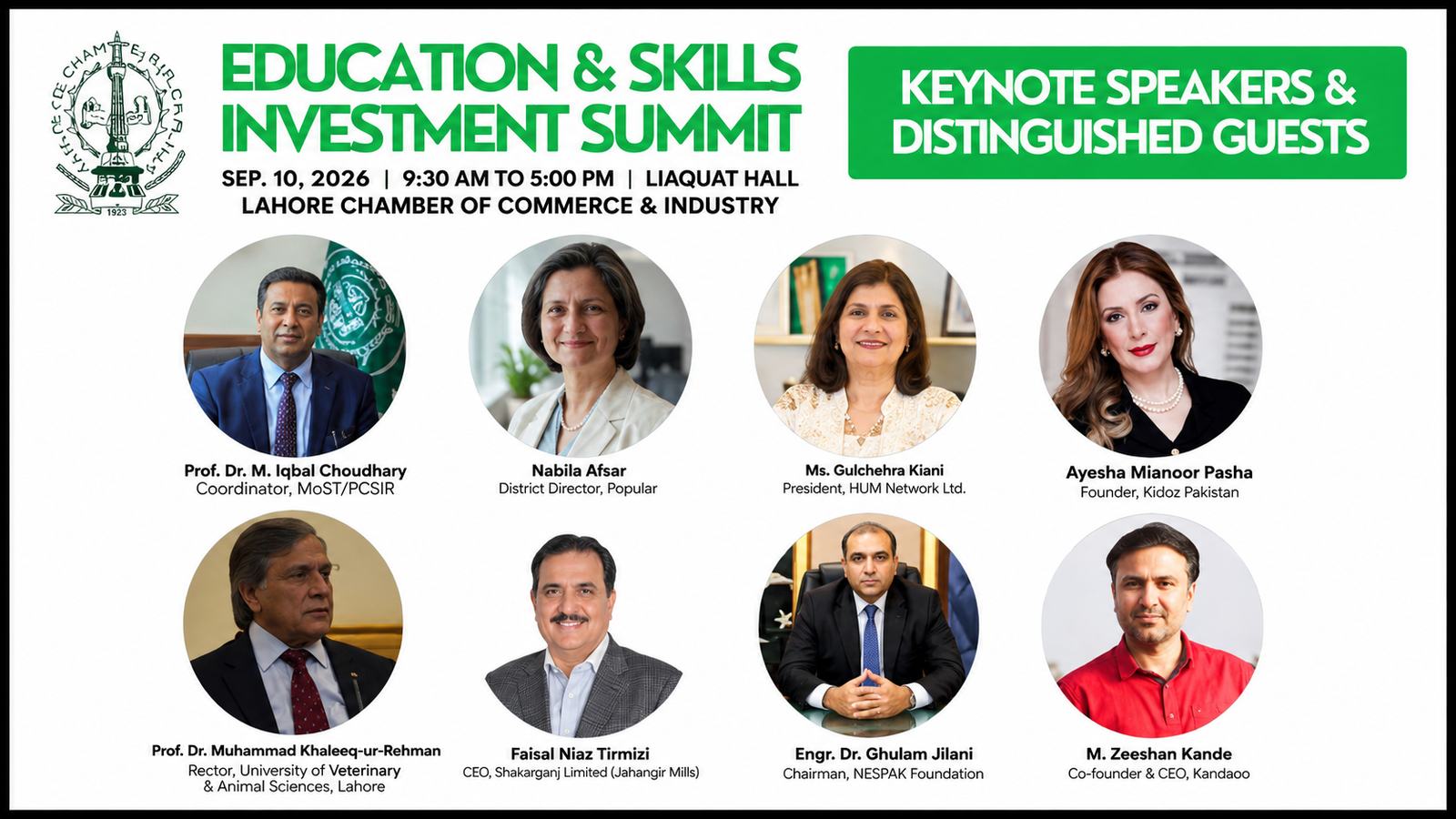
Pakistan’s first Global Education and Skills Investment Summit 2026 brings together top policymakers educators innovators and AI leaders at Lahore Chamber of Commerce on September 10 from 2 PM to 5 PM.
By Imran Malik | Education & Innovation Desk | MediaBites.com.pk
Pakistan’s education and skills ecosystem has a problem that everyone acknowledges, yet very few address in one room at a time. The policymakers who fund it. The academics who deliver it. The innovators who are transforming it. The institutions that regulate it. And the investors who can scale it.
On September 10, 2026, they will all be in the same room.
Pakistan’s First Global Education and Skills Investment Summit 2026 is convening at Ameen Hall, Lahore Chamber of Commerce and Industry from 2:00 PM to 5:00 PM, bringing together the country’s most influential impact creators across education, skills development, artificial intelligence, technology, academia, and policy in what promises to be one of the most consequential gatherings in Pakistani education in recent years.
Who Is Coming — The Most Impressive Speaker List in Pakistani Education
The summit’s speaker and participant list reads like a who’s who of Pakistani education leadership. Every name carries institutional weight and real decision-making authority.
Prof. Dr. M. Iqbal Choudhary — Coordinator General, COMSTECH, the Organization of Islamic Cooperation’s science and technology body whose Pakistan operations he leads from Islamabad.
Nishat Riaz — Chief Executive of the Malala Fund Pakistan, one of the most internationally recognized education advocacy organizations in the world.
Gulmina Bilal — Former Chairperson of NAVTTC, the National Vocational and Technical Training Commission, which oversees Pakistan’s technical and vocational education architecture.
Ayesha Manzoor Wattoo — Director General, PEMRA, Pakistan’s electronic media regulatory authority with significant influence over the media and education content landscape.
Prof. Dr. Mohammad Nizamuddin — Founding Chairperson of PHEC, the Punjab Higher Education Commission, the body responsible for overseeing higher education quality across Pakistan’s largest province.
Rao Khalid Mustafa — Honorary Consul General of Kazakhstan, representing international education cooperation dimensions.
Engr. Dr. Badar-ul-Islam — Chairman, BISE Lahore, the Board of Intermediate and Secondary Education Lahore, one of Pakistan’s most consequential examination bodies.
M. Tanveer Nandla — Founder of iSkills and Workar, bringing the entrepreneurship and skills technology perspective to the summit’s discussions.
Prof. Dr. Shahzad Ali Khan — Health Services Academy, Islamabad, representing the intersection of health education and professional development.
Faisal Manzoor — Chairman, Board of Governors, The University of Sialkot, representing Pakistan’s growing private university sector.
Prof. Dr. Saeed Ul Hasan Chishti — Pro Vice Chancellor, Rashid Latif Khan University.
Dr. Nadeem Bhatti — Vice Chancellor, Lahore Leads University.
Naheed Imran Gill — Secretary, Idara-i-Nazaria-i-Pakistan.
Dr. Izhar Ahmed Khan — Former Government Advisor on Foreign and Legal Education.
Dr. M. Ejaz Ahmed Sandhu — Director General BIPP at NetSol, bridging technology and education policy.
Prof. Dr. Ibrar Hussain — Director, Campus, COMSATS University Attock.
Why This Summit Is Different
Pakistan has held education conferences before. What makes the Global Education and Skills Investment Summit different is the deliberate convergence of three communities that rarely occupy the same space simultaneously.
Policymakers who control regulatory frameworks and government investment in education. Academics and institutional leaders who deliver education on the ground. And innovators and entrepreneurs building technology and skills platforms that are already reshaping how Pakistanis learn and work.
The summit’s focus on investment is particularly significant. Pakistan’s education crisis is not simply a policy failure or a quality failure. It is fundamentally a failure of resource allocation and investment. Bringing investors, policymakers, and educators into the same room at the same time is the first step toward closing that gap.
The inclusion of AI and technology as explicit focus areas reflects the urgency of preparing Pakistan’s workforce for an economy being reshaped by automation faster than the education system can adapt.
The Opportunity for Pakistan
Pakistan has 26 million out-of-school children, the second-highest number in the world. Its higher education sector serves a fraction of the age-eligible population. Its technical and vocational education system has historically been under-resourced and under-valued relative to the workforce development needs of a country of 240 million people.
A summit that brings together the Malala Fund, COMSTECH, NAVTTC, PEMRA, PHEC, BISE, and Pakistan’s leading universities in a single afternoon conversation is not a solution to those problems. But it is the kind of meeting that begins to build the shared understanding, the institutional relationships, and the investment frameworks that solutions require.
September 10. Ameen Hall. Lahore Chamber of Commerce and Industry. 2:00 PM to 5:00 PM.
— Imran Malik | Education and Innovation Desk | MediaBites.com.pk | SharjahNews.ae

