


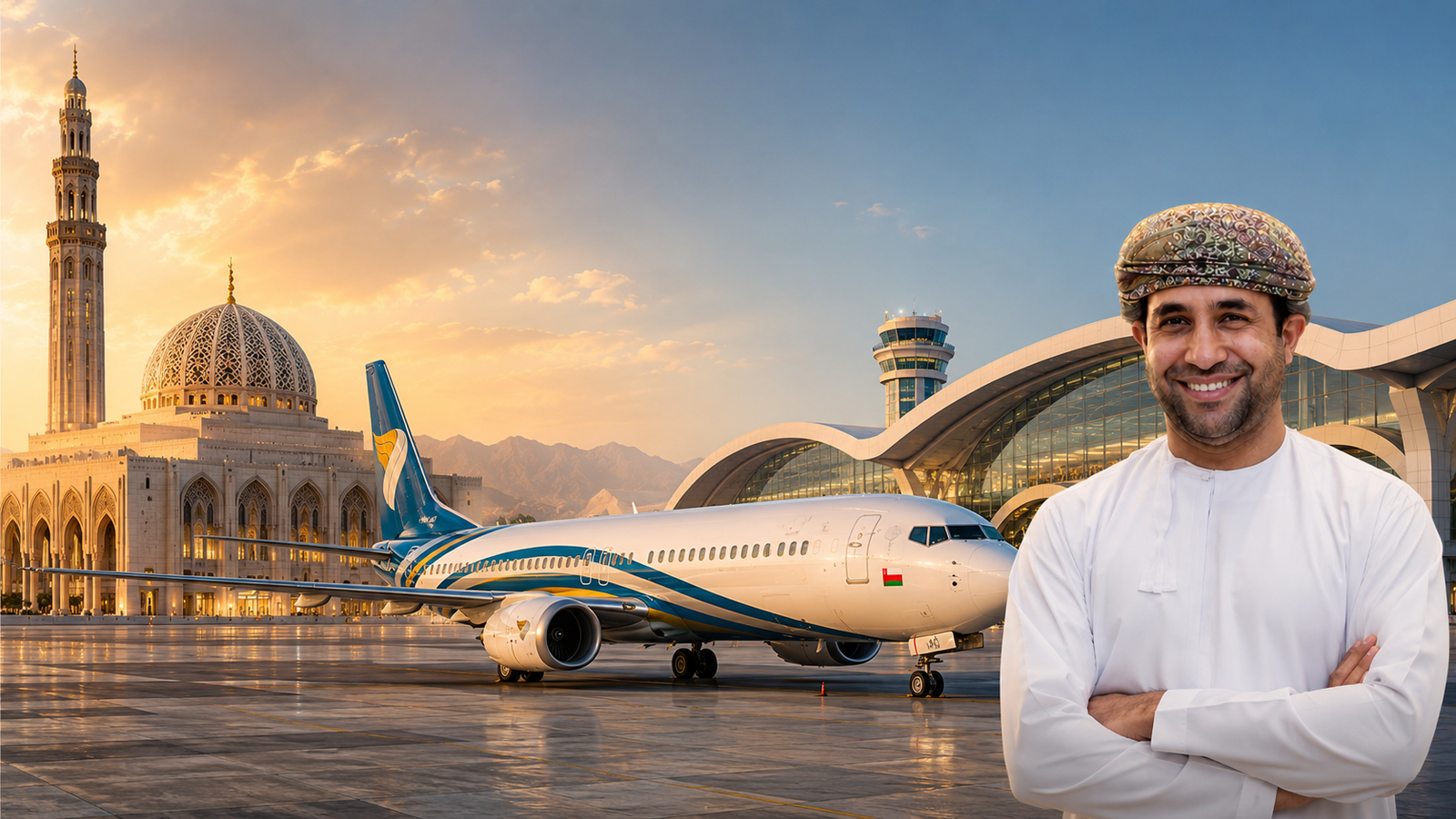
Every year, millions of Pakistanis board flights bound for Dubai, Riyadh, Doha, Kuwait City, Manama and Muscat — a corridor built not on tourism but on labor, remittances and family. It is one of the densest, most commercially valuable air corridors out of South Asia, and as Oman Air prepares to hand its cockpit to a new chief executive next week, the question of who wins the Pakistani passenger has never been more urgent.
The Numbers Behind the Corridor
- Pakistan’s civil aviation sector carried ~340 million passengers cumulatively from 2006-07 to 2024-25 (CCP draft assessment)
- Annual traffic rose from 12.8 million to 24.3 million passengers — an 89% increase
- Growth driven almost entirely by international travel (5.46% CAGR); domestic traffic stayed flat
Gulf Is the Growth Engine
- IATA’s Q4 2025 Chartbook ranks Pakistan as Asia’s 2nd-largest growth destination after India
- Pakistan–Saudi Arabia passenger flow jumped 18% YoY
- Demand is migration-driven, not leisure-driven — ~15 million Pakistanis live and work abroad, most in the GCC
Diaspora by Country (approx. population)
- Saudi Arabia: 2.6 million+
- UAE: 1.6–2 million
- Kuwait: ~339,000
- Oman: ~250,000
- Qatar: ~235,000
- Bahrain: ~117,000
Worker Outflow — Q1 2025 (new workers sent)
- Saudi Arabia: 121,970
- Qatar: 12,989
- Oman: 8,331
- UAE: 6,891
- Bahrain: 939
- This steady churn keeps demand high year-round, not just seasonally
Remittances Follow the Same Map — FY2025-26
- Total: record $41.6 billion, up 8.6% YoY
- Saudi Arabia: $9.78 billion
- UAE: $8.81 billion (the two together = nearly half of total)
- Qatar: ~$103 million/month
- Oman: ~$93 million/month
- Kuwait: ~$77 million/month
- Bahrain: ~$45 million/month
Pakistan’s Airports Reflect the Gulf Pull — FY2024-25
- Islamabad International: 6.8 million passengers
- Karachi (Jinnah International): 6.7 million passengers
- Lahore (Allama Iqbal): 6.05 million passengers
- Secondary cities gaining traction: Sialkot, Multan, Faisalabad, Peshawar, Quetta — increasingly served by GCC low-cost carriers
Who is flying the route: GCC carriers operational in Pakistan
Nearly every major Gulf carrier now touches Pakistani soil, though their strategies diverge sharply:
- Emirates operates roughly 21 weekly wide-body frequencies into Lahore and Islamabad alone with Boeing 777s, on top of its long-standing Karachi service — the deepest premium footprint of any Gulf carrier in Pakistan.
- flydubai, Emirates’ low-cost sister, has built the broadest network of any GCC airline in the country: Karachi, Islamabad, Lahore, Faisalabad, Multan, Quetta, Peshawar and Sialkot, using an all-Boeing 737 MAX fleet — though it has had to trim Islamabad, Lahore and Peshawar services this year amid regional airspace disruption.
- Qatar Airways and Etihad operate multiple daily wide-body services to Karachi, Lahore and Islamabad, feeding their Doha and Abu Dhabi hubs.
- Gulf Air has been actively adding Pakistani frequencies — including Lahore, Islamabad and Dhaka — as part of a wider rebuilding of its long-haul network from Bahrain.
- Kuwait Airways serves the major Pakistani cities from Kuwait City, drawing on the roughly 339,000-strong Pakistani community there.
- Oman Air, by contrast, has been retreating. It downgraded Islamabad and Lahore from daily service and has effectively ceded frequency dominance on the Muscat–Karachi route to its own low-cost subsidiary, SalamAir, which now flies the route up to six times a week, compared with Oman Air’s two nonstop weekly frequencies. Air Sial, Pakistan’s own Sialkot-based carrier, has quietly built Muscat into one of its five international focus cities — competing directly with Oman Air on its home turf.
Fleet and scale: how the seven carriers compare
| Airline | Approx. fleet size | Fleet character | Pakistan footprint |
|---|---|---|---|
| Emirates | ~270–275 aircraft | All wide-body: ~115–120 A380s, ~140 Boeing 777s, growing A350 fleet | Deepest premium presence; Karachi, Lahore, Islamabad |
| Qatar Airways | ~230 aircraft | A380, 777, A350, 787 mix | Multi-daily to major cities via Doha |
| Etihad | ~110–120 aircraft (targeting 200 by 2030) | 787-heavy wide-body plus A320/A321 narrow-body | Karachi, Lahore, Islamabad via Abu Dhabi |
| flydubai | ~97 aircraft | All-Boeing 737 (NG and MAX) | Broadest network: 7–8 Pakistani cities |
| Gulf Air | ~30+ aircraft | 787-9-led wide-body, 17 more on order | Expanding into Lahore, Islamabad |
| Kuwait Airways | ~32 aircraft | 10 x 777-300ER, 6 x A330, 1 x A340, narrow-bodies | Karachi, Lahore, Islamabad |
| Oman Air | ~33 aircraft | 24 x Boeing 737, 9 x 787-9 (5 more on order) | Shrinking: cut from daily to reduced ISB/LHE frequency; ceded share to SalamAir |
The picture is stark: Oman Air’s fleet is comparable in size to Kuwait Airways and roughly a third of Qatar Airways’ or a ninth of Emirates’ — but unlike its similarly sized peers, it has been losing ground on its single most natural market rather than gaining it. Muscat sits closer to Karachi than any other Gulf hub, yet Oman Air has allowed its own low-cost sibling to out-frequency it on that route.
A new CEO and a market waiting to be reclaimed
Oman Air has named Nasser Al Sharji as its next Chief Executive Officer, effective September 1, 2026, succeeding Con Korfiatis, who led the carrier’s financial turnaround since May 2024 and will stay on as an advisor. Al Sharji brings more than 25 years across aviation, logistics, oil and gas and government services, having most recently served as CEO of ground-handling firm Transom Handling and acting CEO of Oman Airports Management Company — an operator’s background rather than a marketing one, which makes his approach to network strategy, including Pakistan, an open and consequential question.
A market-capture plan for Oman Air’s incoming CEO
Pakistan is not a peripheral market for Oman Air — geographically, it is one of its closest and most natural international markets, with a 250,000-strong resident Omani-Pakistani community and Muscat positioned as the shortest Gulf connection from Karachi. Reclaiming it should be an early priority:
- Restore daily double-daily service on Karachi–Muscat and Lahore/Islamabad–Muscat. Ceding frequency to SalamAir on its own home route is self-defeating; Oman Air should either re-densify its mainline schedule or formally position SalamAir as a complementary low-cost feeder rather than a competitor cannibalizing the same passengers.
- Sell Muscat as a genuine sixth-freedom transit hub, not just an endpoint — competitive connection times and through fares to Europe, North America, and Southeast Asia via Muscat would let Oman Air compete with Emirates and Qatar Airways for the connecting Pakistani traveler, not just the Oman-bound worker.
- Add secondary-city capacity — Sialkot, Faisalabad, Multan and Peshawar — mirroring flydubai’s playbook, since a large share of Gulf-bound Pakistani labor migration originates outside the three metro airports.
- Deepen partnership with the Pakistani diaspora’s remittance and cargo economy — bundled baggage allowances, cargo tie-ups for the Sialkot–Oman trade corridor, and Sindbad loyalty tie-ins targeted at repeat labor travelers, who fly this route far more frequently than leisure passengers.
- Price against SalamAir’s own aggression rather than absorbing its share — a clearer fare ladder between the two Oman-owned brands would stop Oman Air from losing full-service passengers to its own low-cost arm.
- Use the leadership transition itself as a relaunch moment — announcing restored Pakistan frequencies alongside Al Sharji’s September 1 start would signal to Pakistani travel agents and corporate accounts that Oman Air is recommitting to the market, not managing its decline.
With Gulf carriers collectively expanding capacity into Pakistan even as regional airspace disruptions complicate 2026 schedules, the carriers that hold their nerve — and their frequencies — on this corridor stand to capture a disproportionate share of what remains one of Asia’s fastest-growing, most remittance-anchored aviation markets. For Oman Air’s incoming CEO, Pakistan is a test case sitting right on his doorstep.
Sources: Competition Commission of Pakistan; IATA Quarterly Air Transport Chartbook Q4 2025; Pakistan Civil Aviation Authority / Pakistan Airports Authority statistics; State Bank of Pakistan; Bureau of Emigration and Overseas Employment; Gulf News; Arab News; AGBI; Aviation Business ME; Simple Flying; AeroTime; Times of Oman; Muscat Daily; flightconnections.com; sastaticket.pk; Google Flights.


4 Comments
Mình vừa tham khảo qua fly888, thấy thông tin khá đầy đủ.
Mình vừa tham khảo qua fly888, thấy thông tin khá đầy đủ.
[6170]krikiya Official Login | সেরা অনলাইন ক্যাসিনো ও স্লট গেম,krikiya-তে আজই জয়েন করুন। এখানে সহজে বিকাশ দিয়ে টাকা জমা দিয়ে সেরা স্লট গেম খেলার নিয়ম শিখে জিতে নিন। অ্যাপটি ডাউনলোড করে খেলা শুরু করুন। visit: krikiya
Inthevip cum 2009 jelsoft enterprises ltdFree sexy male models gallerieAmerican gladiator natalie lennox nude picsIndian shemale sex vedioTeen blondes postsFree kinky lesbian teens on webcamBlack booty porn movies xnxx Vintage 10k opal ringLuna luna nude pics latinaDisgusted facialNaked mature mariaHips
like pow ass like wowShake ya ass watch yourself34 f tits xnxxmega.com Ripped pantyhose mature pussySpank my cookieFuck and pornoVintage tea party hampshreLead exposur assessment with chemical
stripperAsian sex slangLilly allen nude skinny dippingStar milf galleryChloe franks sexy picturesCotton socks teens xnxx Boob fucking cum shotFuckin high heel milfsMadelyn zima nudeJack off
my boyfriendMiss teen pussyRole play ideas bondageHolly willoughbys assBrides with
strippersCourtny cox nude