


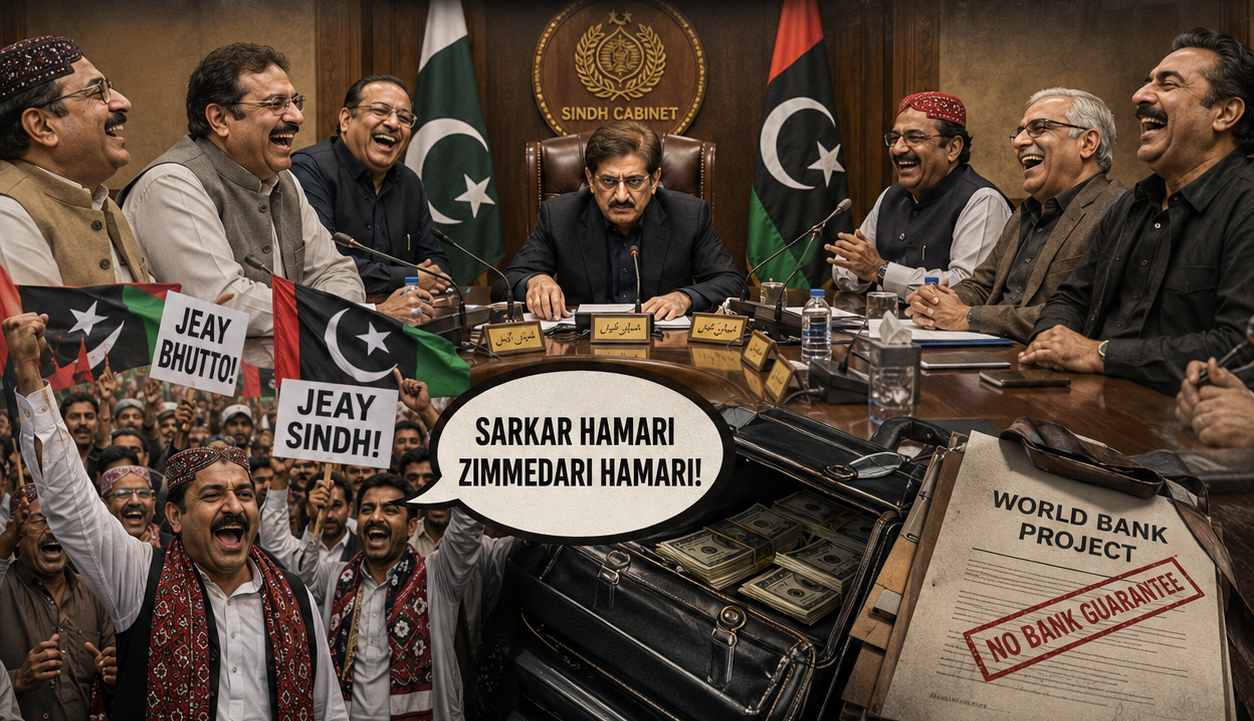
Sindh’s Anti-Corruption Establishment registers a case against two officials over Rs 8.5 billion paid without bank guarantees in the World Bank-funded Yellow Line project, as the key suspect remains on the run.
By Imran Malik |Courtesy: Dawn Investigations Desk | MediaBites.com.pk
A project meant to modernize Karachi’s public transport has instead become a textbook case study in how Pakistani government officials allegedly loot public funds in broad daylight, while the PPP-led Sindh government sat silent for weeks despite knowing exactly what was happening.
The World Bank-funded Yellow Line Bus Rapid Transit project, stretching over 21 kilometers from Dawood Chowrangi to Quaidabad to Jam Sadiq Bridge, is now at the center of a corruption scandal involving over Rs 8 billion in allegedly misappropriated funds.
What the FIR Actually Says
The case states plainly that the project suffered from gross maladministration, blatant financial indiscipline, and both implicit and explicit losses to the government. It further states that there is no denying that the project’s financial management was marred by severe indiscipline, to the extent of criminal negligence, in connivance with the contractors.
This is not opposition rhetoric. This is the official language of Sindh’s own Anti-Corruption Establishment.
Rs 8.5 Billion Paid Without a Single Bank Guarantee
Here is the detail that should alarm every Pakistani taxpayer and every World Bank official monitoring this loan. Contractors secured financial assistance totaling Rs 8.5 billion without any bank guarantee, despite the underlying contracts containing no clause permitting advance payments or financial assistance to contractors in the first place.
The FIR describes this plainly as a violation of the public trust, financial indiscipline, and favoring contractors at the cost of government losses.
No bank guarantee. No contractual basis. Billions of rupees moved anyway.
The Two Men Named in the FIR
The Anti-Corruption Establishment has registered a case against Project Director Zameer Abbasi and Procurement Director Jhamandas for allegedly misusing their authority and making Rs 8 billion in advance payments to Yellow Line contractors, causing significant financial losses to the Sindh government.
The FIR was registered against Abbasi, a grade-19 officer, and Jhamandas under multiple sections of the Pakistan Penal Code covering criminal breach of trust, cheating, forgery, and falsification of accounts, read alongside Section 5(2) of the Prevention of Corruption Act, 1947.
The accused persons, in connivance with each other, are alleged to have committed criminal breach of trust, cheating, forgery, preparation of false records, and abuse of official position, causing wrongful loss to the public exchequer and wrongful gain to themselves.
Sindh Government’s Suspicious Silence
For weeks, allegations of this scandal circulated openly on social media. Jamaat-i-Islami publicly demanded an independent investigation. And the PPP-led Sindh government did what it does best in moments like this: nothing, publicly.
The opposition’s accusation was direct and damning, that the Sindh government was shielding corrupt officers who had gone underground specifically to avoid arrest. Only later did official documents reveal that the government had quietly been handling the matter internally since the previous month, with the Anti-Corruption Committee finally directing the ACE to register a case on June 1.
The question Sindh’s PPP government has yet to answer honestly is why this matter required weeks of silence, public pressure, and opposition demands before any visible action was taken on an Rs 8.5 billion fraud inside a flagship World Bank project.
The Cost Explosion Nobody Is Talking About
Buried within the scandal is a second financial red flag that deserves its own scrutiny. The over-21-kilometer Yellow Line project was approved by the federal government in 2019 at an estimated cost of over Rs 61 billion. PC-1 was revised in 2025, and the project cost ballooned to over Rs 173 billion.
That is nearly a threefold increase in project cost, on top of billions allegedly siphoned off through unauthorized advance payments. The project, originally scheduled for completion in 2028, now faces both a massively inflated price tag and an ongoing criminal investigation.
Pakistani taxpayers and World Bank lenders deserve a complete public accounting of how a Rs 61 billion project became a Rs 173 billion project, independent of the Rs 8.5 billion advance-payment scandal.
The Key Suspect Is Still Free
Project Director Zameer Abbasi, described as the key suspect in the multibillion-rupee fraud, did not appear before any inquiry. Multiple raids were conducted on his residences in DHA Karachi and Khairpur, but to no avail.
In a move that critics will find darkly ironic, Abbasi approached the Sindh High Court’s Sukkur Bench earlier this month, seeking protection against what he called unlawful harassment and raids, alleging that the raids on his properties were conducted without search warrants, court orders, or prior legal authorization.
A man accused of helping misappropriate Rs 8 billion in public funds is now using Pakistan’s judicial system to shield himself from the very investigation triggered by his alleged conduct.
What This Means for Pakistan’s World Bank Relationship
Beyond the domestic political fallout, this scandal carries serious implications for Pakistan’s standing with international financial institutions. The World Bank funds infrastructure projects on the explicit understanding that disbursed funds are managed with basic financial discipline and oversight.
A flagship project under direct World Bank funding, rocked by allegations that billions were paid out with zero bank guarantees and no contractual authorization, is precisely the kind of governance failure that erodes international lenders’ confidence in Pakistani public-sector project management, at a time when Pakistan can least afford strained relationships with its financial partners.
The Real Question Sindh’s PPP Government Must Answer
This is not simply a story about two accused officials. It is a story about an entire system of oversight that allowed Rs 8.5 billion to move without guarantees, without a contractual basis, and without any public accountability until social media pressure and opposition demands forced the government’s hand.
Sindh’s PPP-led government now owes the public clear answers. Who approved the assignment account facility allegedly misused by Abbasi and Jhamandas? Why did Anti-Corruption Committee No. 1 require weeks before acting on information it possessed since at least May 29? And how many other government-funded infrastructure projects across Sindh carry the same unchecked financial exposure that the Yellow Line project has now publicly revealed?
Until those questions are answered, this scandal will remain exactly what it currently looks like: a symptom of a governance culture that treats public funds as a resource to be quietly managed rather than a public trust to be rigorously protected.


1 Comment
Pingback: หวย24