


By Imran Malik | Satire and Opinion Desk | Courtesy: Rauf Klasra
Pakistan has once again demonstrated its extraordinary talent for combining institutional power, personal nepotism, and spectacular unprofessionalism into one beautifully concise fifteen-minute package.
Efficiency, thy name is Pakistan.
The Scene: An Inquiry That Forgot to Inquire
Dr. Iqbal Chaudhry is not a minor figure. He is a Fulbright scholar, an internationally recognised educationist, and the coordinator of OIC COMSTECH in Pakistan, a prestigious position within the Organisation of Islamic Cooperation’s science and technology body. His credentials, by any reasonable measure, are formidable.
But credentials, as Pakistan consistently reminds us, are only as valuable as the protection they receive from people in power. And when the people in power have other plans, credentials become merely an inconvenience to be shouted at and escorted out of the room.
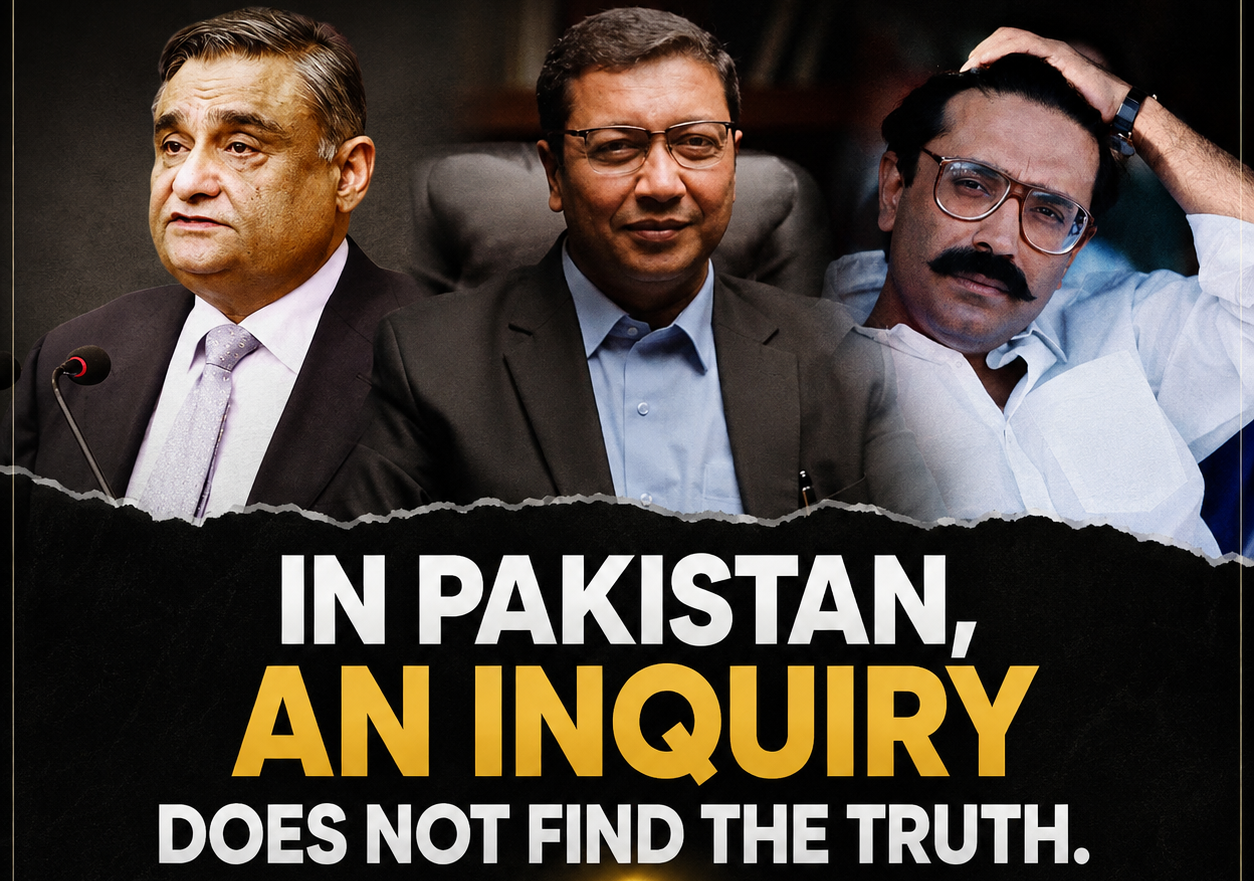
Dr. Iqbal has written a sensational letter directly to President Asif Ali Zardari describing what happened when he appeared before an inquiry committee headed by Dr. Asim Hussain, a figure apparently chosen for his inquiry skills, which, based on the available evidence, consist primarily of volume and creative vocabulary.
The Fifteen-Minute Masterpiece
Dr. Iqbal arrived at the inquiry with a reasonable request. He asked Dr. Asim to tell him what the charges against him actually were, so that he could prepare a response. This is, in most legal systems and most functional countries, considered the bare minimum of due process.
He even produced an Islamabad High Court order directing the inquiry committee to share the details of the allegations so that he could respond in accordance with the principles of justice.
At this point, a reasonable inquiry committee chairperson would have produced the charges, allowed Dr. Iqbal to review them, and scheduled a proper hearing.
Dr. Asim, apparently, is not a reasonable inquiry committee chairperson.
What followed, according to Dr. Iqbal’s letter, was a verbal performance of remarkable aggression. Dr. Asim allegedly told the internationally recognised scholar that he was a “psychological patient and corrupt.” He allegedly told him to “stop talking nonsense.” He allegedly revealed that he had obtained Dr. Iqbal’s phone call records through his high-level connections. He allegedly issued a geographical warning, reminding Dr. Iqbal that he still had to “go to Karachi,” a statement whose implications require no translation in Pakistani professional culture.
And then, as a fitting conclusion to this inquiry into an international scholar’s professional conduct, Dr. Asim allegedly shouted: “Get out of the room. Be gone.”
Fifteen minutes. Not a single formal charge stated. One court order ignored. Several insults delivered. And Federal Secretary Shahid Iqbal Baloch, a member of the inquiry committee, was reportedly present throughout this entire performance.
Minutes of the meeting were reportedly recorded by the Director of Education at the Presidency, Asad Sahib. One assumes those minutes will be a fascinating document.
The Actual Purpose of the Inquiry
Here is where Pakistani institutional theatre achieves its purest and most clarifying form.
Dr. Iqbal states in his letter to President Zardari that the reason for this treatment is simple, direct, and requires no elaborate theorising.
Dr. Asim allegedly wanted Dr. Iqbal to resign from his OIC position immediately, by phone, before the inquiry even began. Dr. Iqbal declined.
The reason Dr. Asim allegedly wanted the position vacated urgently?
He wants to give it to his wife.
Let us pause to appreciate the elegant simplicity of Pakistan’s institutional machinery at its finest. An internationally recognised Fulbright scholar is summoned to a formal government inquiry. The inquiry committee head allegedly skips the charges, skips the due process, skips the High Court order, and proceeds directly to insults and threats. The entire exercise, it is alleged, exists not to investigate any wrongdoing but to pressure a qualified professional out of his position so that it can be handed to the committee chairperson’s spouse.
President Zardari’s close associate. Running an inquiry. To vacate a job. For his wife.
This is not corruption. This is artistry.
A Note on the Inquiry System
Pakistan’s inquiry committees are a remarkable institution. They are convened to establish facts, hear evidence, and deliver conclusions based on the balance of evidence presented.
In practice, based on the account Dr. Iqbal has placed on the record, they appear to sometimes function as fifteen-minute shouting sessions designed to produce a pre-determined outcome for personal benefit.
Dr. Iqbal has written to President Zardari. He has cited a High Court order. He has requested the meeting minutes. He has named the Federal Secretary who was present. He has described the threats made about Karachi.
He has done everything a citizen with legitimate grievance is supposed to do when the system fails them.
The question, as always in Pakistan, is whether anyone with the authority to act on that letter will read it as anything other than another document to be quietly filed and forgotten.
In Conclusion
Pakistan has given us many things. Cricket upsets. Nuclear capability. Constitutional amendments in the middle of the night. Award ceremonies for ministers who announce system collapse.
And now: a fifteen-minute inquiry that forgets to mention the charges, cites a wife’s career ambitions as its operational objective, and concludes with an internationally acclaimed scholar being told to “be gone” by someone who reportedly used his personal connections to obtain private phone records.
The system has not collapsed, Minister Naqvi.
It is performing exactly as designed.
This is a satirical opinion piece based on a letter reportedly written by Dr. Iqbal Chaudhry to President Asif Ali Zardari. All allegations cited are drawn from Dr. Chaudhry’s own letter and remain unverified. MediaBites invites Dr. Asim Hussain, Federal Secretary Shahid Iqbal Baloch, and the Presidency to share their official response for publication.


2 Comments
Finally found a reliable link that actually works. The slots are exciting and the bonuses are generous. I’m having a great time here. Check bigslot288link
Thanks for sharing superb informations. Your site is very cool. I am impressed by the details that you have on this website. It reveals how nicely you perceive this subject. Bookmarked this website page, will come back for more articles. You, my friend, ROCK! I found simply the info I already searched all over the place and simply couldn’t come across. What an ideal web-site.