


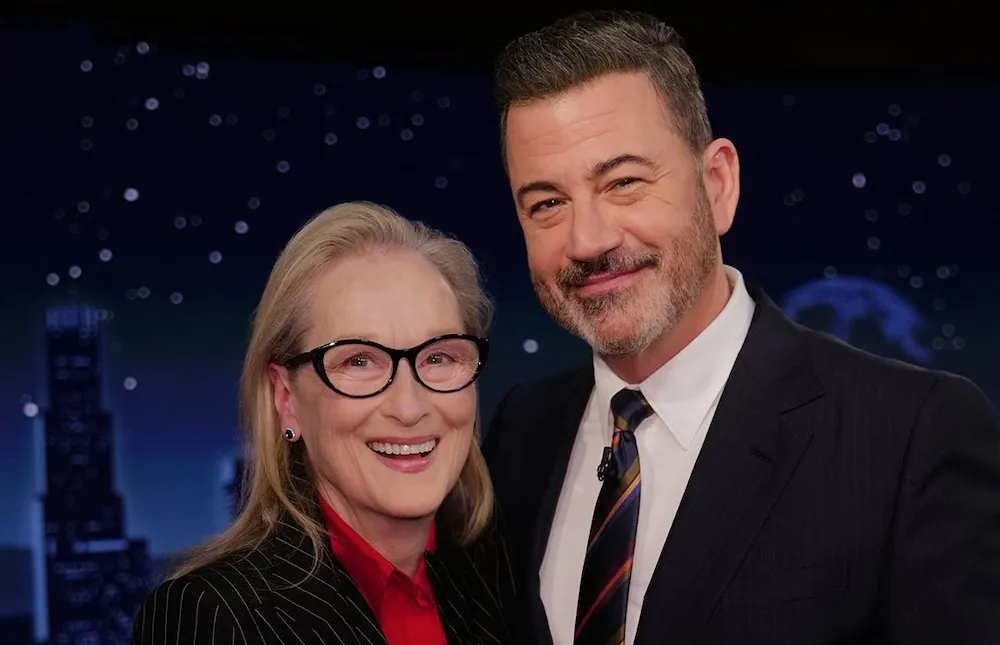
Meryl Streep publicly backed Jimmy Kimmel after Donald Trump demanded his firing, framing the clash as a defining moment for press freedom and political pressure on media voices.
Webdesk – MediaBites News – Courtesy: South Era Network

In a moment that blurred the lines between entertainment and political confrontation, Meryl Streep stood firmly beside late-night host Jimmy Kimmel, offering a forceful defense of media independence after Donald Trump publicly called for Kimmel’s dismissal.
The controversy erupted after Trump took to Truth Social, demanding ABC remove Kimmel, branding him “seriously unfunny” and questioning the show’s ratings—despite industry data indicating stable viewership. The remarks followed a monologue in which Kimmel mocked Trump and former First Lady Melania Trump, triggering a rapid escalation from satire to political pressure.
Appearing on Jimmy Kimmel Live! During a promotional tour for The Devil Wears Prada 2, Streep did not sidestep the tension. Instead, she elevated the moment into a broader defense of journalism and free expression.
“You’re carrying the banner of freedom of the press,” she told Kimmel, framing the host not merely as an entertainer but as a symbolic figure in an increasingly fraught media environment.
Kimmel, striking a more restrained tone, replied: “I’m just trying to do some jokes.”
But the exchange underscored a deeper reality: in today’s polarized landscape, even late-night satire is no longer insulated from political retaliation.
Streep’s intervention carries added weight given her portrayal of Washington Post publisher Katherine Graham in The Post, a film centered on the release of the Pentagon Papers and the press’s role in challenging government authority.
From a media perspective, the incident signals an intensifying collision between political power and entertainment platforms that double as commentary arenas. What was once dismissed as late-night humor is now increasingly treated as political messaging—subject to backlash, scrutiny, and calls for accountability.
The chilling undertone lies in normalization: when public calls for the removal of media figures become routine, the boundary between criticism and coercion begins to erode.
For networks like ABC, the moment raises a familiar yet urgent question: how to navigate political pressure without compromising editorial independence.
For audiences, it is a stark reminder that the fight over narratives is no longer confined to newsrooms. It now plays out nightly under studio lights, where jokes can trigger power and laughter can invite consequences.

