


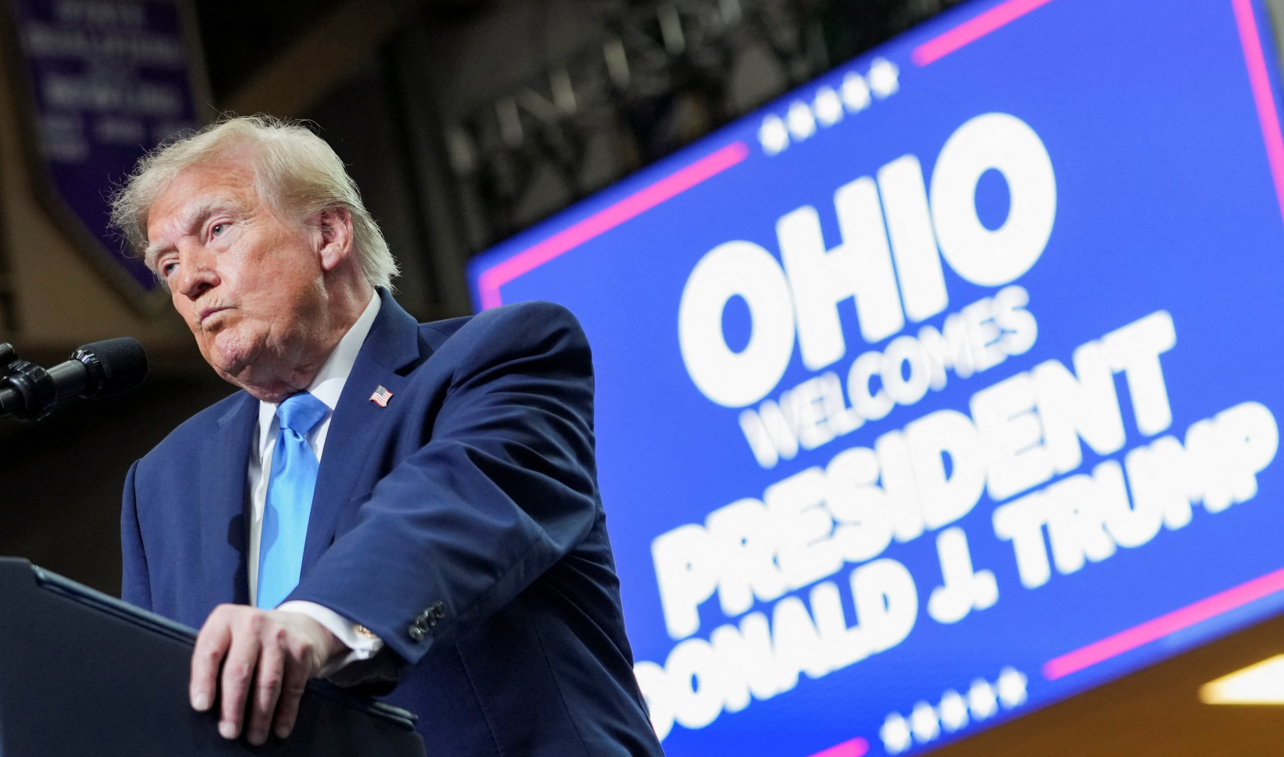
Donald Trump urged Ohio voters to back Republicans in November, warning he would be less inclined to help the state if Democrats win key races.
WEBDESK – IMRAN MALIK
U.S. President Donald Trump used a campaign rally in Ohio to warn voters that electing Democrats in the upcoming midterm elections could make it harder for the state to secure support from his administration.
Speaking Saturday at Butler High School in Vandalia, Trump rallied behind Republican candidates including Sen. Jon Husted and gubernatorial candidate Vivek Ramaswamy, while launching a series of profane attacks on Democrats.
“Just get out and vote,” Trump told supporters, predicting Republicans would win decisively. He also suggested that Ohio could receive more federal assistance if voters kept Republicans in office.
Trump went further when discussing Democratic gubernatorial candidate Amy Acton, saying he would not be inclined to assist her if she wins.
“But I’m not going to help her,” Trump said, according to Reuters.
The remarks inject an unusually direct political dimension into the relationship between federal support and state election results, as Ohio becomes an important battleground ahead of the Nov. 3 midterms.
Ohio emerges as a key Senate battleground
Ohio is among the states where Republicans are facing a competitive Senate race. Republican incumbent Jon Husted faces former Democratic Sen. Sherrod Brown, while Ramaswamy competes against Democrat Amy Acton for governor.
Democrats will decide control of both chambers of Congress in the November elections, hoping to capitalize on concerns over the economy, prices, and Trump’s declining approval ratings.
Trump, however, told the Ohio crowd that Republicans could outperform expectations.
“I think we’re going to have a big surprise because they don’t know what’s happening,” he said.
Husted is relying heavily on Trump’s ability to mobilize Republican voters, particularly those who might otherwise stay home during a midterm election.
At the rally, Husted attacked Brown over his long political career, asking supporters whether they could identify a major accomplishment that had benefited them.
Brown’s campaign, meanwhile, accused Husted of putting corporations and wealthy Americans ahead of ordinary Ohioans and criticized his support for Trump’s policies on Iran.
Rising gasoline prices create political pressure
The political fight comes as Ohio voters face rising household costs.
Average gasoline prices in Ohio have climbed 35% over the past year to about $4.16 per gallon, according to AAA data cited by Reuters.
That increase is a major concern for voters who say higher fuel costs make it harder to manage household budgets.
Jonathan Smith, a 19-year-old construction worker and independent voter, stood outside the rally holding a sign asking: “Where are my lower gas prices?”
Smith said he was saving for a wedding and that rising gasoline costs were making it increasingly difficult to put money aside.
His comments reflect a broader challenge for Republicans: turning Trump’s political energy into support from voters primarily concerned about prices and their personal finances.
Data centers become another Ohio campaign issue
The campaign is also being shaped by a growing debate over data centers and artificial intelligence infrastructure.
Ohio has emerged as an important destination for large data-center investments, but the projects have generated concerns about energy use, taxes, infrastructure, and their impact on local communities.
Some Republican voters at the rally welcomed the investments, while others expressed reservations.
The issue has become particularly significant in the Husted-Brown race, with Brown’s campaign accusing Husted of supporting favorable tax arrangements for data-center companies.
Outside political groups have already spent tens of millions of dollars on the Ohio Senate contest, making it one of the most expensive Senate races in the country, according to Federal Election Commission filings.
Why Ohio matters to Pakistan and the wider world
For American voters, the Ohio contests could help determine which party controls Congress and how much political support Trump has during the second half of his presidency.
For Pakistan and other countries watching Washington, the outcome could also have broader implications.
A stronger Republican majority could give Trump greater freedom to pursue his domestic and foreign-policy agenda, including trade, immigration, military policy and relations with allies and rivals.
Ohio’s election therefore extends beyond a local political contest. It is part of a wider national referendum on Trump’s presidency, the American economy and the direction of U.S. policy.
Trump’s warning that he may be less willing to help Democratic-led Ohio officials adds another layer to an increasingly confrontational midterm campaign, putting federal-state relations directly into the election debate.


3 Comments
I truly appreciate your technique of writing a blog. I added it to my bookmark site list and will
I appreciate you sharing this blog post. Thanks Again. Cool.
I truly appreciate your technique of writing a blog. I added it to my bookmark site list and will