


By Imran Malik | World Affairs & Media Industry Desk | MediaBites.com.pk
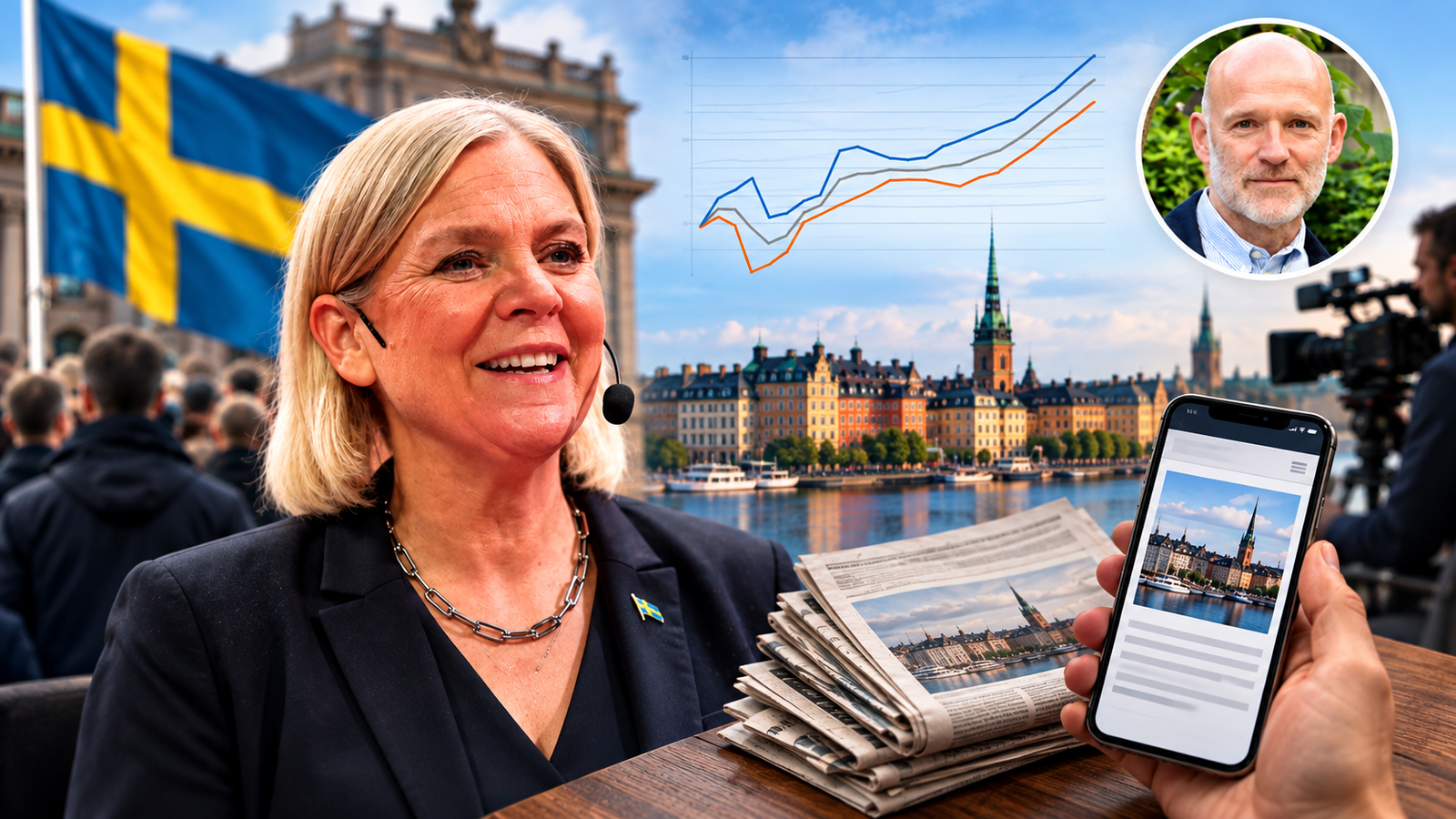
Sweden’s centre-left opposition narrowly defeated the right-wing governing bloc by just 26169 votes as Swedish digital news revenues grew 16 percent year on year in the first half of 2026.
Sweden delivered two remarkable stories this week. One about the knife-edge of democracy. One about the health of the journalism that holds democracy accountable.
Both are worth telling together.
The Election — 26,169 Votes Between Two Visions of Sweden
After 99 percent of votes were counted in Sunday’s parliamentary election, Sweden’s public broadcaster SVT declared that the centre-left opposition had defeated the incumbent right-wing governing bloc by the slimmest of margins.
26,169 votes separated the two blocs in a country of 10 million people.
Magdalena Andersson’s Social Democrats and their opposition allies were on track to win 175 seats in the 349-seat Riksdag, against 174 seats for incumbent Prime Minister Ulf Kristersson’s right-wing bloc, which includes the far-right Sweden Democrats.
“The likelihood of a turnaround at this stage is so low that we can confidently state that the opposition will secure the most seats in this election,” SVT said.
Sweden’s election authority was still counting late incoming ballots from home and overseas, with the process expected to continue until Thursday before all votes are accounted for. The result signals a change of government in one of Scandinavia’s most watched political systems.
The Media Story Nobody Expected
While Sweden counted votes, WAN-IFRA CEO Stig Kirk Ørskov published a piece on LinkedIn asking a question that the global journalism industry desperately needs answered.
Why be optimistic about the future of news media?
His answer came in the form of a single chart and a single statistic that deserves the attention of every publisher, editor, and media entrepreneur in the world.
Swedish digital news reader revenues grew 16 percent year on year in the first half of 2026.
This is not a number from one large national brand capitalising on its scale. The growth is genuinely broad. Metropolitan publishers saw 11 percent year-on-year digital revenue growth. Local and regional publishers grew by an extraordinary 22 percent in the same period.
Local news is not dying in Sweden. It is accelerating.
Total reader revenue grew by 3 percent in both Q2 and the first half of 2026. Since late 2020, it has increased by nearly 8 percent, with almost half of that growth coming in the past year alone.
Why Sweden Is the World’s Most Interesting News Market
32 percent of Swedes now pay for online news — one of the highest levels anywhere in the world according to the Reuters Institute for the Study of Journalism.
That statistic connects the two stories this week in a way that is more than coincidental. A society where nearly a third of the population voluntarily pays for journalism is a society that understands the relationship between a free press and a functioning democracy.
Sweden just had a parliamentary election decided by 26,169 votes out of millions cast. Every one of those voters was forming opinions, reading news, and making decisions based on the journalism available to them. The 32 percent who pay for digital news are investing directly in the information environment that makes democratic participation meaningful.
Stockholm 2027 — The World Comes to Learn
WAN-IFRA has announced that the World News Media Congress will come to Stockholm in June 2027 in collaboration with Bonnier News and Amedia. Ørskov described it as a unique opportunity for the global industry to study some of the strongest examples of reader revenue development anywhere in the world.
For MediaBites, as a WAN-IFRA member following these developments closely, the Stockholm Congress represents exactly the kind of international knowledge exchange that Pakistan’s growing digital news sector needs to learn from. If local and regional Swedish publishers are achieving 22 percent digital revenue growth, the model they are using is worth understanding and adapting.
The Connection Pakistan Must Note
Pakistan’s digital news industry is at a much earlier stage than Sweden’s. But the Swedish story contains lessons that apply regardless of market maturity.
Reader revenue is built on trust. Trust is built on independence. Independence requires financial sustainability. And financial sustainability in 2026 comes from readers who value journalism enough to pay for it.
Sweden’s 32 percent paid news rate did not happen overnight. It was built through years of consistent, credible, independent reporting by publishers who invested in quality before they invested in monetisation.
Sweden’s election was decided by 26,169 votes. Its journalism was paid for by millions. The connection between those two facts is not coincidental.
— Imran Malik | World Affairs and Media Industry Desk | MediaBites.com.pk | Southera.com
Sources: CNN, WAN-IFRA, Stig Kirk Ørskov LinkedIn, Tidningsutgivarna, Reuters Institute

