


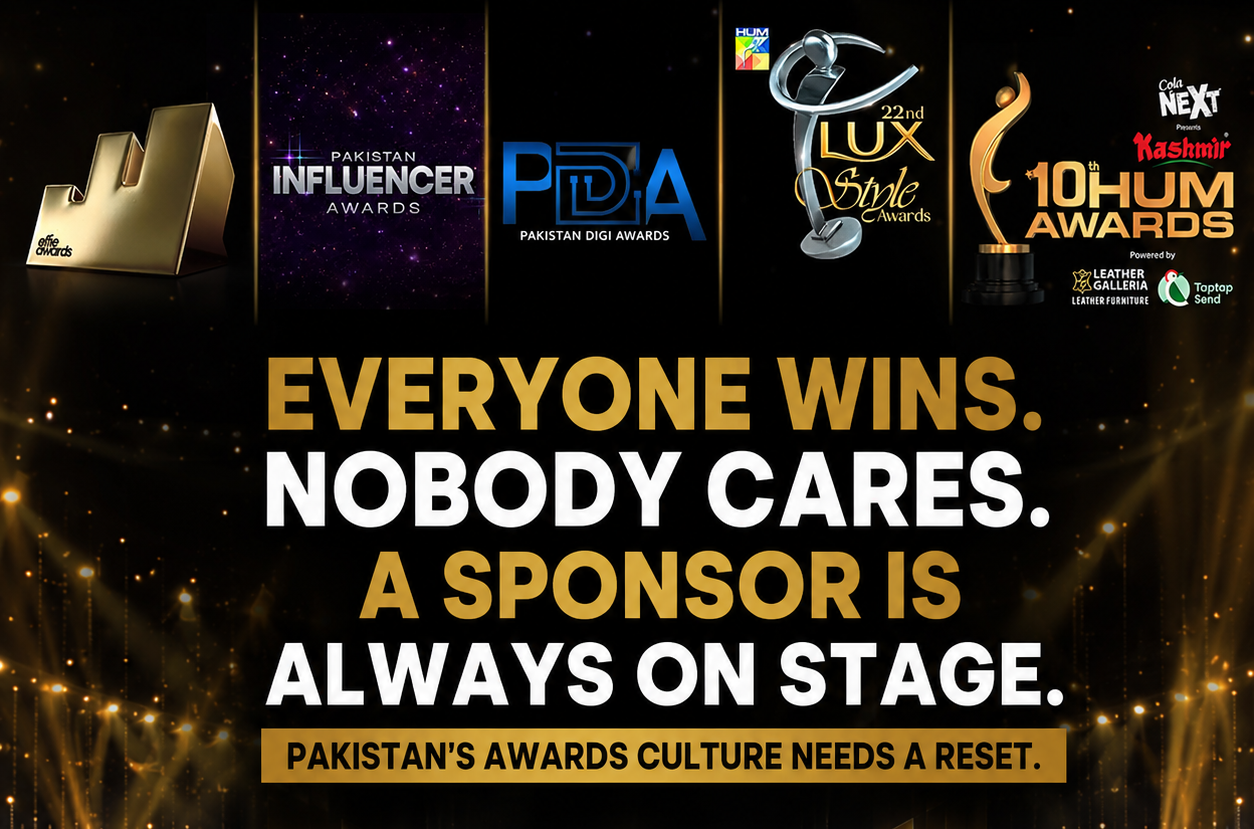
Why do Pakistani awards give trophies to everyone, put sponsors on stage and ignore the one institution that could create a genuinely credible industry-wide show — PTV?
By Imran Malik | Media & Industry Opinion | MediaBites.com.pk
Let me start with a simple observation. The world’s most credible film awards — the Oscars, BAFTA, and Golden Globes — share one defining characteristic. No sponsor walks on stage to present the Best Actor award while delivering a speech about their offices in Canada, the UK, and the USA. The award and the brand are kept in their proper relationship. The award is the moment. The brand is the backdrop.
Pakistan has not quite figured this out yet. And the consequences for our awards culture are becoming increasingly visible.
The Sponsor on Stage Problem
At the recent Hum Awards held in Houston, a client brand was given the privilege of presenting the Best Actor and Best Actress awards. The representative then delivered a speech thanking Hum Management for organizing events in Canada, the UK, and the USA.
Let us pause on this for a moment.
Pakistani brands. Pakistani dramas. Pakistani talent. Award ceremony held abroad. Presented by a client who used the stage as a marketing platform.
The logic escapes me entirely. If heavy branding in the show, prominent logo placement, commercial breaks and VIP table access are not sufficient value for a sponsorship investment — and they should be — then something has gone wrong in the deal structure, not in the awards format.
Putting a sponsor on stage to present a creative excellence award transforms the moment from recognition to transaction. The talent being recognized deserves better. The audience deserves better. And frankly, the sponsor’s own brand equity suffers when their association with an awards show feels forced rather than organic.
This culture began in Indian awards shows and has migrated wholesale into Pakistan’s entertainment industry. We imported the format without questioning whether it serves anyone well.
The Canvas Is Too Small
Hum Awards recognizes Hum dramas. LUX Style Awards makes its own selection from across channels. ARY has its own universe. The result is a fragmented awards landscape where the same talent competes in multiple siloed ceremonies rather than one credible industry-wide recognition.
Why does Pakistan not have one genuinely independent drama awards show that covers every drama aired across every Pakistani channel in a given year — judged by an independent panel with transparent criteria?
The answer, unfortunately, is money. Hum Awards sells advertising for Hum. LUX Style Awards is primarily a vehicle for Unilever’s flagship brand. The awards serve the business models of their organizers first and the industry second.
This is the fundamental structural problem that no number of individual ceremonies can fix.
What Happened to PTV Awards?
There was a time when Pakistan Television Corporation was not simply Pakistan’s best entertainment channel. It was the best in the entire subcontinent, watched with genuine enthusiasm across neighboring India, celebrated by Pakistani diaspora worldwide, and producing drama content that defined the regional standard for writing, acting, and production quality.
And every year the PTV Awards matched that standard. It was the event the entire entertainment industry waited for, a genuinely creative, genuinely entertaining celebration of Pakistani television’s best work. Not a marketing event dressed as an awards show. A real awards show — combining spectacle, credibility, and the institutional authority that only PTV carried.
That tradition has quietly disappeared. And its absence left a vacuum that no commercially driven ceremony has successfully filled.
Here is the opportunity the Ministry of Information appears to be missing entirely.
PTV, backed by the federal government and carrying no commercial obligation to any single channel or sponsor group, is the only institution in Pakistan’s entertainment landscape with the structural independence to create what the industry actually needs — a genuinely inclusive, industry-wide drama awards show that invites every major entertainment channel to compete on equal terms.
ARY Digital. Hum TV. Express Entertainment. Green TV. Geo Entertainment. Aaj Entertainment. Aan TV. All submitting their best dramas of the year. All competing under the same transparent criteria. All judged by an independent panel of drama critics, writers, directors, and entertainment industry veterans whose selections cannot be influenced by channel politics or client money.
And yes — PTV’s own dramas enter the same pool. Competing honestly, without institutional protection or preferential treatment. That discipline would actually strengthen PTV’s credibility rather than shield it from scrutiny.
The judging panel need not be large. It needs to be genuinely independent, publicly named, and free from the sponsor-on-stage pressures that have compromised every other Pakistani awards format.
Pakistan’s drama industry is producing extraordinary content simultaneously across multiple channels. It deserves one awards show that covers it all, judges it fairly, and presents the results with the institutional gravitas the work has earned.
PTV built that show once. The Ministry of Information has both the mandate and the platform to build it again — bigger, more inclusive, and more credible than anything currently on Pakistan’s awards calendar.
Effie Awards — From Credibility to Participation Trophy
The Effie Awards arrived in Pakistan with genuine promise. Fewer categories. Longer nomination lists. Real competitive pressure. In the early years, winning an Effie meant something specific — your campaign had outperformed everything else on demonstrable business effectiveness metrics.
Slowly, that rigor has softened. Categories have expanded. More clients go home with awards. The uncomfortable competitive tension that made early Effie wins meaningful has been replaced by something closer to a participation framework where almost everyone finds a category that fits.
When everyone wins, nobody wins. The Effie Awards in Pakistan need to return to the discipline that made them credible in the first place — or risk becoming indistinguishable from the dozens of other awards shows competing for the same marketing budgets.
Pakistan Advertising Association and APNS — Where Did They Go?
Pakistan had genuine industry credibility in advertising recognition through PAA and APNS. These were industry bodies with institutional standing, whose judgments carried weight precisely because they were not primarily commercial vehicles.
Their gradual disappearance from the awards landscape has left a credibility vacuum that commercial shows have filled imperfectly. Reviving independent industry body recognition for advertising excellence would serve the Pakistani marketing industry far better than another client-sponsored ceremony.
The Influencer Awards Question
Pakistan now has an Influencer Awards. Soon we will presumably have TikToker Awards, Reels Awards, and Twitter Awards — each with judges, categories, and presumably sponsors walking on stage to present trophies.
Here is a more honest question. Do influencers need awards? Or do they need recognition — public, data-driven acknowledgment of reach, engagement, and impact that doesn’t require a judging panel to make subjective decisions about whose content was best?
The digital space has something traditional media never had — objective, publicly available performance data. Use it. Rank the best campaigns by verified engagement. Reward the best creators by demonstrated audience impact. Remove the judges, the client pressures, and the favoritism from the equation entirely.
Rewards over Awards — based on data, transparent, verifiable, and immune to the sponsor-on-stage problem entirely.
That is a model Pakistan’s digital and entertainment industry could actually build credibility around.
The Bottom Line
Pakistan’s awards canvas is small. The talent pool competing within it is genuine and deserving of recognition. The solution is not more awards shows — it is fewer, more credible ones with independent judging, transparent voting, clear separation between sponsorship and presentation, and a scope that covers the entire industry rather than one channel’s output.
Until that exists, Pakistan’s awards culture will continue producing beautiful ceremonies, well-dressed celebrities, smiling clients on stage, and a nagging feeling that the trophy means something different from what it says on the plaque.

