


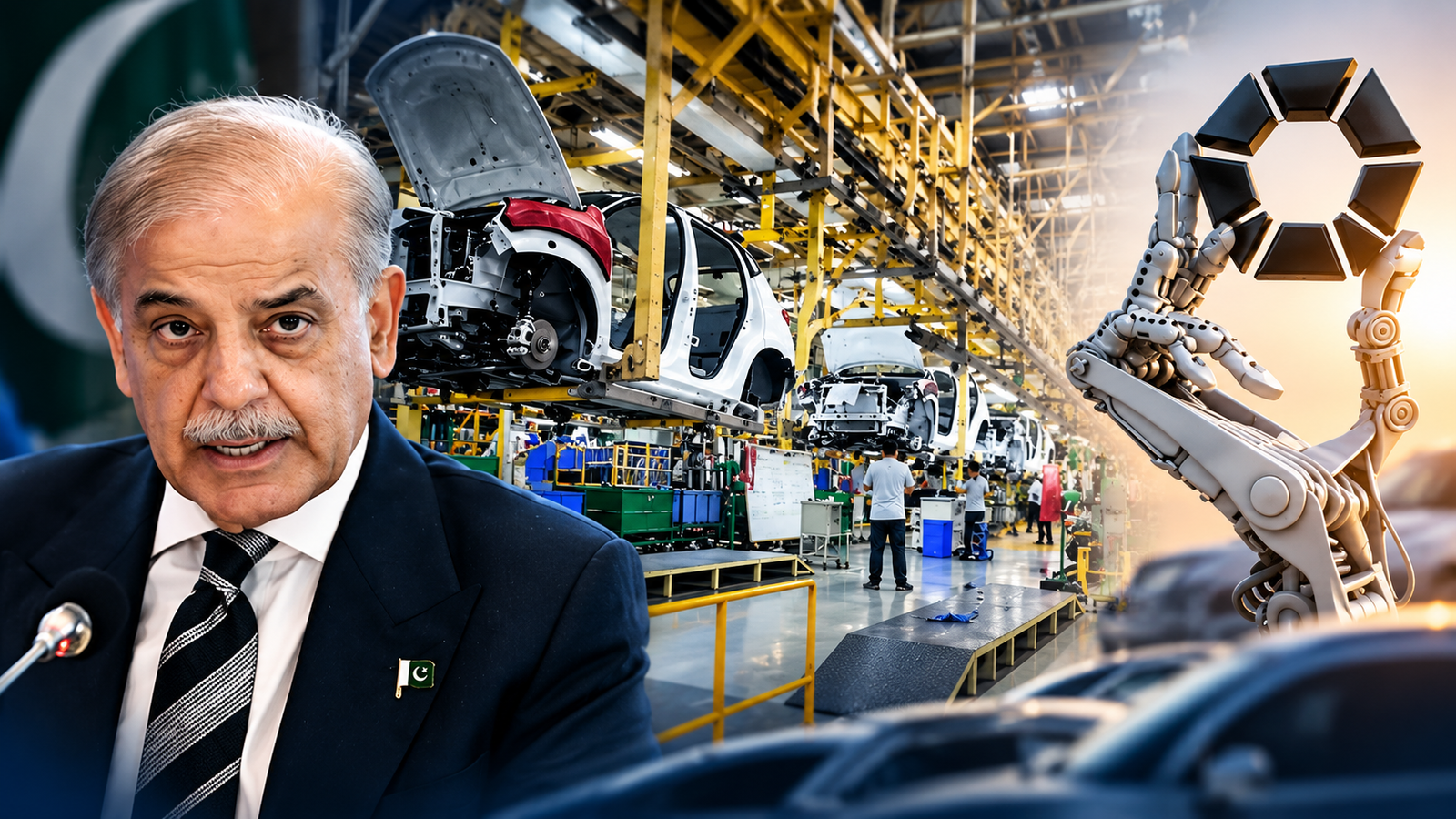
Pakistan’s auto parts manufacturers have urged Prime Minister Shehbaz Sharif to review proposed tariff cuts, warning that rapid liberalization could threaten jobs, local investment and billions in import substitution.
WEBDESK – MEDIABITES
Pakistan’s automotive parts manufacturers have warned that the proposed Auto Policy 2026-31 could put 1.5 million jobs at risk, urging Prime Minister Shehbaz Sharif to reconsider planned tariff reductions and incentives that they fear could weaken domestic manufacturing.
In a letter dated October 23, Pakistan Association of Automotive Parts and Accessories Manufacturers (PAAPAM) Chairman Abdul Rehman Aizaz called for a review of the draft policy before finalizing it, citing the sector’s contribution to employment, industrial investment, and import substitution. The letter said
PAAPAM represents an industry comprising more than 1,200 companies that collectively support around 1.5 million jobs. The association also highlighted $1.8 billion in annual import substitution and Rs700 billion worth of locally manufactured components supplied to vehicle assemblers.
The association has requested a meeting with the prime minister to present alternatives to the proposed measures.
Tariff cuts raise concerns over local industry
The draft policy proposes phased tariff reductions on completely built-up (CBU) vehicles and auto parts, alongside concessions for new-energy vehicles. While the measures aim to increase competition and expand consumer choice, parts manufacturers fear cheaper imported vehicles and components could erode demand for locally produced products.
For domestic suppliers, the concern extends beyond competition between vehicle brands. Lower import duties could make imported components more attractive to assemblers, potentially undermining local suppliers and threatening investments made in Pakistan’s automotive manufacturing ecosystem over several decades.
The dispute reflects a wider divide between businesses seeking greater access to imported vehicles and components and manufacturers advocating a gradual transition that protects domestic production while improving competitiveness.
Pakistan’s automotive sector is also facing a structural shift as Chinese manufacturers, electric-vehicle companies and hybrid technology providers challenge the dominance of established Japanese brands, including Suzuki, Toyota and Honda.
Industry divided over the future
The growing range of vehicle technologies has complicated efforts to develop a common industry position. Petrol-powered vehicles, conventional hybrids, plug-in hybrids, battery-electric vehicles and range-extended electric vehicles have different production requirements and levels of dependence on imported components.
A senior official at a Japanese automotive manufacturer said the industry was no longer united because businesses had different investment priorities.
The official warned that opening the market too quickly could hurt local suppliers and employment, while excessive protection could discourage competition and keep vehicle prices high.
The industry needs a predictable policy that promotes exports, localization and technology transfer, the official said, adding that the transition should not destroy productive capacity built over decades.
The comments underline the challenge facing policymakers: protecting domestic manufacturing without allowing prolonged trade barriers to weaken efficiency, innovation or consumer choice.
$6 billion export target under draft policy
The proposed Auto Policy 2026-31 seeks to generate $6 billion in cumulative vehicle and auto-parts exports by 2030-31. It includes incentives for companies that meet export targets and penalties for those that fail to achieve them.
The draft also proposes preferential sales tax rates of 1% for battery-electric vehicles, 6% for range-extended electric vehicles and 9% for plug-in hybrids, subject to the remaining approval process.
Supporters of liberalization argue that lower tariffs and greater competition could encourage manufacturers to improve quality, introduce new technologies and offer consumers more choices. However, parts manufacturers say the pace of reform matters because local suppliers may struggle to compete with imports if duties fall before domestic production becomes more efficient.
At the same time, maintaining high levels of protection without measurable improvements in productivity, exports and local value addition could leave the industry dependent on a relatively sheltered domestic market.
Policy must balance jobs, exports and affordability
The government’s challenge is to ensure tariff reforms translate into tangible economic gains, not simply shift demand from locally manufactured components to imported products.
The policy’s long-term success will depend on whether it delivers higher domestic value addition, stronger exports, technology transfer and more affordable vehicles while preserving viable manufacturing capacity.
Predictable rules will also be essential for companies making long-term investment decisions, industry stakeholders said, warning that frequent changes to taxes and tariffs could undermine business planning.
PAAPAM’s appeal places employment and local manufacturing at the center of the policy debate. The government must now weigh the benefits of greater competition against the risks to an established supply chain as Pakistan’s automotive industry moves towards a more diverse mix of vehicle technologies.
The draft policy remains subject to the government’s approval process.
Source: Express Tribune

