


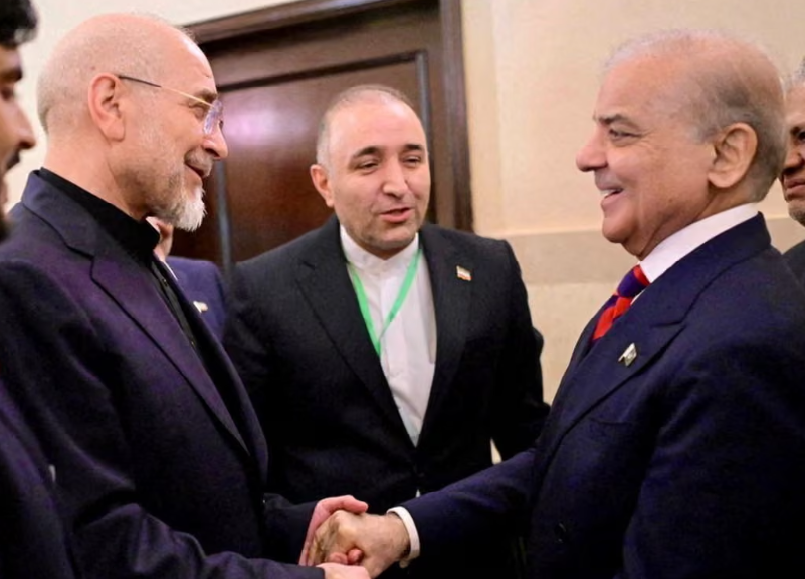
Pakistan and Iran deepened strategic ties as Tehran expressed strong interest in expanding trade through Karachi and Gwadar ports while Iran’s foreign ministry officially named Pakistan as its primary mediator with the United States.
By Imran Malik | National & Foreign Affairs Desk | MediaBites.com.pk
In a development that signals Pakistan’s rapidly growing strategic importance in the Middle East’s reshaping geopolitical landscape, Pakistan and Iran on Tuesday took significant steps to deepen their bilateral partnership — advancing economic cooperation through Pakistan’s two most critical ports and intensifying diplomatic engagement at the highest levels.
Most significantly, Iran’s Foreign Ministry publicly described Pakistan as its primary mediator in discussions involving the United States — an extraordinary acknowledgment that places Islamabad at the center of one of the world’s most consequential diplomatic situations.
Karachi and Gwadar — Iran’s Gateway to the World
The most immediately consequential economic development came during the 10th session of the Pakistan-Iran Joint Trade Committee in Islamabad, where Iranian Minister for Industry, Mine and Trade Mohammad Atabak expressed Tehran’s strong desire to expand bilateral trade specifically through Karachi and Gwadar ports.
For Pakistan, this is enormous strategic news. Gwadar — the centerpiece of the China-Pakistan Economic Corridor and Pakistan’s ambition to become a regional connectivity hub — now has a major neighboring economy actively seeking to route its trade through it. Karachi, Pakistan’s commercial lifeline, would simultaneously benefit from expanded Iranian trade volumes.
Atabak co-chaired the meeting with Pakistan’s Commerce Minister Jam Kamal Khan, and left little ambiguity about Tehran’s priorities. “Iran places the highest priority on expanding comprehensive cooperation, particularly with the brotherly nation of Pakistan,” he said.
Free Trade Agreement — Closer Than Ever
The Iranian minister confirmed that negotiations on the proposed Pakistan-Iran Free Trade Agreement were progressing positively, expressing confidence the agreement could be finalized in the near future.
Both sides also discussed operationalizing joint border markets to improve livelihoods and facilitate cross-border commerce — a development that would directly benefit Pakistan’s border communities in Balochistan.
Transport and regional connectivity also featured prominently, with both sides building on recent agreements to revive the Islamabad-Tehran-Istanbul freight train and expand railway cooperation. Last year both countries signed protocols aimed at removing tariff and non-tariff barriers, expanding electricity exchanges, and increasing bilateral trade toward a long-term target of USD 10 billion.
Jam Kamal Khan called for a “seamless, structured and predictable environment” to support businesses on both sides of the border — signaling Pakistan’s commitment to making this economic relationship work practically rather than just diplomatically.
Pakistan Named Iran’s Primary Mediator With Washington
Beyond the economic developments, Tuesday’s diplomatic picture was equally significant.
Iran’s Foreign Ministry on Monday publicly described Pakistan as its primary mediator in discussions involving the United States, with Qatar providing additional support where necessary. This is a formal, public acknowledgment from Tehran that Islamabad is the most trusted channel between Iran and America at this critical juncture.
Islamabad also invited Iranian Parliament Speaker Mohammad Bagher Ghalibaf and Foreign Minister Seyyed Abbas Araghchi for urgent consultations on regional developments — following a telephone conversation between Deputy Prime Minister and Foreign Minister Ishaq Dar and his Iranian counterpart on the evolving regional situation.
Diplomatic sources said both Iranian leaders were requested to visit Pakistan as soon as possible, though no official dates have been announced.
Pakistan’s Strategic Moment
The convergence of economic and diplomatic developments on Tuesday reflects Pakistan’s increasingly central role in the Middle East’s reshaping strategic architecture.
US President Donald Trump recently suspended planned military strikes on Iran to allow diplomacy another chance — while simultaneously warning Tehran of severe consequences if no agreement is reached. Iran has denied that direct negotiations with Washington are currently taking place.
Into that space, Pakistan has stepped as the trusted intermediary — a role that carries both enormous opportunity and significant responsibility.
For Pakistan, expanding trade through Karachi and Gwadar while serving as Tehran’s primary diplomatic channel enhances Islamabad’s long-held ambition to become a regional connectivity and diplomacy hub linking South Asia, Central Asia, and the Middle East.
The coming weeks, as both the free trade agreement negotiations and wider regional security consultations continue, could prove pivotal not just for Pakistan-Iran relations but for the region’s broader stability.


3 Comments
Great article, thanks for sharing this useful information. For anyone looking for professional chocolate moulds, I also recommend checking our website
[5088]64bet Official Login | Pinakamabilis na GCash Casino sa PH,Gamitin ang 64bet para sa legit online slots ph. I-download ang app para sa mabilis na access at alamin kung paano maglaro ng baccarat. Mag-register na rito! visit: 64bet
[5186]hb88 | Link vào chính thức và cách chơi baccarat online,hb88 cung cấp link vào chính thức, hỗ trợ tải app hb88 nhanh chóng và hướng dẫn nạp tiền qua Momo tiện lợi. Truy cập ngay để khám phá sảnh game casino trực tuyến. visit: hb88