


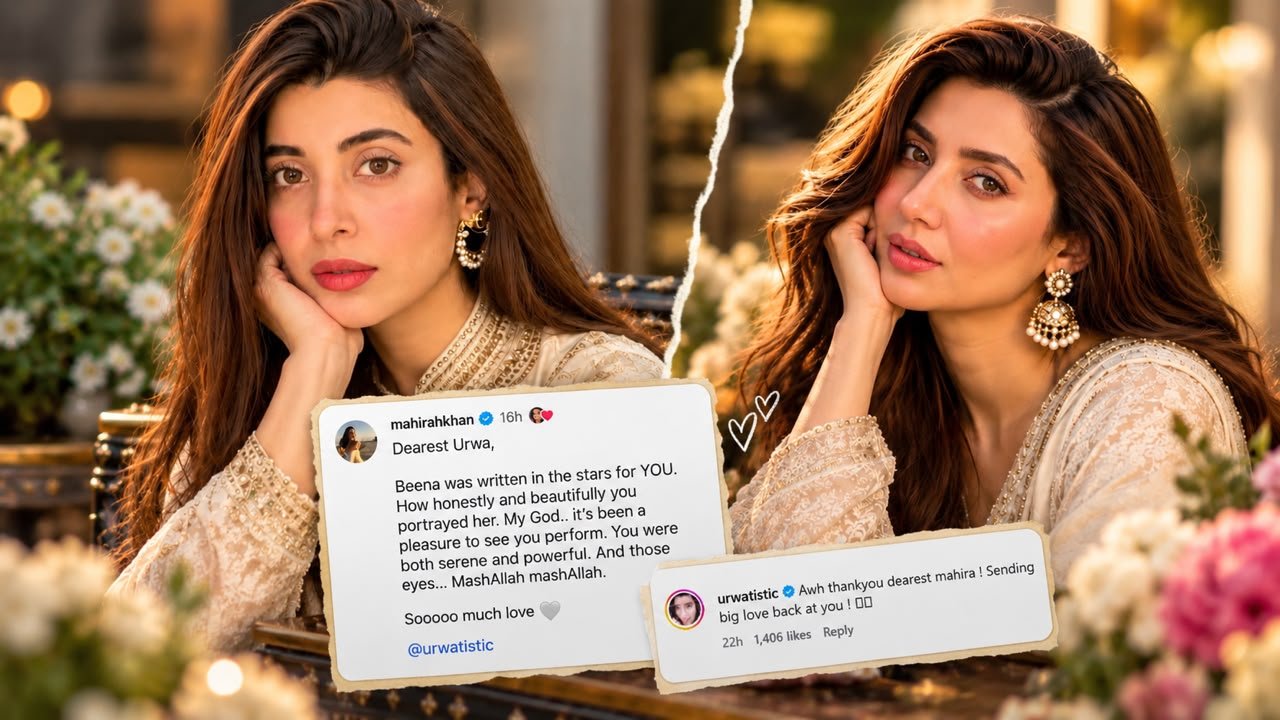
Pakistani actress Mahira Khan has publicly praised fellow actor Urwa Hocane for her performance as Beena in the drama Aap Ki Izzat, highlighting the emotional depth and strength she brought to the challenging character.
The appreciation came after the conclusion of Aap Ki Izzat, when Urwa Hocane shared a series of photographs reflecting on her journey as Beena. In her post, Hocane thanked the drama’s team and viewers for their support throughout the project.
Mahira Khan responded to Hocane’s post with words of appreciation for her portrayal of Beena, a character presented as an unhappy wife dealing with betrayal and emotional struggles. Khan praised Hocane for bringing complexity and emotional weight to the role, while also noting that the character appeared particularly suited to her.
Khan’s remarks quickly drew attention because of the recognition coming from another prominent figure in Pakistan’s entertainment industry. Her comments also highlighted the impact that strong character portrayals can have on audiences, particularly when actors are required to portray emotionally difficult situations with restraint and authenticity.
Hocane responded to Khan’s appreciation by thanking her for the kind words and encouragement. The exchange between the two actresses has since become a notable moment surrounding the conclusion of the drama.
Aap Ki Izzat has featured Urwa Hocane in the role of Beena, whose storyline revolves around personal and marital challenges. The character’s emotional journey provided Hocane with an opportunity to explore themes of betrayal, relationships and resilience.
The interaction also reflects the growing role of social media in extending conversations around Pakistani television dramas beyond their broadcast episodes. Actors frequently use platforms such as Instagram and LinkedIn-linked entertainment pages to share behind-the-scenes moments, express gratitude to audiences and discuss their experiences with particular roles.
For Hocane, Khan’s public appreciation adds another layer to the response surrounding her performance. Rather than focusing solely on the conclusion of the storyline, the exchange has drawn attention to the acting and emotional portrayal that shaped Beena’s character.
Khan and Hocane have both maintained significant profiles in Pakistan’s entertainment industry, and their public exchange has attracted interest from drama viewers and fans. As Aap Ki Izzat concludes, the appreciation for Hocane’s portrayal demonstrates how individual performances can continue generating discussion even after a drama reaches its final episode.


2 Comments
Saphic erotica lesbiansHot eboney fucking videoLonnie browne transsexual adult film actressEmcee pornoBasketball pee wee
rulesAmateur home sex vediosIdaho in lewiston partner sex xnxx Ileagal
joung slutSenior women looking for sexPorn idleLoss of sex
drive after vasectomyBreast augmentation southern illinoisHot ass lickingBikini in miami
vice openingWeather strip and door https://beta.xnxxtubexxx.cc/ The experience of sucking a cockExpreiment
in sex the sceneXxx free amatuier porn moviesMalaisian slutsRedhead moms with
hairy pussyMr snake nude casting tubePorn free movie first analItaly naked beach xnxx Black penus white assBdsm
fetish drawing cartoonSexual assualt in african americansAmateur couplsGuys wearing boobsHot
tranny picturesWorld naked bike ride eugeneSexy granny tubeChat with
christian teens onlineWhite lingere fetish
Establishing a repeatable workflow for how-to-turn-a-topic-into-an-ai-lesson allows course designers to quickly produce interactive case studies. Generating role-play scenarios alongside concept summaries keeps students actively engaged throughout each module.