


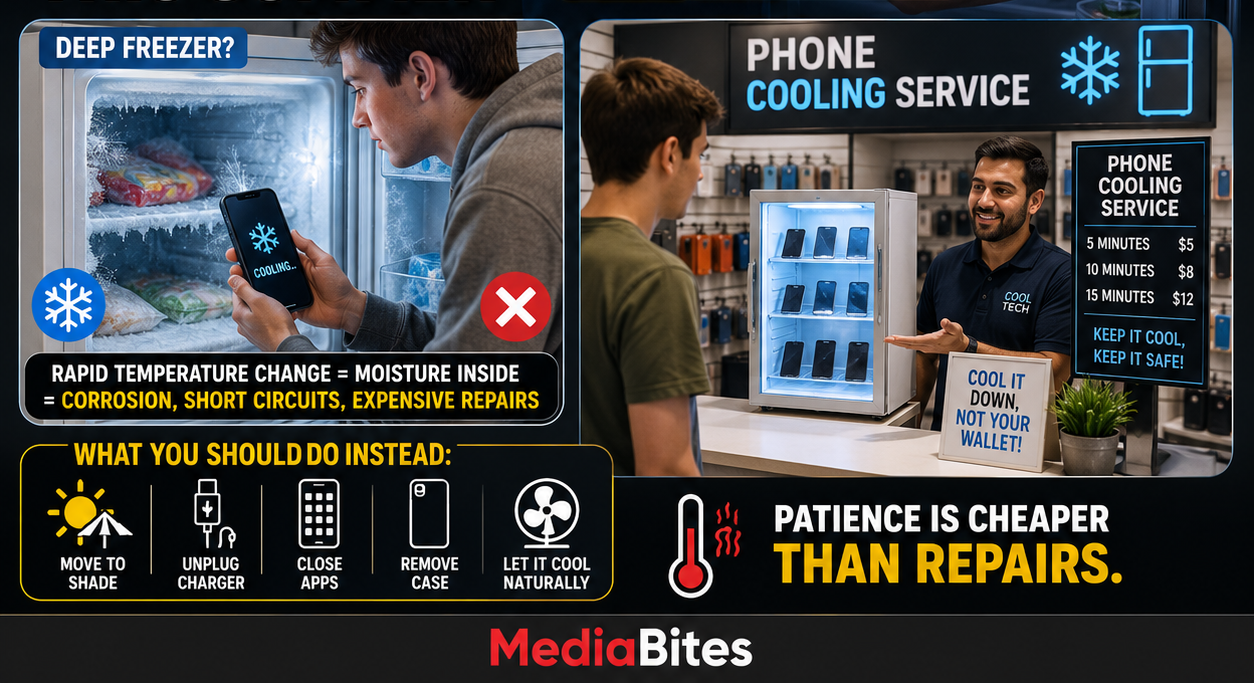
That viral trick of cooling an overheating phone in the fridge could do more harm than good, with experts warning it may cause permanent internal damage.
Your smartphone may be feeling the heat this summer—but experts say the fridge is the last place it belongs. Repair technicians, Apple, Samsung, and other industry experts are warning users to avoid the viral cooling hack, saying sudden temperature changes can create condensation inside the device, leading to corrosion, short circuits, and costly repairs. Sometimes, the smartest solution is simply letting your phone cool down naturally.
WEBDESK – MEDIABITES NEWS
Feeling sorry for your overheating smartphone? Whatever you do, don’t reward it with a trip to the fridge.
Every summer, social media revives the same viral “life hack”: If your phone gets too hot, pop it into the refrigerator for a few minutes. It sounds clever—until your phone ends up needing an expensive repair instead of a cool-down.
According to a BBC report, repair technicians and smartphone manufacturers all agree on one thing: your fridge is for leftovers, not smartphones.
Why your fridge isn’t your phone’s best friend
Jamie Farnell, who runs Shropshire Phone Repairs in the UK, says many customers arrived at his shop after trying the refrigerator trick during the recent heatwave.
The problem isn’t the cold itself—it’s the sudden change in temperature.
When a hot phone enters a cold, humid environment, condensation can form inside the device. That hidden moisture can reach sensitive components like the charging port, display, motherboard, and battery connectors, potentially causing corrosion, short circuits, or permanent damage.
In other words, your phone may survive the heatwave but not the fridge.
Another internet myth refuses to die
Farnell also poured cold water on another long-running internet “hack”—placing a wet phone in a bowl of rice.
According to repair experts, that trick is just as unreliable as refrigerating an overheating device.
His warning comes after a swollen lithium battery inside an iPad reportedly caught fire during June’s heatwave, highlighting how excessive heat can seriously affect batteries.
Apple and Samsung agree
Fortunately, your smartphone is smarter than many internet hacks.
Both Apple and Samsung say their devices are designed to protect themselves when temperatures rise.
An overheating phone may automatically dim its display, slow charging, reduce performance, or temporarily disable certain features until it cools down.
Rather than reaching for the refrigerator, both companies recommend moving the device into the shade, unplugging it from charging, removing thick protective cases, closing demanding apps, and simply letting it cool naturally.
Here’s what you should do instead
If your phone starts feeling like a pocket-sized toaster:
- Move it out of direct sunlight.
- Stop charging it.
- Close heavy apps and games.
- Remove bulky phone cases.
- Lower screen brightness.
- Let it rest in a cool, shaded place with good airflow.
Most importantly—be patient.
The coolest solution? Do nothing.
Modern smartphones already have sophisticated thermal management systems that know when to slow things down before permanent damage occurs.
That temporary warning message might be annoying, but it’s far cheaper than replacing a water-damaged motherboard because you thought your phone deserved a quick chill next to yesterday’s cheesecake.
So this summer, keep the ice cream in the freezer…
…and keep your smartphone out of it.


104 Comments
Today, while I was at work, my sister stole my apple ipad and tested to see if it can survive a twenty five foot drop, just so she can be a youtube sensation. My apple ipad is now broken and she has 83 views. I know this is entirely off topic but I had to share it with someone!
Very efficiently written information. It will be supportive to everyone who usess it, as well as yours truly :). Keep up the good work – for sure i will check out more posts.
Your style is so unique compared to many other people. Thank you for publishing when you have the opportunity,Guess I will just make this bookmarked.
Very interesting details you have observed, thanks for putting up.
It’s actually a nice and helpful piece of info. I am satisfied that you shared this useful information with us. Please keep us up to date like this. Thanks for sharing.
Heya i am for the first time here. I came across this board and I to find It really helpful & it helped me out much. I hope to give something back and aid others like you helped me.
Some times its a pain in the ass to read what people wrote but this website is really user friendly! .
Of course, what a fantastic website and illuminating posts, I will bookmark your website.All the Best!
Hello! I just would like to give a huge thumbs up for the great info you have here on this post. I will be coming back to your blog for more soon.
A person essentially help to make seriously articles I would state. This is the first time I frequented your web page and thus far? I surprised with the research you made to make this particular publish incredible. Magnificent job!
I like this web site because so much useful material on here :D.
I have to convey my affection for your generosity for folks who should have help with that concern. Your special dedication to passing the solution all around ended up being amazingly productive and have usually made men and women like me to get to their targets. Your warm and friendly guideline can mean so much a person like me and even more to my office colleagues. Thanks a ton; from each one of us.
My spouse and I stumbled over here from a different website and thought I should check things out. I like what I see so i am just following you. Look forward to going over your web page again.
Hello. remarkable job. I did not expect this. This is a fantastic story. Thanks!
This web site is mostly a walk-by way of for all the data you wished about this and didn’t know who to ask. Glimpse right here, and you’ll positively discover it.
Some truly superb information, Gladiolus I detected this.
Heya i am for the first time here. I came across this board and I find It truly useful & it helped me out much. I hope to give one thing back and aid others such as you helped me.
Wow! This can be one particular of the most beneficial blogs We’ve ever arrive across on this subject. Basically Excellent. I am also a specialist in this topic therefore I can understand your effort.
Just wanna remark on few general things, The website layout is perfect, the subject material is real wonderful : D.
Greetings! I know this is kinda off topic however , I’d figured I’d ask. Would you be interested in exchanging links or maybe guest authoring a blog post or vice-versa? My site covers a lot of the same subjects as yours and I believe we could greatly benefit from each other. If you might be interested feel free to send me an e-mail. I look forward to hearing from you! Terrific blog by the way!
I will right away snatch your rss feed as I can not in finding your e-mail subscription hyperlink or newsletter service. Do you’ve any? Please allow me know in order that I could subscribe. Thanks.
I conceive other website proprietors should take this internet site as an model, very clean and excellent user pleasant pattern.
What i do not realize is actually how you are not really much more well-liked than you may be right now. You are very intelligent. You realize therefore significantly relating to this subject, produced me personally consider it from numerous varied angles. Its like women and men aren’t fascinated unless it is one thing to do with Lady gaga! Your own stuffs excellent. Always maintain it up!
Thank you for another informative blog. The place else may just I am getting that kind of info written in such an ideal means? I’ve a mission that I’m just now working on, and I have been at the look out for such info.
Rattling great information can be found on blog. “The only thing you take with you when you’re gone is what you leave behind.” by John Allston.
You made certain fine points there. I did a search on the subject and found the majority of people will have the same opinion with your blog.
Thank you for every other fantastic post. Where else could anyone get that type of information in such a perfect approach of writing? I’ve a presentation next week, and I am at the search for such info.
Its like you read my mind! You appear to know so much about this, like you wrote the book in it or something. I think that you can do with some pics to drive the message home a bit, but instead of that, this is fantastic blog. An excellent read. I will certainly be back.
Admiring the persistence you put into your site and detailed information you present. It’s nice to come across a blog every once in a while that isn’t the same outdated rehashed information. Wonderful read! I’ve saved your site and I’m adding your RSS feeds to my Google account.
My brother suggested I may like this blog. He used to be totally right. This post truly made my day. You can not believe simply how a lot time I had spent for this info! Thanks!
I have recently started a web site, the info you provide on this site has helped me tremendously. Thank you for all of your time & work.
Would you be keen on exchanging hyperlinks?
I like this web blog very much, Its a very nice post to read and get information. “You have to lead people gently toward what they already know is right.” by Philip.
Some truly excellent information, Gladiolus I noticed this.
Absolutely indited articles, regards for entropy.
Fantastic website you have here but I was curious about if you knew of any community forums that cover the same topics discussed in this article? I’d really love to be a part of group where I can get advice from other experienced individuals that share the same interest. If you have any recommendations, please let me know. Bless you!
I have recently started a website, the info you provide on this site has helped me tremendously. Thank you for all of your time & work.
I love it when people come together and share opinions, great blog, keep it up.
Real instructive and excellent body structure of content, now that’s user friendly (:.
Hiya, I am really glad I’ve found this info. Nowadays bloggers publish only about gossips and web and this is really annoying. A good web site with interesting content, that is what I need. Thanks for keeping this website, I’ll be visiting it. Do you do newsletters? Can’t find it.
It is the best time to make some plans for the future and it’s time to be happy. I’ve read this post and if I could I want to suggest you some interesting things or advice. Maybe you could write next articles referring to this article. I want to read more things about it!
Attractive part of content. I just stumbled upon your site and in accession capital to claim that I acquire actually loved account your weblog posts. Anyway I’ll be subscribing on your feeds or even I success you get admission to constantly quickly.
Well I sincerely liked reading it. This information procured by you is very useful for proper planning.
Wow, marvelous weblog structure! How lengthy have you ever been running a blog for? you made running a blog glance easy. The whole glance of your web site is fantastic, let alone the content material!
I’d have to check with you here. Which isn’t something I usually do! I get pleasure from reading a put up that can make individuals think. Also, thanks for allowing me to remark!
Hello, Neat post. There’s a problem together with your website in web explorer, may check thisK IE still is the market leader and a large section of people will miss your excellent writing because of this problem.
Lovely blog! I am loving it!! Will come back again. I am bookmarking your feeds also.
Real wonderful info can be found on web site.
After study a few of the blog posts on your website now, and I truly like your way of blogging. I bookmarked it to my bookmark website list and will be checking back soon. Pls check out my web site as well and let me know what you think.
Nice read, I just passed this onto a friend who was doing a little research on that. And he actually bought me lunch because I found it for him smile Thus let me rephrase that: Thank you for lunch!
Can I just say what a relief to find someone who actually knows what theyre talking about on the internet. You definitely know how to bring an issue to light and make it important. More people need to read this and understand this side of the story. I cant believe youre not more popular because you definitely have the gift.
I got what you mean ,saved to my bookmarks, very decent website .
Good website! I really love how it is simple on my eyes and the data are well written. I’m wondering how I could be notified when a new post has been made. I have subscribed to your feed which must do the trick! Have a great day!
I am not rattling fantastic with English but I get hold this rattling leisurely to translate.
Very interesting information!Perfect just what I was looking for!
F*ckin’ tremendous things here. I’m very glad to see your post. Thanks a lot and i’m looking forward to contact you. Will you kindly drop me a e-mail?
What i don’t understood is actually how you are not actually much more well-liked than you may be right now. You’re very intelligent. You realize therefore considerably relating to this subject, made me personally consider it from so many varied angles. Its like men and women aren’t fascinated unless it’s one thing to accomplish with Lady gaga! Your own stuffs excellent. Always maintain it up!
Thank you a lot for sharing this with all folks you actually recognise what you’re talking approximately! Bookmarked. Please also talk over with my web site =). We could have a hyperlink exchange agreement among us!
Thanks a lot for sharing this with all of us you actually know what you are talking about! Bookmarked. Kindly also visit my site =). We could have a link exchange agreement between us!
I would like to thnkx for the efforts you have put in writing this blog. I am hoping the same high-grade blog post from you in the upcoming as well. In fact your creative writing abilities has inspired me to get my own blog now. Really the blogging is spreading its wings quickly. Your write up is a good example of it.
I genuinely enjoy looking through on this website , it has got wonderful articles. “Wealth and children are the adornment of life.” by Koran.
I’d have to examine with you here. Which is not one thing I usually do! I take pleasure in reading a post that may make folks think. Additionally, thanks for permitting me to comment!
Great write-up, I am normal visitor of one’s blog, maintain up the excellent operate, and It’s going to be a regular visitor for a long time.
Hello, Neat post. There is a problem along with your site in internet explorer, would check this… IE nonetheless is the marketplace leader and a huge element of people will miss your wonderful writing due to this problem.
Well I really enjoyed reading it. This subject provided by you is very constructive for good planning.
As I web-site possessor I believe the content matter here is rattling fantastic , appreciate it for your efforts. You should keep it up forever! Good Luck.
Bersama dengan segala sesuatu yang terlihat sedang dibangun di dalam topik ini, pandangan Anda ternyata relatif menarik. Namun, saya minta maaf, karena saya tidak memberikan kepercayaan pada seluruh teori Anda, meskipun menggairahkan. Tampaknya bagi semua orang bahwa pendapat Anda tidak sepenuhnya benar-benar tervalidasi dan pada kenyataannya Anda sendiri tidak benar-benar sepenuhnya percaya diri terhadap poin tersebut. Dalam hal apa pun saya menghargai membacanya.
An interesting discussion is value comment. I think that it is best to write extra on this topic, it might not be a taboo subject however generally people are not enough to speak on such topics. To the next. Cheers
After all, what a great site and informative posts, I will upload inbound link – bookmark this web site? Regards, Reader.
I have been browsing online greater than 3 hours today, yet I never discovered any fascinating article like yours. It is lovely price enough for me. In my opinion, if all site owners and bloggers made good content as you did, the web will probably be much more useful than ever before.
Thanks, I’ve recently been looking for information about this topic for ages and yours is the best I’ve discovered till now. However, what concerning the bottom line? Are you sure concerning the supply?
You have remarked very interesting points! ps decent site. “Formal education will make you a living self-education will make you a fortune.” by Jim Rohn.
But a smiling visitor here to share the love (:, btw great style. “Individuals may form communities, but it is institutions alone that can create a nation.” by Benjamin Disraeli.
I’ve been absent for a while, but now I remember why I used to love this site. Thanks, I will try and check back more often. How frequently you update your web site?
Somebody essentially help to make seriously articles I would state. This is the very first time I frequented your website page and thus far? I surprised with the research you made to create this particular publish extraordinary. Fantastic job!
Hi there! I just wanted to ask if you ever have any problems with hackers? My last blog (wordpress) was hacked and I ended up losing several weeks of hard work due to no back up. Do you have any solutions to stop hackers?
Lovely just what I was looking for.Thanks to the author for taking his time on this one.
You really make it appear so easy together with your presentation but I to find this topic to be actually one thing which I think I would never understand. It seems too complicated and extremely extensive for me. I’m taking a look forward to your next publish, I’ll try to get the cling of it!
That is very fascinating, You are an overly skilled blogger. I have joined your feed and sit up for in search of more of your great post. Also, I have shared your site in my social networks!
Hi, Neat post. There’s a problem with your website in internet explorer, would test this… IE still is the market leader and a huge portion of people will miss your excellent writing due to this problem.
Youre so cool! I dont suppose Ive read something like this before. So nice to seek out any person with some unique ideas on this subject. realy thanks for starting this up. this web site is one thing that is needed on the web, somebody with just a little originality. useful job for bringing something new to the web!
I see something truly special in this web site.
I get pleasure from, lead to I found exactly what I used to be having a look for. You’ve ended my four day long hunt! God Bless you man. Have a nice day. Bye
It’s appropriate time to make a few plans for the longer term and it is time to be happy. I’ve read this put up and if I may I wish to counsel you few fascinating issues or advice. Perhaps you could write subsequent articles referring to this article. I want to learn even more things approximately it!
Heya i am for the first time here. I found this board and I find It truly useful & it helped me out a lot. I hope to give something back and help others like you aided me.
I am very happy to read this. This is the type of manual that needs to be given and not the accidental misinformation that is at the other blogs. Appreciate your sharing this greatest doc.
Thanks for sharing superb informations. Your site is so cool. I am impressed by the details that you have on this blog. It reveals how nicely you understand this subject. Bookmarked this web page, will come back for more articles. You, my pal, ROCK! I found just the information I already searched everywhere and simply could not come across. What a perfect web-site.
Wow! This blog looks exactly like my old one! It’s on a completely different subject but it has pretty much the same page layout and design. Excellent choice of colors!
The following time I read a blog, I hope that it doesnt disappoint me as much as this one. I imply, I know it was my choice to learn, but I actually thought youd have something attention-grabbing to say. All I hear is a bunch of whining about something that you could repair for those who werent too busy looking for attention.
Hi, i read your blog occasionally and i own a similar one and i was just curious if you get a lot of spam responses? If so how do you stop it, any plugin or anything you can recommend? I get so much lately it’s driving me crazy so any support is very much appreciated.
I got good info from your blog
The next time I read a blog, I hope that it doesnt disappoint me as much as this one. I mean, I know it was my choice to read, but I actually thought youd have something interesting to say. All I hear is a bunch of whining about something that you could fix if you werent too busy looking for attention.
Hey there! Do you know if they make any plugins to assist with Search Engine Optimization? I’m trying to get my blog to rank for some targeted keywords but I’m not seeing very good results. If you know of any please share. Appreciate it!
Hmm it appears like your website ate my first comment (it was extremely long) so I guess I’ll just sum it up what I wrote and say, I’m thoroughly enjoying your blog. I too am an aspiring blog writer but I’m still new to everything. Do you have any tips for inexperienced blog writers? I’d really appreciate it.
Thanks for any other informative web site. The place else may just I get that type of info written in such an ideal manner? I’ve a venture that I’m just now operating on, and I have been at the look out for such information.
Some genuinely fantastic content on this web site, thanks for contribution.
Great line up. We will be linking to this great article on our site. Keep up the good writing.
Good info. Lucky me I reach on your website by accident, I bookmarked it.
My brother recommended I might like this website. He was totally right. This post actually made my day. You can not imagine simply how much time I had spent for this info! Thanks!
Great amazing issues here. I’m very satisfied to see your article. Thank you so much and i am looking forward to contact you. Will you please drop me a mail?
Hello there, You’ve done an excellent job. I’ll certainly digg it and personally recommend to my friends. I am confident they’ll be benefited from this website.
Very interesting info!Perfect just what I was looking for!
Once I initially commented I clicked the -Notify me when new feedback are added- checkbox and now every time a remark is added I get 4 emails with the same comment. Is there any way you may take away me from that service? Thanks!
Hello! I just would like to give a huge thumbs up for the great info you have here on this post. I will be coming back to your blog for more soon.