


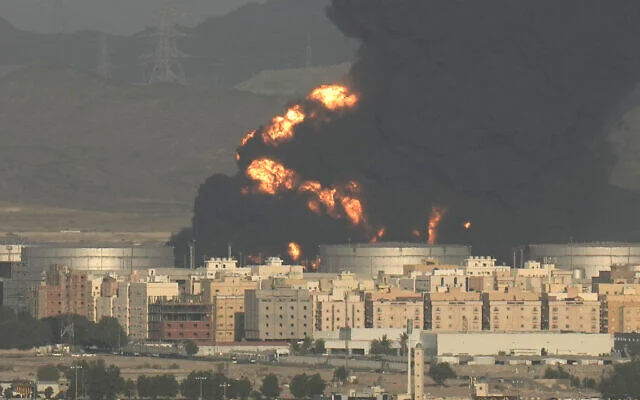
Iran launched coordinated strikes across Kuwait, Bahrain, Jordan, and, reportedly, Saudi Arabia, escalating regional tensions, disrupting oil infrastructure, and prompting a worldwide U.S. travel advisory Saturday.
WEBDESK – MEDIABITES
Iran dramatically widened its military campaign on Saturday, launching missile and drone attacks targeting multiple Gulf countries, including Kuwait, Bahrain, and Jordan, while Saudi Arabia activated emergency warning systems following reports of a possible Iranian missile strike.
The latest escalation marks one of the broadest regional expansions of the conflict in recent months, raising fears of a wider Middle East war that could threaten global energy supplies, regional security, and international aviation.
According to Kuwait’s armed forces, the country came under sustained Iranian ballistic missile and drone attacks. Officials said air defense systems intercepted several incoming projectiles, but firefighters and oil sector workers were injured while responding to the attacks.
Iran’s Islamic Revolutionary Guard Corps (IRGC) claimed responsibility for striking Camp Arifjan, a major U.S. military support base in Kuwait, as well as destroying a radar facility at Ali Al Salem Air Base. Kuwait Petroleum Corporation later confirmed that one of its oil facilities suffered significant damage during what it described as repeated Iranian attacks, with several workers injured. Authorities did not immediately disclose the extent of production disruptions.
Iranian state media also reported that the IRGC targeted Bahrain’s Sheikh Isa Air Base, where U.S. combat aircraft are stationed, along with an intelligence data center.
In Jordan, Iranian state television claimed missile and drone strikes destroyed at least two U.S. fighter aircraft and three additional military aircraft at the Al Azraq Air Base. Reuters said it could not independently verify those claims.
Saudi Arabia also appeared to be drawn into the escalating conflict. Early warning systems issued emergency alerts urging residents in Al-Kharj, east of Riyadh, and the Red Sea port city of Yanbu to seek shelter. Al-Kharj hosts a military base used by U.S. forces, while Yanbu is home to one of the kingdom’s key oil export terminals.
Two people familiar with the matter told Reuters that the alerts followed an Iranian missile attack — the first reported strike on Saudi Arabia in more than three months. However, the IRGC did not mention any operations targeting Saudi Arabia, and Saudi authorities had not officially commented by Saturday.
The growing conflict prompted the U.S. State Department to issue a worldwide travel advisory for American citizens abroad, warning that heightened tensions across the Middle East could lead to sudden escalation, flight cancellations, and periodic airspace closures affecting international travel.
The cross-border attacks came as fighting between the United States and Iran intensified around the strategically vital Strait of Hormuz.
Earlier Saturday, U.S. Central Command announced strikes against Iranian surveillance sites, military logistics infrastructure, underground weapons storage facilities, and maritime assets. Iranian state television reported that U.S. airstrikes in Hormozgan province killed three people and wounded eight others, while damaging two bridges and a road tunnel near the Strait of Hormuz.
Iran’s Health Ministry said U.S. military operations over the past three weeks have killed at least 50 people and injured more than 500.
Iranian Foreign Ministry spokesperson Esmaeil Baghaei accused Washington of attempting to seize control of the Strait of Hormuz, through which nearly one-fifth of the world’s oil supply normally passes. The United States says it is enforcing a naval blockade, while Iran maintains it is targeting vessels violating its navigation rules in the strategic waterway.
The European Union and Gulf states jointly called on Iran to immediately halt attacks and interference with maritime navigation, urging that the Strait of Hormuz remain open without restrictions or additional fees.
The widening military confrontation has heightened concerns about global energy markets, commercial shipping routes, and the risk of a broader regional conflict involving multiple Gulf nations.


10 Comments
References:
Erwin Casino Erfahrungen http://www.google.as/
References:
Irwin Casino App ooopic.com
References:
Goldex Casino Bewertung http://www.hamatata.com/play?video_src=https://taptagger.in/marianobrewton&page_url=https://openload.co/embed/-oA678d28zc/&video_type
References:
Vulkan Vegas Casino App m.t.napoto.cafe24.com
References:
Pistolo Casino Bewertung http://prod-dbpedia.inria.fr/
References:
Play It Casino App http://arduino-tex.ru
References:
Legiano Casino Erfahrungen https://jandlfabricating.com
References:
Casinia Casino Bonus ohne Einzahlung angdesh.com
References:
Fremont street casinos https://1gocasinotest.onlinespielhallende.workers.dev/
References:
N1 Casino Bonus uacarehelper.com