


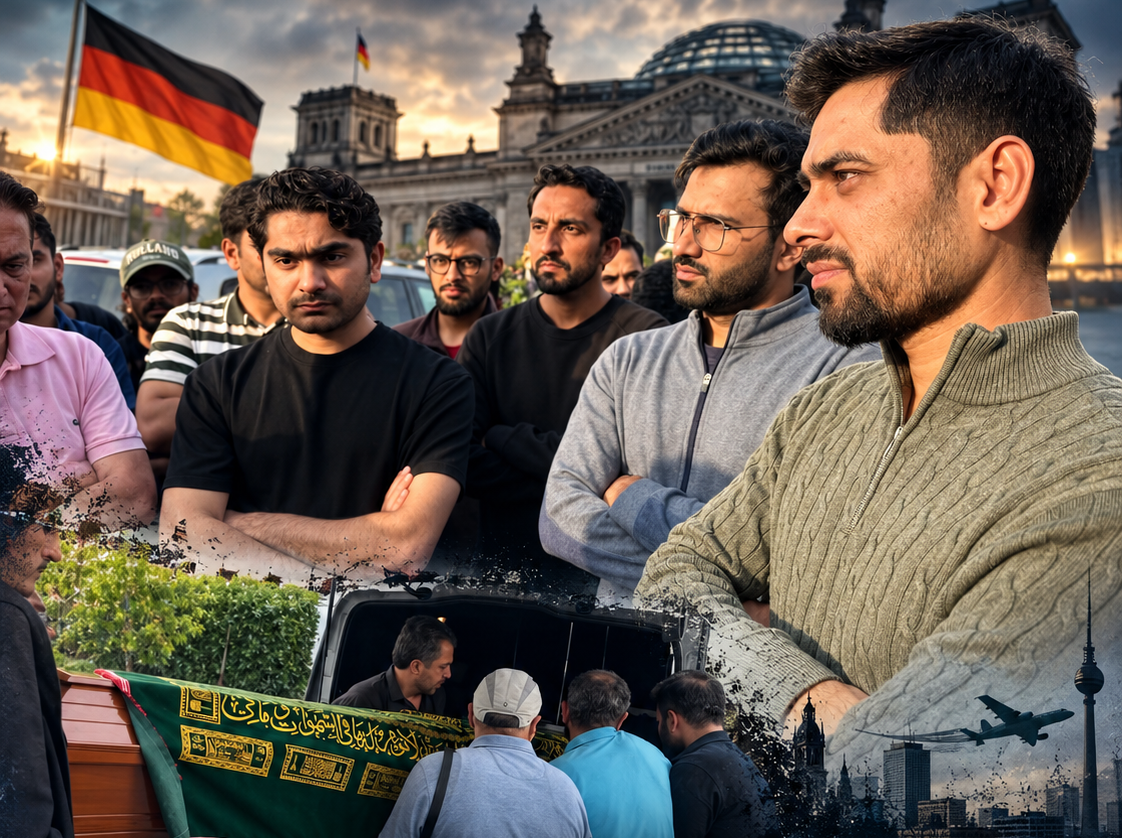
The family of Ahmed Qureshi, who died in Darmstadt, Germany, has blocked the repatriation of his body after rejecting the police’s suicide finding, pointing to frontal wounds on the body that they say tell a different story.
WEBDESK — MEDIABITES
A Pakistani family in Germany is refusing to accept the official cause of death of their loved one, demanding a second post-mortem after a police report attributed his death to suicide, a conclusion the family firmly rejects.
Ahmed Qureshi, a Pakistani national residing in Darmstadt, Germany, passed away under circumstances that have left his family deeply unsatisfied with the official account. His funeral prayers were held in Germany, and preparations to repatriate his body to Pakistan had been completed. However, the family stepped in at the last moment to halt the process.
“Ahmed was a conscious, aware, and responsible person. He could never have taken such a step,” family members said, challenging the police’s suicide ruling outright.
Their doubts deepened after reviewing the post-mortem report, which they say revealed wounds on the front of his body, a detail they argue is inconsistent with a self-inflicted death and raises the possibility of foul play.
The family has now formally requested German authorities to conduct a second post-mortem examination before the body is released for repatriation to Pakistan. The repatriation has been suspended pending that review.
No arrest has been made, and no suspect has been named. German authorities have not issued a public statement in response to the family’s request.
Who Is Looking Out for Pakistanis in Germany?
Ahmed’s case raises a question that the Pakistani community in Germany has long grappled with in silence: when something goes wrong, who steps in?
Germany is home to approximately 131,500 people of Pakistani origin or nationality, including around 76,000 Pakistani citizens and 30,000 naturalized German nationals. Nearly 10,000 Pakistani students are currently enrolled in German universities, one of the largest Pakistani student populations in Europe.
Yet there is no well-known, formally structured community welfare body specifically dedicated to the safety and legal protection of Pakistanis in Germany. The Pakistani Embassy in Berlin and the Consulate General in Frankfurt provide consular services, but diplomatic protocol and German legal jurisdiction limit their capacity to intervene in individual cases, particularly criminal or suspicious death investigations.
Informal community networks, WhatsApp groups and mosque-based organizations do exist across cities like Berlin, Frankfurt, Hamburg and Munich, but these lack the legal standing, funding or institutional weight to advocate effectively when a Pakistani national faces a crisis.
The question is now being asked openly in Pakistani circles in Germany: with nearly 10,000 students living far from home in a foreign legal system, is there a structured, accessible body they can turn to when they face danger, discrimination or, as in Ahmed’s case, a death that raises more questions than answers?
The Pakistani Embassy has not commented publicly on the Qureshi case.
The Family’s Resolve
The family is determined to pursue the truth before Ahmed is laid to rest. Until German authorities agree to a second post-mortem and provide answers that satisfy the family, his body will not be returning to Pakistan.
Courtesy/ Reporting: Mehwish Zafar, Berlin, Germany. This is a developing story.

