


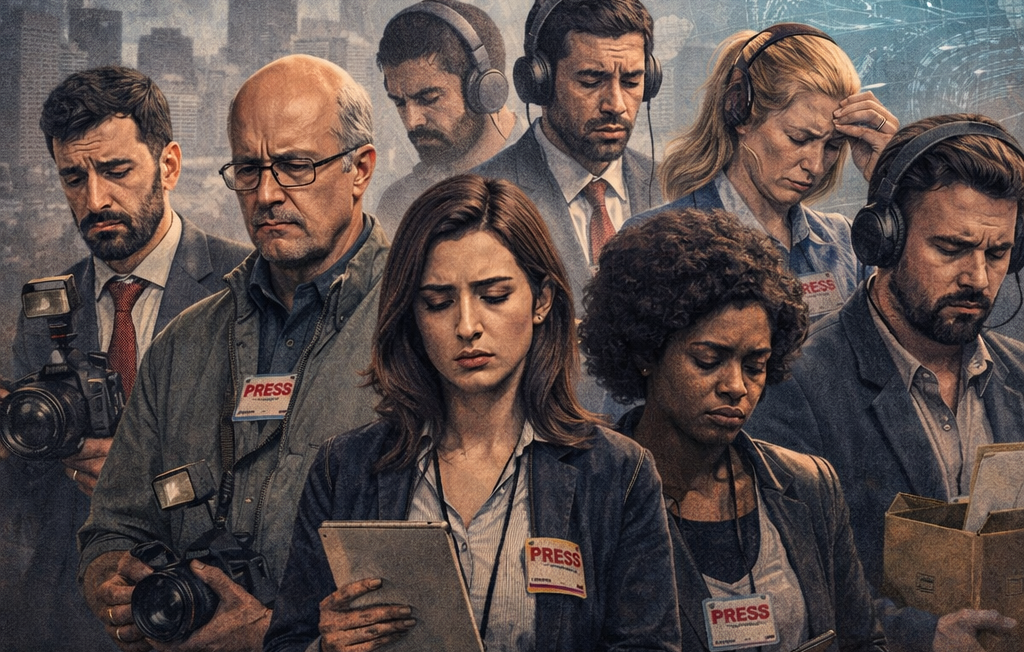
The news industry is not dying.
But the newsroom job is.
Global newsroom layoffs are accelerating — but can journalism bodies like ICFJ, WAN-IFRA and ONA actually help displaced reporters and editors find new roles? A closer look at the missing safety net in modern media.
Imran Malik – MediaBites
Across continents, from New York to London, Athens to Sofia, experienced editors, reporters, and curators are quietly disappearing from payrolls. Not because journalism is irrelevant. Not because audiences vanished. But because the business model changed faster than the profession could adapt.
And the question no one in conferences wants to ask loudly:
Do journalism’s top professional organisations — ONA and WAN-IFRA — have the capacity, or the responsibility, to help displaced journalists?
The digital revolution that first hit circulation, then hit journalists
Around the year 2000, media houses proudly launched websites.
It felt like expansion.
- Then came online subscriptions.
- Then programmatic ads.
- Then, social media distribution.
The first victims were predictable: Circulation departments. Print copies dropped, vendors disappeared, and logistics shrank.
But what many didn’t see coming was Phase Two.
- Reporters became replaceable.
- Editors became optional.
- Curators became invisible.
The newsroom didn’t collapse overnight; it evaporated role by role.
When reading habits changed, loyalty ended
I had one of the longest continuous subscriptions to TIME magazine.
The day print stopped arriving was more than nostalgia; it was behavioural disruption.
I tried the digital subscription for a year.
But here’s the uncomfortable truth about digital news:
We consume more news than ever — yet read less journalism than ever.
- Scrolling replaced reading.
- Headlines replaced reporting.
- Feeds replaced loyalty.
Eventually, even I cancelled.
Multiply that by millions — and you understand newsroom layoffs.
2026: The year layoffs became routine
This year alone:
- Washington Post — hundreds of cuts proposed, nearly one-third of the workforce
- Atlanta Journal-Constitution — 15% staff reduction
- Politico — 3% workforce cut
- Future plc — 45 editorial jobs removed across TechRadar & Tom’s Guide
- Wall Street Journal, Vox Media, Bustle Digital Group — layoffs across divisions
And this isn’t statistics for me.
I was laid off from a U.S. news website, along with six other editors.
Across my professional circle:
Editors in Greece, the UK, and Bulgaria — still jobless months later.
- Not juniors.
- Not trainees.
- Career journalists.
The silent gap in journalism organisations
Here is where the uncomfortable part begins.
Organisations like ICFJ, ONA and WAN-IFRA do exceptional work:
- conferences
- training
- innovation discussions
- newsroom transformation strategy
But when journalists actually lose jobs —
There is no structured support ecosystem.
- No placement exchange.
- No priority hiring pool.
- No emergency network for displaced professionals.
We celebrate innovation.
But we don’t protect innovators.
Journalism has unions, but no safety net
Ironically, journalism is one of the few global professions where:
- Doctors have medical boards
- Engineers have placement networks
- Tech workers have recruiter ecosystems
- But journalists have… panels.
A laid-off editor today relies on LinkedIn posts and personal messages, not institutional pathways.
A simple system could change lives
What if ONA & WAN-IFRA built a Global Newsroom Transition Network?
- Not charity. Not employment guarantees.
- Just structured opportunity circulation.
Possible model:
- A verified laid-off member database
- Publisher-side dashboard within member organisations
- Mandatory referral visibility for new openings
- Priority weightage for displaced professionals
- Monthly “available talent bulletin” across member publishers
- Even a single referral per publisher could save hundreds of careers annually.
Journalism protects democracy, but who protects journalists?
The industry constantly debates misinformation, AI, and trust.
Yet the biggest trust crisis is internal:
Talented journalists are leaving journalism.
Not because they want to.
Because the system has no landing ground.
Professional bodies can’t stop layoffs —
But they can stop isolation.
The real question
In a global profession built on solidarity, truth, and public service:
Should journalism organisations only train journalists,
Or also stand with them when the newsroom disappears?
The future of journalism won’t be decided only by technology.
It will be decided by whether the industry treats journalists as content creators…
or as a community.

