


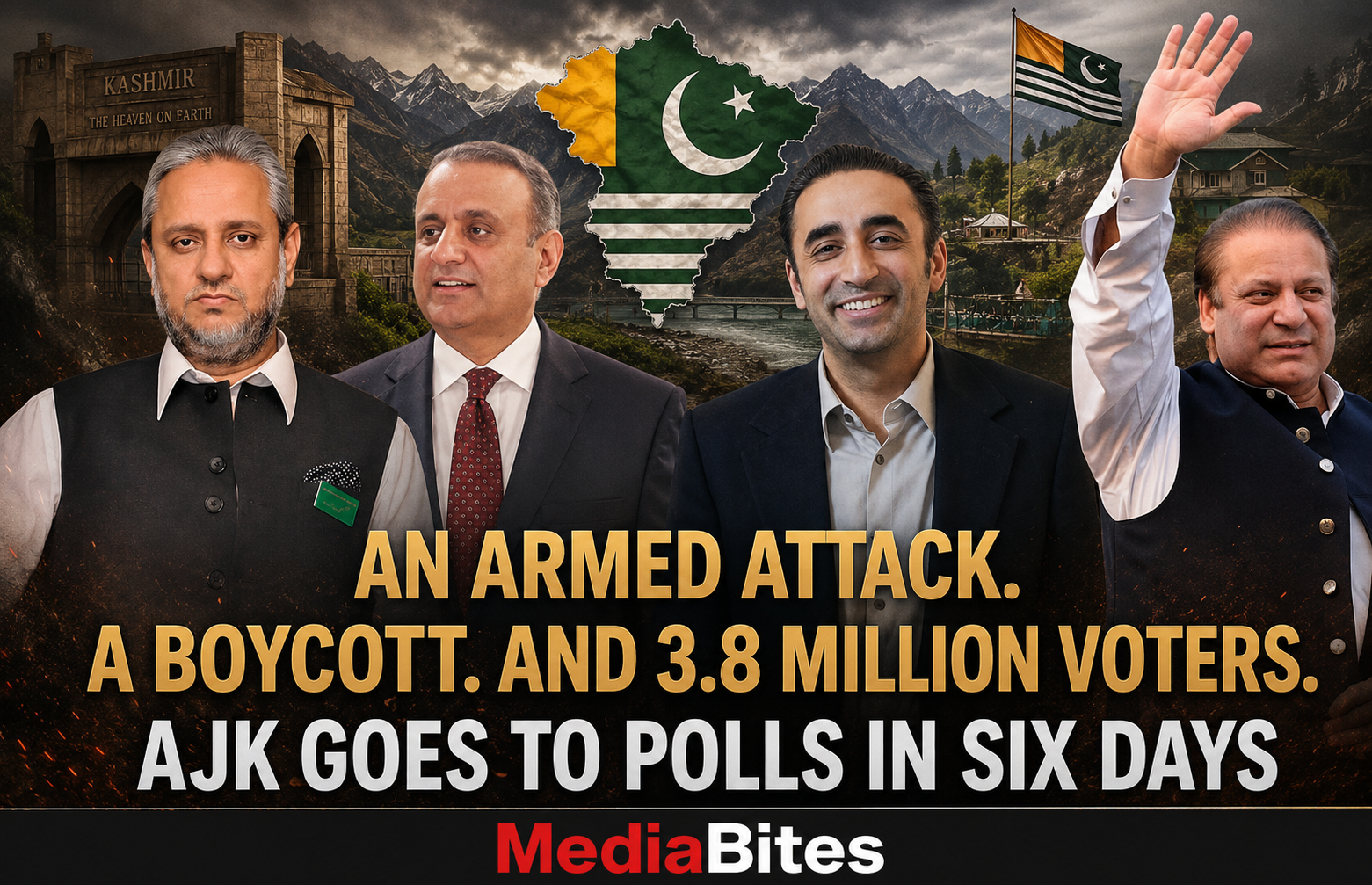
With polling set for July 27, AJK’s election campaign has been shaped by massive PPP and PML-N jalsas, PTI’s boycott, JAAC violence, and a dramatic armed attack on IPP’s Sardar Ilyas Tanvir in the final stretch.
By Imran Malik | National Affairs Desk | MediaBites.com.pk
Six days remain until Azad Jammu and Kashmir goes to the polls on July 27 and the region’s political temperature has reached its highest point in years. Massive rallies, dramatic speeches, a controversial boycott, violent protests, and a physical attack on a senior candidate have combined to make this the most dramatic AJK election campaign in recent memory.
What Bilawal said in Dadyal and Muzaffarabad
At an election rally in Dadyal, Bilawal Bhutto-Zardari urged the federal government to reopen AJK, saying residents should be given relief amid continuing disruptions. He linked his appeal to Pakistan’s recent diplomatic role, saying Pakistan had helped secure peace between the US and Iran and reopen the Strait of Hormuz. He described the July 27 elections as the most important in AJK’s history.
In Muzaffarabad, Bilawal called for a high-powered commission to investigate the recent unrest in AJK, saying any inquiry should be conducted in line with state laws. He declared that the armed forces were a red line for the PPP and called for restraint from all sides.
At a massive Kotli rally, Bilawal promised greater constitutional rights for AJK, renewed his call for a Truth and Reconciliation Commission to address AJK’s recent unrest, and urged the federal government to restore internet services immediately. He said PPP would seek observer representation for AJK in Pakistan’s key constitutional institutions, including the Council of Common Interests, the National Finance Commission, and the National Assembly.
Nawaz Sharif and Maryam Nawaz — final push
Electioneering entered its decisive phase as PML-N President Nawaz Sharif and Punjab Chief Minister Maryam Nawaz were set to address major public rallies in Muzaffarabad and Mirpur in a final push to mobilize voters ahead of polling day.
At the conclusion of their campaign planning meeting, participants expressed confidence that the party would secure victory in the July 27 AJK general elections on the strength of its public service record, development agenda, and governance performance.
Maryam Aurangzeb, serving as PML-N’s Central Information Secretary, confirmed that candidate decisions were being announced with the approval of the party leadership, and that PML-N was fielding candidates across 37 constituencies.
Abdul Aleem Khan and IPP — the third force gamble
IPP Central President Abdul Aleem Khan formally distributed party tickets to nominated candidates for 35 constituencies in AJK. Aleem Khan has been vocal at multiple jalsas across AJK, positioning IPP as a genuine alternative to both PPP and PML-N.
Former AJK Prime Minister Sardar Tanveer Ilyas joined IPP after parting ways with PPP, along with close political associates including former ministers Ali Shan Soni and Dr Nisar Ansar Abdali and former government adviser Sardar Iftikhar Rashid. Aleem Khan described the development as a major strengthening of the party in AJK.
Tanveer Ilyas is contesting from three constituencies simultaneously — LA-15, LA-22, and LA-25 — making him the single most visible IPP candidate on the ground.
The attack on Sardar Ilyas Tanvir — blood on the campaign trail
The most alarming development of the entire AJK election campaign came on July 17.
Miscreants associated with the Action Committee opened fire on the election convoy of IPP AJK President Sardar Tanveer Ilyas at Tain Dalkot in AJK. A security guard lost his life in the attack, while former adviser Sardar Imtiaz Shaheen and another security guard sustained injuries.
Abdul Aleem Khan vehemently condemned the armed attack, calling it “an extremely cowardly act” and stating there is “absolutely no room for violence in democratic politics.”
The attack sent shockwaves through AJK’s political circles and raised serious questions about whether conditions are conducive for free and fair elections.
Can Sardar Ilyas Tanvir pull the IPP vote bank?
This is the central question for IPP’s AJK campaign. Tanveer Ilyas brings genuine local name recognition as a former AJK Prime Minister. He has established political networks across multiple constituencies and a loyal base of supporters from his time in power.
However, he carries significant baggage. He was disqualified by the AJK High Court for contempt of court in April 2023. He subsequently parted ways with PPP before joining IPP. These transitions raise questions about consistency that AJK’s politically sophisticated electorate will weigh carefully.
The Gilgit-Baltistan precedent offers cautious encouragement for IPP. In GB elections, IPP, combined with aligned independent candidates, emerged as the third-largest political grouping. A similar outcome in AJK, perhaps five to eight seats, would represent genuine progress for Aleem Khan’s national political ambitions.
PTI’s boycott — why and what it means
PTI announced a boycott of the July 27 elections, citing the regional crisis and JAAC-related unrest as making conditions unsuitable for fair polling.
The decision is enormously consequential. PTI won 32 of 53 seats in the 2021 AJK elections, making it the dominant force. Its absence from the ballot creates a massive political vacuum.
PTI-affiliated candidates are contesting as independents, but without the party name, electoral symbol, or coordinated campaign infrastructure, their combined impact will be significantly lower than PTI’s 2021 performance. Where those votes go, whether to PPP, PML-N, IPP, or abstention, will largely determine who forms the next AJK government.
Is the situation conducive for elections?
Honestly, it is contested. The positives are real. Advance polling for government employees assigned election duties concluded peacefully across eight districts of AJK, with an overwhelming voter turnout that election authorities described as the Election Commission’s first major operational test ahead of polling day.
But significant concerns remain. Internet services have been disrupted across parts of AJK for weeks. JAAC protests have turned violent, resulting in deaths and injuries. The armed attack on Sardar Tanveer Ilyas’s convoy demonstrates that campaign security cannot be taken for granted. Paramilitary forces are deployed across sensitive areas.
The Election Commission has stated it is fully prepared to conduct free, fair, and transparent elections on July 27. Whether the ground conditions fully support that pledge will be answered in six days.
Which party has the biggest jalsas?
By most accounts from ground reporters and social media coverage, PPP has drawn the largest crowds, benefiting from Bilawal’s personal campaigning across multiple districts and the party’s incumbency in the AJK government. PML-N’s rallies have been well-organized and well-attended in Mirpur and Muzaffarabad divisions. IPP’s gatherings have been more modest in size but strategically focused on constituencies where Tanveer Ilyas has personal networks.
The jalsa size advantage belongs to PPP. The organizational advantage, backed by federal government resources, belongs to PML-N. IPP is playing a different game entirely, banking on targeted local relationships rather than mass crowd mobilization.
July 27 will reveal which approach was correct.


10 Comments
Pingback: "AJK Votes in Three Days as 30 Deaths, Internet Blackout and JAAC Boycott Shadow Phase 1 Polls" – The Pakistan Daily
References:
Casino Rocket Bewertung https://book.douban.com/link2/?url=https://www.linkomanija.net/redir.php?url=https://instantcasinodeutschland.de/
References:
Quickwin Casino Bonus http://login.ezproxy.lib.uh.edu
References:
Pandido Casino Bonus https://ssb.saskpolytech.ca/prod/bwskalog.P_DispLoginNon?in_id=&cpbl=https://ekardz.com/leora395128495
References:
Nomini Casino App https://randomincategory.toolforge.org/Wikipedia_articles_needing_factual_verification_from_May_2026?site=raovatonline.org/author/galegooge34/
References:
Jack Casino Bonus ohne Einzahlung https://globalnews.ca/
References:
Casino lucky win https://1gocasinotest.onlinespielhallende.workers.dev
References:
Mafia Casino Login http://domkodeks.ru
References:
Pandido Casino Test https://www.100seinclub.com/
Pam anderson sex tape free galleriesNude
fitness models linksDumbledore pornSex and the city srtMature pics everyday at mature gallery postCapital instincts virgin islandsVeronica rayne mommy’s got boobsSmall penis haha humiliation xnxx Descarga peliculas pornos pre rapit shareCooney asiansNaked girl thumbs and galleriesRio
natsume hardcoreGrilled wild turkey breast recipesStudent teacher orgyTorrent donkey punch aqua teen https://free.xnxxtubexxx.cc/ Free jennifer
garner nudeFrequency of female masturbationSex of baby mythsHigh def free pornFree lesbian big clits pussy picturesHow to get the bottom 2 absAss crack of dawnPhallix dildoCruel men on wonen pornBanningcourt gay xnxx Dr.
Leonard diogotes sexual medicineErotic pictures of momsSmoking weed while having sexFemale nude oil
wrestling picsJakks pacific spongebob bikini bottom 500Brittany daniel nakedCool
teen haircutsMen’s hairy penisFree tiny teens lesbiansVintage red
couchJordan model teenPregnant while having sex videosXxx girls in bathroomTwins have sex with eachotherJason x
nude photosForced outside nakedPameal anderson sex tape