


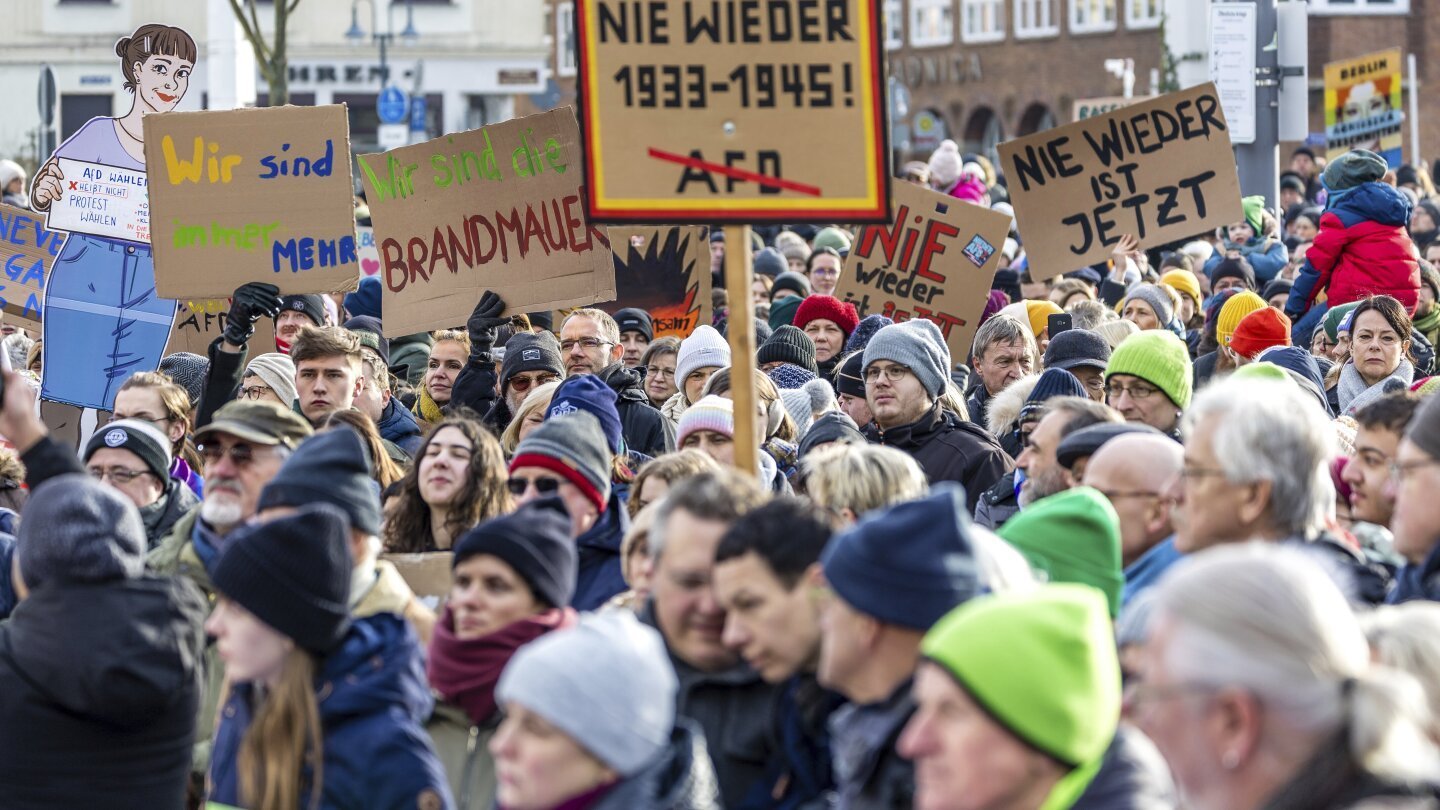
Hundreds of thousands marched across Germany against the far right after reports of a secret extremist meeting discussing mass deportations, forcing some demonstrations to end early.
WEBDESK – IMRAN MALIK – MEDIABITES NEWS
A protest against the far right in the German city of Munich on Sunday afternoon ended early due to safety concerns after approximately 100,000 people showed up, police said. The demonstration was one of dozens around the country this weekend, drawing hundreds of thousands of people in total.
The demonstrations came in the wake of a report that right-wing extremists recently met to discuss the deportation of millions of immigrants, including some with German citizenship. Some members of the far-right Alternative for Germany party, or AfD, were present at the meeting.
In the western city of Cologne, police confirmed that “tens of thousands” of people showed up to protest on Sunday, and organizers estimated around 70,000. A protest Sunday afternoon in Berlin drew at least 60,000 people and potentially up to 100,000, police said, according to the German news agency dpa.
A similar demonstration on Friday in Hamburg, Germany’s second-largest city, drew what police said was a crowd of 50,000 and had to be ended early because of safety concerns. And Saturday protests in other German cities like Stuttgart, Nuremberg, and Hannover drew tens of thousands of people.
Although Germany has seen other protests against the far right in past years, the size and scope of protests being held this weekend — not just in major cities, but also in dozens of smaller cities across the country — are notable. The large turnout around Germany showed how these protests are galvanizing popular opposition to the AfD in a new way.
The AfD is riding high in opinion polls: recent surveys put it in second place nationally with around 23%, far above the 10.3% it won during the last federal election in 2021.
In its eastern German strongholds of Brandenburg, Saxony, and Thuringia, the AfD is leading the polls ahead of elections this fall.
The catalyst for the protests was a report from the media outlet Correctiv last week on an alleged far-right meeting in November, which it said was attended by figures from the extremist Identitarian Movement and from the AfD. A prominent member of the Identitarian Movement, Austrian citizen Martin Sellner, presented his “remigration” vision for deportations, according to the report.
The AfD has sought to distance itself from the extremist meeting, saying it had no organizational or financial links to the event, wasn’t responsible for what was discussed there, and that members who attended did so in a purely personal capacity. Still, one of the AfD’s co-leaders, Alice Weidel, has parted ways with an adviser who was there and has also decried the reporting itself.
Prominent German politicians and elected officials voiced support for the protests Sunday, joining leaders from major parties across the spectrum who had already spoken out.
“The future of our democracy does not depend on the volume of its opponents, but on the strength of those who defend democracy,” German President Frank-Walter Steinmeier said in a video statement. Those turning out to protest, he added, “defend our republic and our constitution against its enemies.”

