


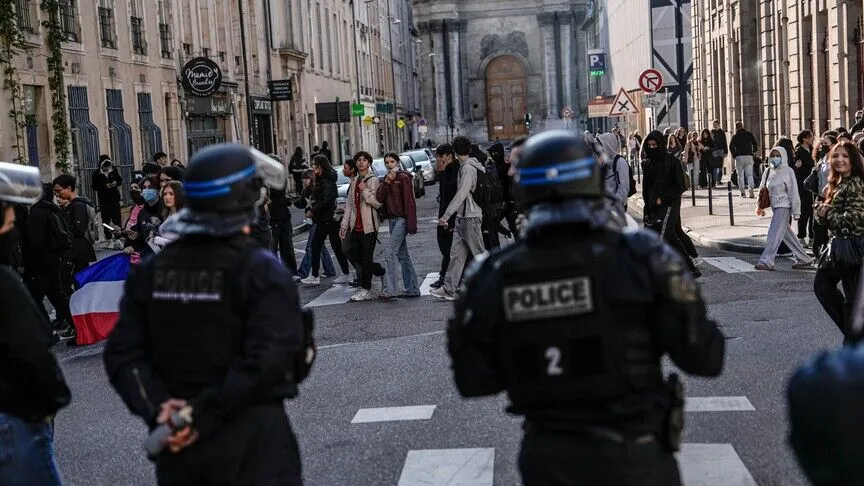
France’s student protests have spread nationwide, disrupting 1,800 high schools as students demand more teachers and resources, while scrutiny of police actions intensifies.
WEBDESK – MEDIABITES – AA
Protests spread nationwide
Around 1,800 high schools across France were blockaded, affected by demonstrations or closed by education authorities on Tuesday, according to the Union Syndicale Lycéenne (USL), as a growing student movement entered another nationwide day of mobilization.
The student union said participation reached a record level, with young people demanding increased funding, more teachers and staff, and repairs to deteriorating school buildings. Students have also raised concerns about overcrowded classrooms and a shortage of replacement teachers.
The demonstrations, which began in the Paris region in September, have expanded to cities including Nantes, Marseille and Lyon, with student organizations planning a major rally at Paris’ Place de la République.
Education unions have backed the mobilization and called on their members to join demonstrations in Paris and around 30 other cities.
The movement has also spread into higher education. Union Etudiante said more than 57 university sites were blockaded and reported that about 90% of universities in mainland France were affected by the broader movement.
The scale of disruption reported by student groups is larger than government figures. France’s Education Ministry reported nearly 900 schools closed or partially closed, according to AP, highlighting the gap between official figures and union assessments of how many schools were affected by the protests.
Police response under scrutiny
The protests have become increasingly tense following an incident in Lens on Monday, where a 15-year-old student suffered the loss of a hand after a police dispersal grenade exploded during clashes near a high school.
Authorities have launched an investigation into the circumstances. Reuters reported that the teenager apparently picked up the grenade before it exploded, while prosecutors have said the precise circumstances were still being established.
The incident has intensified criticism of police tactics, with students, teachers and rights groups questioning the use of crowd-control weapons against young demonstrators.
Teachers at Geoffroy-Saint-Hilaire High School in Étampes have also accused police of using excessive force during unrest last week, alleging that students and staff were tear-gassed, pushed and beaten.
Interior Minister Laurent Nunez defended police intervention when violence occurs, arguing that any response must remain proportionate. The government has also pointed to injuries suffered by police and school staff during the protests.
Government promises response
Education Minister Edouard Geffray has said authorities want affected schools to begin reopening gradually from Wednesday. He also promised an eight-day response to identified difficulties involving the replacement of absent teachers.
The Education Ministry has opened an anonymous online consultation allowing high school students to submit concerns and proposals until Oct. 23. Contributions will be compiled nationally later this month and used to inform discussions with students.
The government is now under pressure to address the protesters’ demands, contain violence, and restore normal school operations.
Why it matters
The protests have evolved from localized school blockades into a nationwide movement involving students, teachers, parents and university groups. Their demands highlight broader concerns about the state of France’s public education system, including staffing shortages, aging infrastructure and unequal access to resources.
The Lens incident has added another layer to the crisis, making the government’s handling of the demonstrations and police conduct central to the debate.
With thousands of young people continuing to mobilize, the coming days will test whether the government’s promises on staffing and school conditions can calm the movement — or whether further protests will follow.

