


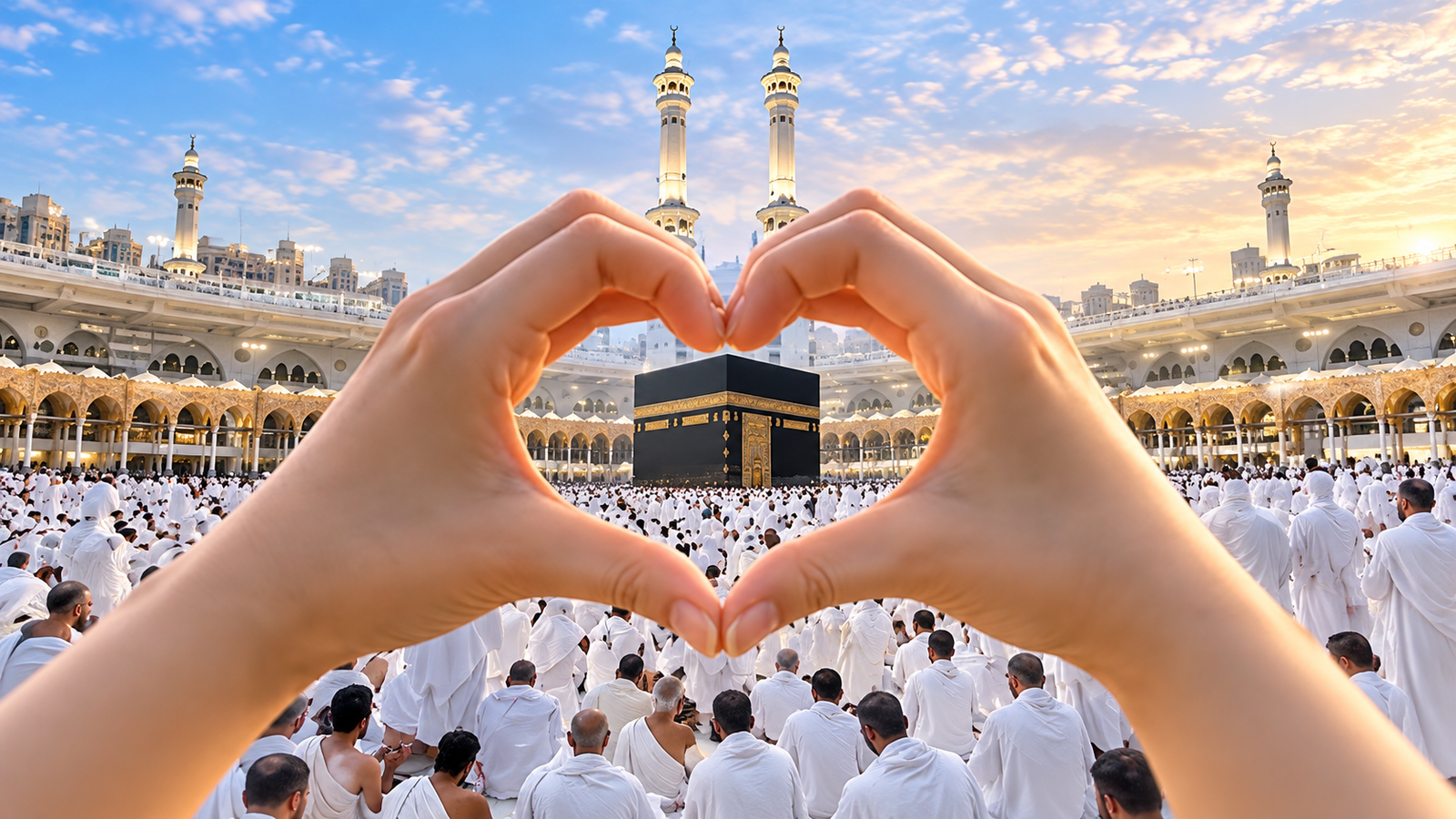
Saudi air defenses destroyed a Houthi drone attempting to enter Makkah’s airspace in a major escalation that Saudi coalition spokesman called a red line demanding immediate deterrent measures.
By Imran Malik | World Affairs & Gulf Desk | SharjahNews.ae | MediaBites.com.pk
There are provocations. There are escalations. And then there are acts that cross a line so fundamental that the entire Muslim world must stop and respond.
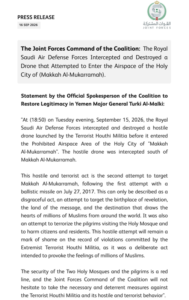
On Tuesday evening at 6:50 PM Saudi time, a Houthi drone was destroyed south of Makkah before it could enter the airspace of Islam’s holiest city.
Major General Turki Al-Malki, spokesperson for the Coalition to Restore Legitimacy in Yemen, did not mince words.
“This can only be described as a disgraceful act — an attempt to target the birthplace of revelation, the first of the message, and the destination that draws the hearts of millions of Muslims from around the world.”
He called it a red line. He said the coalition “will not hesitate to take the necessary and deterrent measures.”
The question the Muslim world must now ask is whether that red line means anything at all.
This Is Not the First Time
This is not the first Houthi attack near Makkah. In 2017, Saudi air defenses intercepted a ballistic missile launched toward Makkah, shot down over Al-Wasliya area in Taif province.
The pattern since then has been consistent and escalating. Last week Houthi attacks injured more than 70 people including women and children across Saudi cities. On Monday alone 13 civilians were injured in attacks on Khamis Mushait, Abha, and Taif. Saudi Arabia temporarily shut down its East-West Pipeline after drone attacks targeted facilities in the Riyadh and Madinah regions.
Each attack has been met with condemnation. Each condemnation has been followed by another attack.
Are Houthis Crossing the Final Red Line?
Targeting Makkah is not a military calculation. It is a theological provocation designed to inflame 1.8 billion Muslims worldwide and expose Saudi Arabia’s inability to protect the holiest site in Islam.
The Kaaba. The Grand Mosque. The destination of Hajj, one of Islam’s five pillars. The birthplace of the Prophet Muhammad. These are not military targets. They are the spiritual center of an entire civilisation.
If Iran-backed Houthi forces believe they can target Makkah’s airspace without triggering a response that fundamentally changes the strategic calculus of this conflict, they are testing a hypothesis that Saudi Arabia, Turkey, and Pakistan cannot allow to be validated.
The Saudi-Turkey-Pakistan Defence Dimension
The attempted drone attack on Makkah lands in a specific and significant strategic context. Saudi Arabia has defence cooperation arrangements with both Turkey and Pakistan that take on new urgency when the holiest site in Islam is directly threatened.
Pakistan has one of the most capable military establishments in the Muslim world and has historically maintained a deep and special relationship with Saudi Arabia’s security. Pakistani military personnel have served in Saudi Arabia, and the relationship between Islamabad and Riyadh on defence matters is long-standing and institutionalised.
Turkey under President Erdogan has positioned itself as a defender of Muslim interests globally and has military cooperation with Saudi Arabia that has evolved significantly in recent years.
A Houthi drone targeting Makkah is not simply a Saudi problem. It is a problem for every Muslim-majority nation that has a defence relationship with Saudi Arabia and a moral obligation to the protection of Islam’s holy sites.
The question that Islamabad, Ankara and Riyadh must now answer together is this. What does the defence pact actually mean when a drone crosses toward Makkah? Is condemnation sufficient? Or does the red line demand a response that matches the gravity of what the Houthis have attempted?
The Iran Connection
The Houthis do not manufacture long-range drones capable of targeting Makkah from Yemen without Iranian technology, Iranian logistics, and Iranian strategic guidance. Every Houthi attack on Saudi Arabia is an Iranian attack conducted through a proxy with sufficient distance to maintain deniability.
Iran is currently engaged in a direct military confrontation with the United States. It is under unprecedented international pressure. And its Houthi proxies chose this moment to send a drone toward Makkah.
That is not coincidence. That is a deliberate strategic signal from Tehran about the limits of what it will accept and the tools it is willing to deploy.
What Happens Next
Saudi Arabia has promised deterrent measures. The coalition has called it a red line. The Muslim world has expressed outrage.
But outrage without consequence is what has produced today’s situation. The Houthis have been outrage-tested for years and have consistently concluded that the cost of escalation is lower than the benefit of provocation.
A drone targeting Makkah’s airspace changes that calculation — or it should.
The holiest city in Islam was targeted on a Tuesday evening. The Muslim world is watching what happens on Wednesday morning.
— Imran Malik | World Affairs and Gulf Desk | SharjahNews.ae | MediaBites.com.pk | Southera.com
Source: Arab News, Saudi Coalition Statement


1 Comment
Gần đây mình hay đọc nội dung tại fly888, thấy cập nhật khá nhanh.