


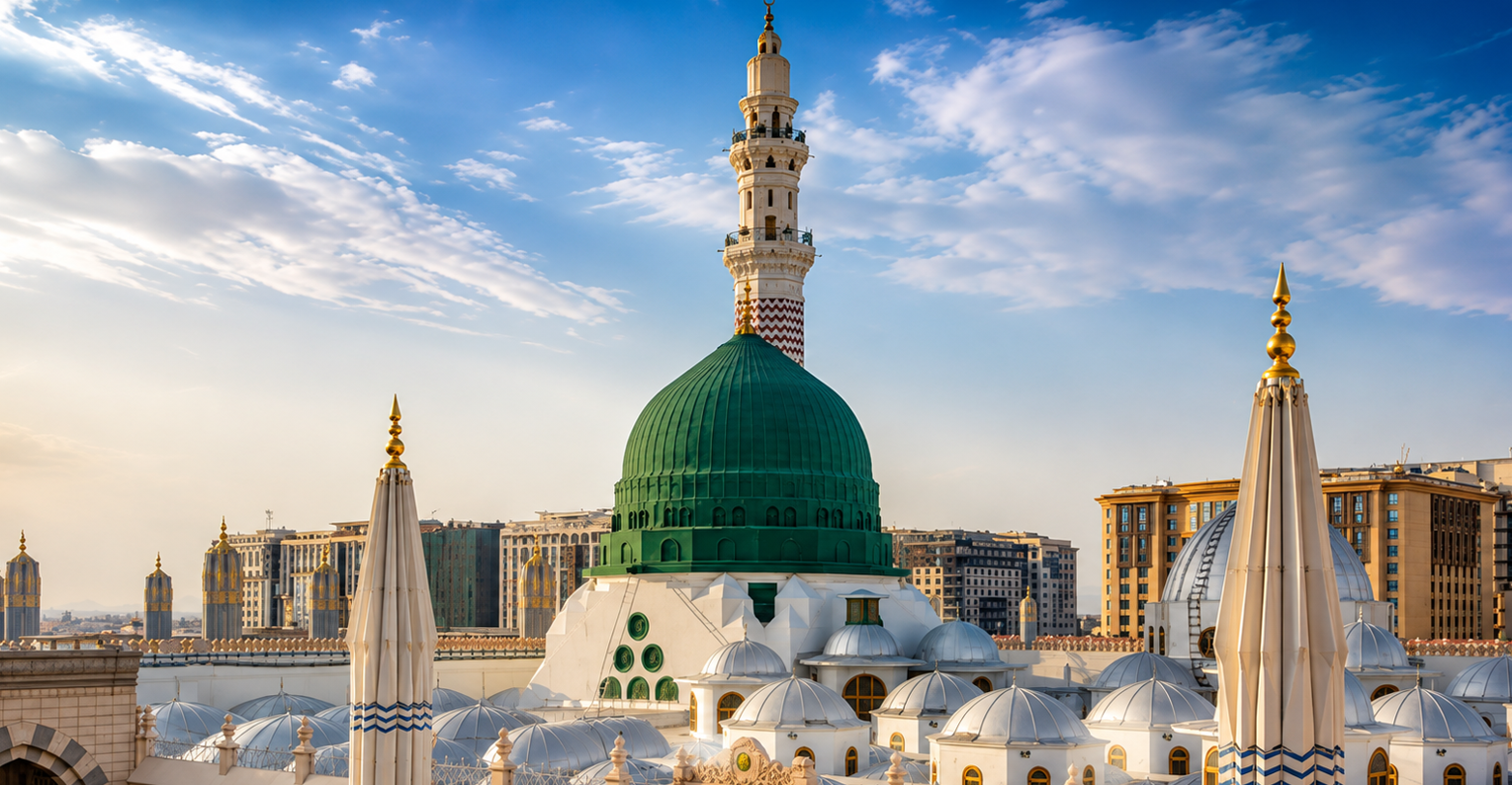
Muslims across the world celebrate 12 Rabi ul Awwal, the birth anniversary of Prophet Muhammad PBUH, whose teachings of mercy, compassion, justice and human dignity continue to guide 1.9 billion believers globally.
By Imran Malik | Faith & Community Desk | MediaBites.com.pk | SharjahNews.ae
Today, across every continent, in every time zone, in mosques and homes and streets from Karachi to Cairo, from Istanbul to Jakarta, from London to Lagos, more than 1.9 billion Muslims pause to remember the man who changed the course of human history.
12 Rabi ul Awwal. The birth anniversary of Hazrat Muhammad, Peace Be Upon Him, the final Prophet of Islam, the Messenger of God, and by any measure of historical impact, one of the most consequential human beings who ever lived.
This is not merely a religious occasion. It is a moment for all of humanity to reflect on a life that embodied the highest values any civilisation has ever articulated. Mercy. Compassion. Justice. Dignity. Equality. And a love for humanity so complete that it extended to enemies, to strangers, and to every living creature.
Born Into the World to Change It
The Prophet Muhammad PBUH was born in Mecca in 570 CE into the Banu Hashim clan of the Quraysh tribe, in a society defined by tribal warfare, the oppression of the weak, the burial of daughters alive, the enslavement of the vulnerable, and the worship of idols carved from stone.
He grew up as an orphan. His father Abdullah died before his birth. His mother Aminah died when he was six years old. He was raised by his grandfather Abdul Muttalib and later by his uncle Abu Talib, learning from his earliest years what it meant to navigate the world without the protection that wealth and powerful parenthood provided.
He grew into a young man so universally trusted for his honesty and integrity that the people of Mecca called him Al-Amin — the Trustworthy — before a single verse of revelation had descended upon him. His character was recognised and celebrated before his prophethood.
At the age of 40, in the Cave of Hira in the mountains above Mecca, the first revelation came. And the world was never the same.
His Teachings — A Blueprint for Humanity
The Prophet PBUH did not simply deliver a religious text. He lived a complete human life as a practical demonstration of the values he taught, as a husband, a father, a leader, a neighbour, a friend, and a citizen of the world.
On Mercy and Compassion
The Prophet PBUH described God as Al-Rahman, Al-Raheem, the Most Merciful, the Most Compassionate, before any other divine attribute. His own life was a reflection of those attributes. He showed mercy to those who wronged him, forgave those who persecuted him, and consistently chose compassion over retribution when the choice was his to make.
When he returned to Mecca after years of persecution and exile, the people who had tortured his companions, killed his loved ones, and driven him from his home stood before him expecting punishment. He asked: “What do you think I will do with you?” They said: “You are a noble brother and the son of a noble brother.” He replied: “Go, for you are free.”
On Justice and Equality
The Prophet PBUH declared in his Final Sermon, delivered before 124,000 people on the plain of Arafat, words that remain among the most radical statements of human equality in recorded history.
“O people, your Lord is one and your father Adam is one. There is no virtue of an Arab over a non-Arab, nor of a non-Arab over an Arab, nor of a white person over a black person, nor of a black person over a white person, except through piety.”
These words, spoken in the 7th century, articulated a principle of human equality that the Western world would not formally inscribe in law for more than a thousand years.
On Kindness to Women
In a society that buried daughters alive and treated women as property, the Prophet PBUH declared: “The best of you are those who are best to their wives.” He consulted his wife Khadijah RA in matters of profound importance. He helped with household work. He said that paradise lies at the feet of mothers. He transformed the status of women in a society that had treated them as less than human in the span of a single generation.
On the Environment and Animals
The Prophet PBUH taught that the earth is a trust, not a possession. He prohibited the wasting of water even in ablution beside a flowing river. He forbade the cutting of trees unnecessarily. He stopped to move a sleeping cat rather than disturb it. He said that a woman was punished for imprisoning a cat and a man was rewarded with paradise for giving water to a thirsty dog.
These are not metaphors. They are a complete ethical framework for humanity’s relationship with the natural world that environmental philosophy is only now beginning to articulate in secular language.
On Knowledge and Education
The very first word revealed to the Prophet PBUH was Iqra — Read. In a society with overwhelming illiteracy, the first divine instruction was to seek knowledge. He declared that seeking knowledge is an obligation upon every Muslim, male and female. He said: “Go even unto China to seek knowledge.” He established that scholars are the inheritors of the prophets.
How the World Celebrates Today
In Pakistan, Eid Milad un Nabi is a public holiday observed with processions, religious gatherings, naat recitations, illumination of mosques and public buildings, and communal acts of charity and service. Homes and streets are decorated with green lights. Mosques overflow with worshippers reciting blessings upon the Prophet PBUH.
In Saudi Arabia, the birthplace of the Prophet PBUH, Mecca and Medina receive millions of pilgrims and visitors who come to stand in the places where he walked, prayed, and lived.
In Turkey, the occasion is observed as Mevlid Kandili, one of the most spiritually significant nights of the Islamic calendar, marked by special prayers and the recitation of the Mevlid, a classical poem in honour of the Prophet PBUH.
In the UAE, Bahrain, Qatar, Kuwait, and across the Gulf, the day is a public holiday marked by religious programmes, charitable distributions, and community gatherings that bring Muslim and non-Muslim communities together in the spirit the Prophet PBUH embodied.
In Indonesia, the world’s largest Muslim-majority country, the occasion is observed with elaborate processions, communal prayers, and cultural programmes that reflect the diversity of Islamic practice across the archipelago.
In the United Kingdom, United States, Canada, and across the Muslim diaspora in the West, Islamic centres and mosques hold special programmes, open houses, and community events that use the occasion to share the Prophet’s message with non-Muslim neighbours and friends.
The Man Non-Muslim Historians Recognised
The Prophet Muhammad PBUH is not only revered by Muslims. His historical significance has been acknowledged by scholars, historians, and thinkers across religious traditions throughout history.
Mahatma Gandhi wrote: “I wanted to know the best of the life of one who holds today an undisputed sway over the hearts of millions of mankind. I became more than ever convinced that it was not the sword that won a place for Islam in those days in the scheme of life. It was the rigid simplicity, the utter self-effacement of the Prophet, the scrupulous regard for pledges, his intense devotion to his friends and followers, his intrepidity, his fearlessness, his absolute trust in God and his own mission. These and not the sword carried everything before them.”
Michael Hart, in his book The 100: A Ranking of the Most Influential Persons in History, ranked the Prophet Muhammad PBUH as the single most influential person in human history. His reasoning: no other figure in history has been as singularly responsible for both a religious and a political revolution that continues to shape the lives of more than a billion people fourteen centuries after his death.
A Message for Today
On 12 Rabi ul Awwal 2026, as the world celebrates the birth of the Prophet Muhammad PBUH, the most honest gift any Muslim can offer to his memory is not a procession or an illumination. It is the sincere attempt to embody what he taught.
To be honest in dealings. To be kind to family. To protect the vulnerable. To seek knowledge without end. To treat every human being, regardless of race, religion, or background, with the dignity that he taught was their birthright.
He said: “I was sent only to perfect good character.”
In a world fractured by division, hatred, and injustice, that mission has never been more urgently needed.
Eid Milad un Nabi Mubarak. Peace and blessings be upon the final Messenger of God.
— Imran Malik | Faith and Community Desk | MediaBites.com.pk | SharjahNews.ae | Southera.com

