


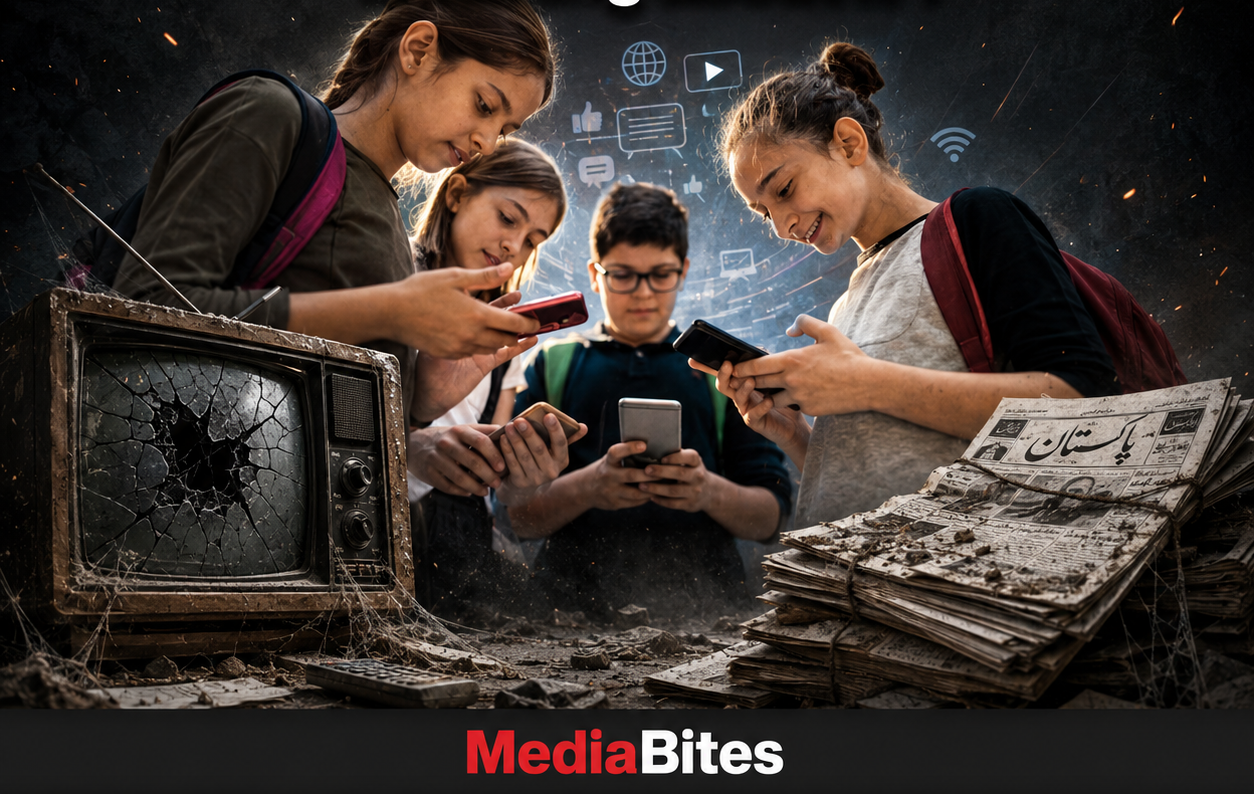
A major Australian survey reveals most under-25s have abandoned newspapers, radio, and traditional TV entirely. Pakistani youth data shows an alarmingly similar pattern, and Pakistan’s media industry is not responding fast enough.
By Imran Malik | Media Industry Desk | MediaBites.com.pk
A landmark Australian media survey should be sounding alarm bells in every newsroom and television studio across Pakistan. The findings are not just an Australian story. They are a preview of what is already happening, largely undocumented, in Pakistani households.
What Australia’s Survey Revealed
Most Australians under the age of 25 have never used newspapers or radio as a source of news, according to the 2026 Digital News Report. The report found that 60% of Australians aged between 18 and 24 have never relied on newspapers for news, while 53% said radio had never been part of their news habits.
Television is also losing relevance among younger demographics, with 25% of under-25 respondents saying they have never used TV as a source of news. Meanwhile, social media has surged to near parity with television, sitting at 56% compared to television’s 57%.
Nearly half of Australians aged 18 to 24, about 48%, now use TikTok for news consumption, reflecting the growing role of influencers and content creators in shaping public understanding of current affairs. Generative AI tools such as ChatGPT and Gemini are now being used by almost 10% of Australians to access or better understand news stories.
This is not a fringe trend. This is a generational rupture in how an entire society consumes information.
What Does Pakistan’s Data Show? The Pattern Is Strikingly Similar
Pakistan does not yet have a comprehensive, government-backed Digital News Report equivalent to Australia’s. But the academic and industry research that does exist paints an unmistakably similar picture, one Pakistani television executives and newspaper editors can no longer afford to ignore.
A study of Pakistani youth in Lahore found a significant shift towards social media, with 78% of youth using it for social interaction, news, and entertainment. Traditional media, including newspapers and radio, has declined sharply, with only 20% of youth still relying on them.
A broader demographic study of Pakistani university students found that 67.1% of students spend more than four hours daily on social media, compared to just 25.2% using traditional media. The study concluded that social media remains active in satisfying informational needs, while traditional media’s growing dependency on social media for distribution suggests it will soon be displaced entirely.
This is the Pakistani version of Australia’s finding. Different country, different culture, same trajectory.
Pakistan’s Digital Numbers Tell the Same Story
Pakistan had 117 million internet users by late 2025, representing 45.6% online penetration, and 79.9 million social media user identities, equating to 31.2% of the total population. Pakistan’s median age stood at just 20.6 years, meaning half the entire population is younger than 21.
This is critical context. Pakistan is one of the youngest nations on earth, and that young population is overwhelmingly digital-first in how it consumes information.
Among Pakistan’s Instagram users, those aged 18 to 24 form the single largest user group, with 10.2 million users in that age bracket alone as of March 2026.
The Pattern Australia and Pakistan Share
| Indicator | Australia (Under 25) | Pakistan (Youth/University Students) |
|---|---|---|
| Newspaper usage | 60% never use | Only 20% rely on traditional media |
| Radio usage | 53% never use | Minimal, folded into traditional media decline |
| Primary news source | Social media (56%), nearly equal to TV | Social media (78% usage) |
| Daily social media time | Not specified | 67.1% spend 4+ hours daily |
| TikTok for news | 48% of 18-24 year olds | Rapidly growing, untracked formally |
The numbers are not identical, methodologies differ, and Pakistan lacks the rigorous national survey infrastructure Australia has. But the direction of travel is unmistakably the same.
READ MORE: Most young Australians no longer use traditional TV, newspapers or radio for news, report finds
Why This Should Alarm Pakistani TV Channels and Newspapers
Here is the uncomfortable truth Pakistan’s media industry has been slow to confront. The Pakistani television landscape remains dominated by an editorial format that has barely evolved in fifteen years: the 8 PM to 11 PM talk show triangle, three rotating anchors, the same political guests, the same shouting matches, repeated across half a dozen channels simultaneously every single night.
That format was built for an audience that no longer exists in the numbers it once did. The data is now screaming what industry insiders have whispered privately for years: Pakistani youth are not watching these shows. They are on TikTok, Instagram, YouTube, and increasingly, asking ChatGPT to explain the news to them directly.
Pakistani academic research confirms that social media platforms are perceived as more accessible, interactive, and current, although concerns regarding credibility persisted. Television maintained cultural relevance but was increasingly secondary for informational purposes, with demographic characteristics, particularly age and education, underscoring the growing dominance of digitally mediated news environments among Pakistani youth.
The Trust Crisis Makes It Worse
Globally, the picture is even more troubling for traditional broadcasters. Trust in news has fallen to its lowest recorded level internationally, and several major news organisations globally have experienced significant drops in public trust.
Pakistani television channels face this same trust erosion, compounded locally by perceptions of political bias, sensationalism, and editorial capture by ownership interests, none of which encourage a young, sceptical, digitally fluent audience to return to traditional formats.
What Pakistani Media Must Do Now
The 1 to 3 talk show era, where every channel runs near-identical political shouting matches at the same hour every evening, has run its course with younger viewers. Survival requires fundamental reinvention, not incremental adjustment.
Pakistani channels need genuine short-form video strategies built specifically for TikTok, Instagram Reels, and YouTube Shorts, not simply clipped excerpts from existing talk shows. They need young, credible digital-native voices and creators integrated into newsroom operations, not as social media afterthoughts but as core editorial talent. They need formats designed for attention spans and consumption habits that exist in 2026, not formats inherited from 2010. And they need to seriously engage with how AI tools are increasingly mediating how young Pakistanis access and understand news, rather than treating AI purely as a threat to be resisted.
The Window Is Closing
Australia’s youth have already largely left traditional news platforms behind. Pakistan’s youth, vastly larger in absolute numbers given the country’s young demographic profile, are moving in precisely the same direction, just without the comprehensive national data to fully quantify it yet.
Pakistani television channels and newspapers that wait for definitive local survey data before acting will simply be confirming a decline they could have addressed years earlier. The international evidence is now overwhelming. The Pakistani academic evidence, while less comprehensive, points in exactly the same direction.
The audience has already started leaving. The only open question is whether Pakistan’s media industry notices in time to build something that brings them back.


1 Comment
How has the rise of digital platforms and social media changed the way younger viewers consume political news and current affairs compared to traditional television?